
Table of Contents
Introduction
Ecommerce Digital Marketing has become one of the most important growth drivers for modern online businesses. With millions of online stores competing for customer attention, simply launching an ecommerce website is no longer enough. Businesses now require advanced marketing strategies to attract visitors, convert leads, improve customer retention, and increase long-term revenue.
From SEO and social media campaigns to AI-powered automation and performance advertising, ecommerce businesses are investing heavily in digital marketing to stay competitive in today’s fast-changing online marketplace. Whether you run a small online shop, a startup brand, or a large ecommerce enterprise, implementing the right marketing strategies can dramatically improve visibility and sales performance.
Modern consumers search products online, compare prices, read reviews, and interact with brands on multiple digital platforms before making purchase decisions. This makes ecommerce marketing more data-driven, personalized, and customer-focused than ever before.
In this detailed guide, we will explore the best Ecommerce Digital Marketing strategies for online stores, their benefits, implementation techniques, and how businesses can maximize ROI through smart digital growth tactics.
What is Ecommerce Digital Marketing?
Ecommerce Digital Marketing refers to the use of online marketing strategies and digital channels to promote ecommerce businesses, attract customers, generate sales, and improve brand awareness.
It includes:
- Search Engine Optimization (SEO)
- Pay-Per-Click Advertising (PPC)
- Social Media Marketing
- Email Marketing
- Content Marketing
- Influencer Marketing
- Affiliate Marketing
- Video Marketing
- Conversion Rate Optimization
- AI Marketing Automation
The main goal is to drive targeted traffic and convert visitors into loyal customers.
Why Ecommerce Digital Marketing is Important
1. Increased Online Visibility
Digital marketing helps ecommerce businesses appear in search engines, social media feeds, and online advertisements where customers spend most of their time.
2. Higher Conversion Rates
Optimized campaigns improve user engagement and increase the chances of turning visitors into buyers.
3. Better Customer Targeting
Businesses can target audiences based on age, interests, shopping behavior, location, and purchase history.
4. Cost-Effective Marketing
Compared to traditional advertising, ecommerce digital campaigns provide measurable and scalable results.
5. Data-Driven Decision Making
Analytics tools help brands understand customer behavior and optimize campaigns for better ROI.
Powerful Ecommerce Digital Marketing Strategies
1. Search Engine Optimization (SEO)
SEO is one of the most powerful long-term ecommerce marketing strategies.
Ecommerce SEO Includes:
- Product page optimization
- Keyword research
- Technical SEO
- Mobile optimization
- Internal linking
- Image optimization
- Schema markup
Benefits:
- Organic traffic growth
- Better search rankings
- Increased trust
- Long-term visibility
Important Ecommerce SEO Keywords:
- buy online
- best ecommerce store
- online shopping
- affordable products online
- ecommerce solutions
2. Social Media Marketing
Social media platforms are essential for ecommerce brand awareness and engagement.
Popular Platforms:
- TikTok
- YouTube
Effective Strategies:
- Product reels
- Influencer collaborations
- User-generated content
- Live selling
- Interactive stories
Benefits:
- Brand engagement
- Viral reach
- Customer interaction
- Community building
3. Google Ads & PPC Advertising
Paid advertising delivers fast traffic and measurable conversions.
Types of Ecommerce Ads:
- Google Shopping Ads
- Search Ads
- Display Ads
- Remarketing Ads
- Video Ads
PPC Benefits:
- Immediate traffic
- High purchase intent
- Better targeting
- Quick sales growth
Best Practices:
- Use high-converting keywords
- Optimize landing pages
- Create attractive ad copy
- Track conversions
4. Email Marketing Automation
Email marketing remains one of the highest ROI marketing channels.
Important Ecommerce Emails:
- Welcome emails
- Cart abandonment emails
- Promotional campaigns
- Product recommendations
- Re-engagement emails
Benefits:
- Customer retention
- Repeat purchases
- Personalized communication
- Improved loyalty
Automation Tools:
- Mailchimp
- Klaviyo
- HubSpot
- ConvertKit
5. Influencer Marketing
Influencer marketing builds trust and social proof.
Types of Influencers:
- Nano influencers
- Micro influencers
- Industry experts
- Celebrity creators
Benefits:
- Audience trust
- Increased credibility
- Better engagement
- Improved conversions
Effective Influencer Strategies:
- Product reviews
- Unboxing videos
- Sponsored reels
- Affiliate collaborations
6. Content Marketing for Ecommerce
Content marketing helps attract and educate customers.
Content Types:
- Blog posts
- Buying guides
- Tutorials
- Product comparison articles
- Videos
Benefits:
- SEO improvement
- Brand authority
- Organic traffic
- Customer trust
Example Topics:
- Best products for beginners
- Product maintenance tips
- Industry trends
- Shopping guides
7. Video Marketing
Video marketing significantly increases engagement and sales.
Popular Video Formats:
- Product demos
- Customer testimonials
- Explainer videos
- Behind-the-scenes videos
- Live shopping streams
Benefits:
- Better product understanding
- Increased trust
- Higher engagement
- Improved conversion rates
Platforms:
- YouTube
- Instagram Reels
- TikTok
- Facebook Videos
8. AI-Powered Ecommerce Marketing
Artificial Intelligence is transforming ecommerce marketing.
AI Applications:
Benefits:
- Better personalization
- Faster customer support
- Improved targeting
- Higher efficiency
AI Marketing Trends:
- AI-generated ads
- Automated customer segmentation
- Predictive purchasing behavior
9. Conversion Rate Optimization (CRO)
Driving traffic is not enough. Businesses must optimize websites for conversions.
CRO Techniques:
- Faster loading speed
- Mobile-friendly design
- Clear CTA buttons
- Simplified checkout
- Trust badges
- Customer reviews
Benefits:
- Higher sales
- Reduced bounce rate
- Better user experience
- Improved revenue
10. Retargeting & Remarketing
Most visitors do not purchase on the first visit.
Retargeting campaigns help reconnect with potential customers.
Retargeting Platforms:
- Google Ads
- Facebook Ads
- Instagram Ads
Benefits:
- Improved conversion rates
- Better ROI
- Increased brand recall
- Reduced cart abandonment
Mobile Commerce Marketing
Mobile shopping is growing rapidly worldwide.
Mobile Optimization Strategies:
- Responsive websites
- Fast-loading pages
- Mobile payment integration
- Mobile-friendly ads
- App-based marketing
Importance:
Most ecommerce purchases now happen through smartphones.
Voice Search Optimization
Voice search is becoming popular due to smart assistants.
Voice Search SEO Tips:
- Use conversational keywords
- Optimize FAQ pages
- Improve local SEO
- Focus on mobile performance
Examples:
- “Best shoes near me”
- “Affordable online clothing stores”
Local Ecommerce Marketing
Even online stores benefit from local SEO.
Local Marketing Strategies:
- Google Business Profile optimization
- Local keywords
- City-specific landing pages
- Local influencer marketing
Example:
- Ecommerce Digital Marketing services in Pune
- Online shopping solutions in Maharashtra
Importance of Customer Reviews
Customer reviews influence purchasing decisions.
Benefits:
- Increased trust
- Better conversions
- SEO advantages
- Social proof
Tips:
- Encourage reviews after purchase
- Display ratings prominently
- Respond to customer feedback
Ecommerce Marketing Analytics
Tracking data is essential for campaign success.
Important Metrics:
- Conversion rate
- Customer acquisition cost
- Return on ad spend
- Bounce rate
- Average order value
Analytics Tools:
- Google Analytics
- Google Search Console
- Meta Business Suite
- Hotjar
Future Trends in Ecommerce Digital Marketing
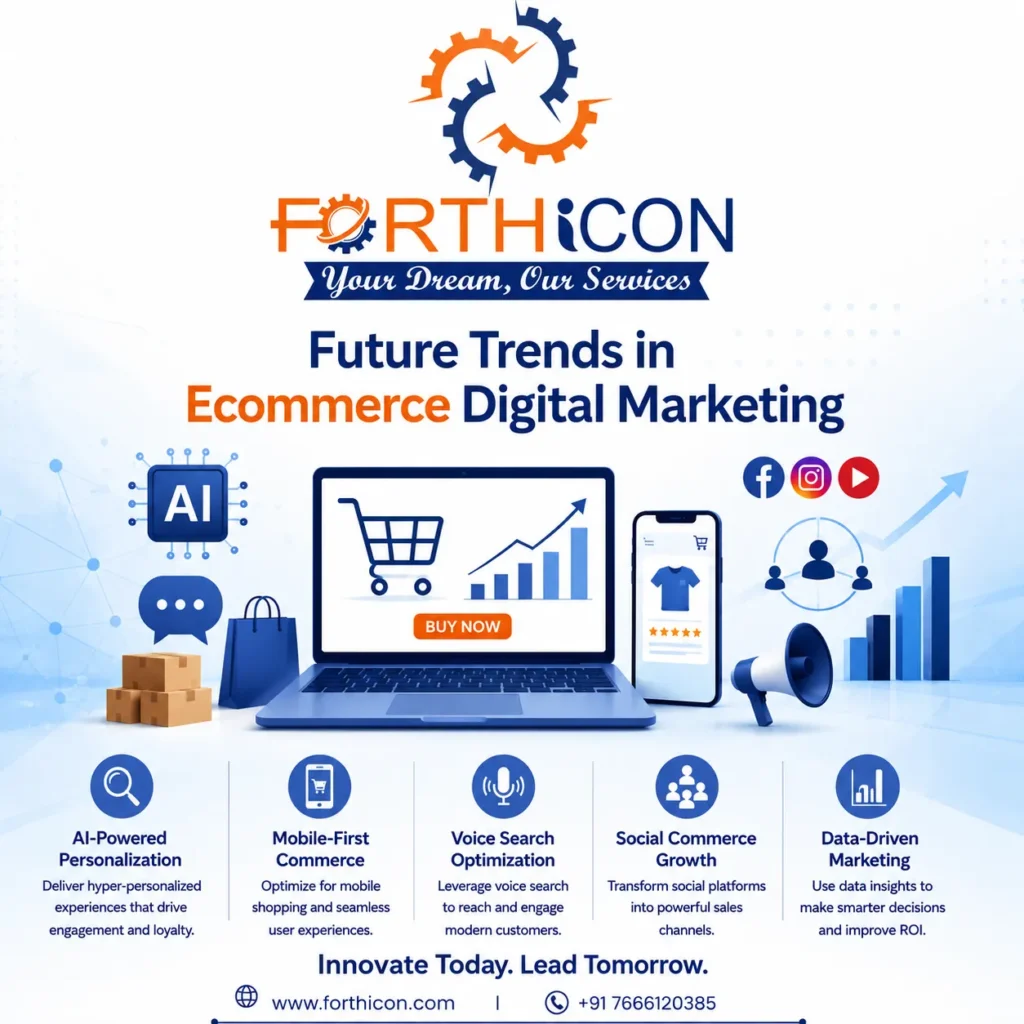
1. AI-Powered Personalization
AI will create hyper-personalized shopping experiences.
2. Augmented Reality Shopping
Customers will virtually try products before buying.
3. Voice Commerce
Voice-based shopping will continue to grow.
4. Predictive Marketing
AI will predict customer behavior more accurately.
5. Sustainable Brand Marketing
Consumers increasingly prefer eco-friendly brands.
Common Ecommerce Marketing Mistakes
Ignoring SEO
Without SEO, online stores struggle to attract organic traffic.
Poor Mobile Experience
Slow mobile websites reduce conversions significantly.
Weak Product Descriptions
Generic content affects rankings and buyer trust.
No Analytics Tracking
Businesses cannot optimize campaigns without data.
Inconsistent Branding
Strong branding improves customer recognition and loyalty.
How to Choose the Right Ecommerce Marketing Strategy
Consider Your Business Goals
Decide whether you want:
- More traffic
- More sales
- Brand awareness
- Customer retention
Understand Your Audience
Study:
- Customer interests
- Buying behavior
- Preferred platforms
Analyze Competitors
Monitor competitor campaigns and identify market opportunities.
Focus on ROI
Prioritize strategies that generate measurable business growth.
Why Businesses Need Professional Ecommerce Marketing Services
Professional agencies help businesses:
- Create strategic campaigns
- Optimize conversions
- Manage paid advertising
- Improve SEO rankings
- Scale revenue efficiently
Experienced ecommerce marketers understand market trends, customer behavior, and platform algorithms.
Ecommerce Digital Marketing for Small Businesses
Small businesses can compete effectively using:
- Local SEO
- Organic social media
- Email marketing
- Influencer collaborations
- Content marketing
Affordable digital strategies help small brands grow faster online.
Conclusion
Ecommerce Digital Marketing is no longer optional for online businesses. It is the foundation of sustainable growth, customer engagement, and long-term success in today’s digital economy.
From SEO and social media marketing to AI automation and video campaigns, modern ecommerce businesses must use multiple digital channels to remain competitive. Businesses that invest in strategic marketing not only increase visibility but also improve customer trust, conversions, and profitability.
As technology evolves, ecommerce marketing will continue becoming smarter, more personalized, and more data-driven. Brands that adapt quickly to new trends and customer expectations will dominate the future online marketplace.
Whether you are launching a new ecommerce business or scaling an existing online store, implementing powerful Ecommerce Digital Marketing strategies can help you achieve consistent business growth and maximize revenue opportunities.
Frequently Asked Question On Ecommerce Digital Marketing
1. What is Ecommerce Digital Marketing and why is it important for online stores?
Ecommerce Digital Marketing is the process of promoting online stores using digital channels such as search engines, social media, email marketing, paid advertising, influencer campaigns, and content marketing. The primary goal of Ecommerce Digital Marketing is to increase website traffic, generate qualified leads, improve conversions, and boost online sales.
In today’s competitive digital world, businesses cannot rely only on having a website. Millions of ecommerce stores compete online, making visibility one of the biggest challenges. Ecommerce Digital Marketing helps businesses stand out by targeting the right audience with the right message at the right time.
A strong Ecommerce Digital Marketing strategy improves brand awareness, customer trust, and long-term business growth. Businesses can use SEO to rank on Google, social media marketing to engage audiences, and paid advertising to generate instant traffic.
Another major advantage of Ecommerce Digital Marketing is data-driven decision-making. Businesses can track customer behavior, campaign performance, conversion rates, and return on investment using tools like Google Analytics and Meta Ads Manager.
Benefits of Ecommerce Digital Marketing include:
- Increased website traffic
- Higher online sales
- Better customer targeting
- Improved customer engagement
- Stronger brand authority
- Better ROI compared to traditional marketing
- Enhanced customer retention
Modern consumers search online before making purchases. Therefore, businesses that invest in Ecommerce Digital Marketing gain a competitive advantage in attracting and converting customers.
2. Which are the best Ecommerce Digital Marketing strategies for online businesses?
The best Ecommerce Digital Marketing strategies depend on business goals, target audience, industry, and budget. However, several proven techniques consistently help ecommerce brands grow faster.
Search Engine Optimization (SEO)
SEO helps ecommerce websites rank higher on Google search results. Optimizing product pages, category pages, blogs, and technical SEO can increase organic traffic significantly.
Social Media Marketing
Platforms like Instagram, Facebook, LinkedIn, Pinterest, and TikTok help businesses engage customers through content, reels, stories, and ads.
Pay-Per-Click Advertising (PPC)
Google Ads and Meta Ads generate targeted traffic instantly. Ecommerce businesses use PPC campaigns for product promotions, retargeting, and seasonal sales.
Email Marketing
Email campaigns help nurture leads, recover abandoned carts, and increase repeat purchases.
Influencer Marketing
Collaborating with influencers builds trust and expands brand reach among niche audiences.
Content Marketing
Blogs, videos, guides, and tutorials improve SEO rankings while educating customers.
Conversion Rate Optimization (CRO)
Improving website design, product descriptions, call-to-actions, and checkout experiences increases sales conversions.
Mobile Marketing
Most ecommerce shoppers use smartphones. Mobile optimization is critical for better user experience and higher conversions.
A successful Ecommerce Digital Marketing strategy combines multiple channels for maximum business growth and customer engagement.
3. How does SEO help Ecommerce Digital Marketing improve sales?
SEO plays a crucial role in Ecommerce Digital Marketing because it helps websites attract organic traffic from search engines like Google. Organic traffic is highly valuable because users actively search for products or services, making them more likely to convert into customers.
When ecommerce websites rank higher in search results, they receive more clicks, visibility, and credibility. SEO involves optimizing product pages, images, keywords, website speed, mobile responsiveness, internal links, and content quality.
Key SEO benefits for Ecommerce Digital Marketing include:
- Increased organic website traffic
- Better search engine visibility
- Improved customer trust
- Higher conversion rates
- Long-term marketing results
- Reduced advertising costs
- Stronger online authority
Important SEO strategies include:
Keyword Research
Businesses should target high-volume and low-competition keywords relevant to their products.
On-Page SEO
Optimizing titles, meta descriptions, headings, URLs, and product descriptions improves rankings.
Technical SEO
Improving page speed, website structure, mobile optimization, and security enhances user experience.
Content Marketing
Publishing blogs and guides increases keyword visibility and website authority.
Local SEO
Local ecommerce businesses benefit from Google Business Profile optimization and location-based keywords.
SEO is one of the most cost-effective Ecommerce Digital Marketing methods because it provides long-term traffic and sustainable business growth.
4. Why is social media important in Ecommerce Digital Marketing?
Social media has become one of the most powerful tools in Ecommerce Digital Marketing because billions of users spend time daily on platforms like Instagram, Facebook, TikTok, Pinterest, and LinkedIn.
Social media helps ecommerce businesses connect directly with their audience, build relationships, increase engagement, and drive sales. Businesses can showcase products visually through images, reels, stories, and live videos.
Benefits of social media in Ecommerce Digital Marketing include:
- Increased brand awareness
- Better customer engagement
- Direct customer communication
- Higher website traffic
- Stronger customer loyalty
- Better lead generation
- Improved sales conversions
Popular social media platforms for ecommerce include:
Ideal for fashion, beauty, lifestyle, and product-based brands.
Excellent for ads, retargeting campaigns, and community building.
TikTok
Perfect for viral marketing and younger audiences.
Highly effective for home decor, fashion, and DIY ecommerce brands.
Useful for B2B ecommerce and professional branding.
Businesses should create consistent content, use hashtags strategically, run paid campaigns, and engage actively with followers to maximize Ecommerce Digital Marketing success through social media.
5. What role does paid advertising play in Ecommerce Digital Marketing?
Paid advertising is one of the fastest ways to generate traffic and sales in Ecommerce Digital Marketing. Platforms like Google Ads, Facebook Ads, Instagram Ads, and YouTube Ads help businesses reach targeted audiences instantly.
Unlike organic methods, paid advertising delivers immediate visibility. Businesses can promote products to users based on demographics, interests, behavior, and purchase intent.
Benefits of paid advertising in Ecommerce Digital Marketing include:
- Instant traffic generation
- Precise audience targeting
- Faster lead generation
- Better brand visibility
- Improved sales conversions
- Scalable business growth
Popular paid advertising methods include:
Google Search Ads
Appear when users search for products online.
Display Ads
Visual banner ads shown across websites.
Shopping Ads
Product-focused ads displayed in Google Shopping results.
Social Media Ads
Targeted campaigns on Facebook, Instagram, LinkedIn, and TikTok.
Retargeting Ads
Re-engage users who visited the website but did not purchase.
To achieve success, businesses should optimize ad copy, visuals, targeting, landing pages, and budgets regularly.
6. How can Ecommerce Digital Marketing improve customer retention?
Customer retention is essential for long-term ecommerce growth because retaining existing customers costs less than acquiring new ones. Ecommerce Digital Marketing improves retention through personalized experiences, email campaigns, loyalty programs, and consistent customer engagement.
Businesses can increase repeat purchases by:
- Sending personalized emails
- Offering discounts and rewards
- Using retargeting campaigns
- Providing excellent customer service
- Creating valuable content
- Engaging customers on social media
Customer retention strategies improve brand loyalty and lifetime customer value, making Ecommerce Digital Marketing more profitable.
7. What are the biggest challenges in Ecommerce Digital Marketing?
Ecommerce businesses face several challenges in digital marketing, including intense competition, rising advertising costs, changing algorithms, and customer acquisition difficulties.
Common challenges include:
- High competition in search rankings
- Expensive paid advertising
- Low conversion rates
- Cart abandonment
- Customer retention issues
- Content saturation
- Mobile optimization problems
Businesses can overcome these challenges by investing in SEO, improving website speed, creating quality content, and using data-driven marketing strategies.
8. How important is mobile optimization in Ecommerce Digital Marketing?
Mobile optimization is extremely important because most ecommerce users browse and shop using smartphones. A mobile-friendly website improves user experience, engagement, and sales conversions.
Benefits include:
- Faster loading speed
- Better user experience
- Higher search rankings
- Improved conversion rates
- Lower bounce rates
Responsive design, mobile-friendly navigation, and optimized checkout processes are critical for Ecommerce Digital Marketing success.
9. How does content marketing support Ecommerce Digital Marketing?
Content marketing helps ecommerce businesses educate, engage, and convert customers. Blogs, videos, guides, product tutorials, and infographics improve SEO and build customer trust.
Content marketing benefits include:
- Increased organic traffic
- Better brand authority
- Improved customer trust
- Higher engagement rates
- Better SEO rankings
Educational and informative content helps businesses attract potential buyers and improve online visibility.
10. Why should businesses invest in professional Ecommerce Digital Marketing services?
Professional Ecommerce Digital Marketing services help businesses implement advanced strategies, improve campaign performance, and achieve faster business growth.
Experts provide:
- SEO optimization
- PPC management
- Social media marketing
- Conversion optimization
- Content creation
- Analytics tracking
Professional agencies save time, improve ROI, and help businesses stay competitive in the fast-changing digital marketplace.
For businesses aiming to increase online visibility, customer engagement, and revenue, investing in Ecommerce Digital Marketing services is one of the smartest long-term decisions.