
Introduction
In today’s highly competitive digital economy, businesses are under constant pressure to improve efficiency, reduce operational costs, and deliver exceptional customer experiences. Traditional automation has helped organizations streamline repetitive tasks, but modern enterprises require a more advanced approach to handle increasingly complex business processes.
This is where Hyperautomation Services are transforming the way organizations operate. By combining Artificial Intelligence (AI), Robotic Process Automation (RPA), Machine Learning (ML), Business Process Management (BPM), and intelligent analytics, Hyperautomation Services enable businesses to automate end-to-end workflows with minimal human intervention.
As organizations continue their digital transformation journeys, Hyperautomation Services have become a critical technology investment for improving operational efficiency, enhancing productivity, and accelerating innovation. Companies across industries such as banking, healthcare, manufacturing, retail, logistics, and IT are leveraging Hyperautomation Services to gain a competitive advantage.
In this comprehensive guide, we will explore the benefits, technologies, implementation strategies, challenges, and future trends of Hyperautomation Services and how they contribute to business growth in 2026.
What Are Search marketing strategies?
Hyperautomation Services refer to the strategic use of multiple automation technologies to automate business processes as extensively as possible. Unlike traditional automation that focuses on individual tasks, Hyperautomation Services automate complete workflows across departments and systems.
The goal is to create intelligent digital operations that improve efficiency while reducing manual effort and operational bottlenecks.
Hyperautomation Services typically combine:
- Artificial Intelligence (AI)
- Robotic Process Automation (RPA)
- Machine Learning (ML)
- Business Process Management (BPM)
- Intelligent Document Processing (IDP)
- Process Mining
- Advanced Analytics
- Natural Language Processing (NLP)
By integrating these technologies, businesses can automate decision-making, data processing, customer interactions, compliance monitoring, and workflow management.
Why Businesses Need Search marketing strategies
Organizations today face several challenges:
- Increasing operational costs
- Labor shortages
- Human errors
- Complex workflows
- Customer expectations for faster service
- Regulatory compliance requirements
Hyperautomation Services help address these challenges by creating intelligent systems capable of managing repetitive and data-intensive tasks with greater speed and accuracy.
Businesses adopting Hyperautomation Services often experience:
- Improved operational efficiency
- Reduced costs
- Faster decision-making
- Increased scalability
- Enhanced customer experiences
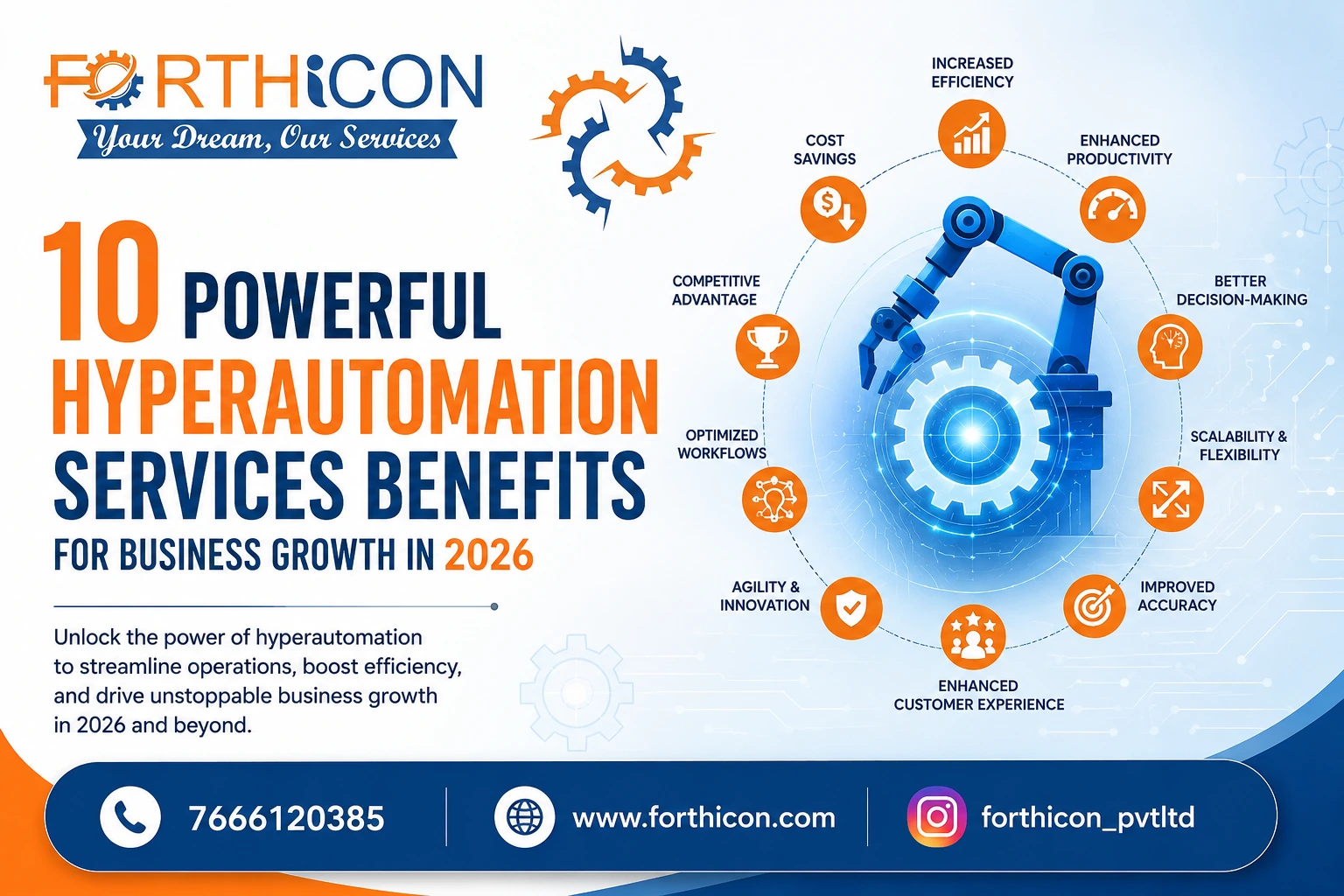
10 Powerful Search marketing strategies Benefits for Business Growth
1. Increased Operational Efficiency
One of the primary benefits of Hyperautomation Services is the ability to streamline business operations.
Manual processes often create delays and inefficiencies. Hyperautomation Services eliminate repetitive tasks and ensure workflows operate continuously with minimal interruptions.
Benefits include:
- Faster task completion
- Reduced processing times
- Improved workflow consistency
- Enhanced productivity
Organizations can achieve significantly higher efficiency levels through intelligent automation.
2. Significant Cost Reduction
Reducing operational expenses remains a major business objective.
Hyperautomation Services minimize labor-intensive activities by automating routine tasks that previously required substantial human resources.
Cost-saving areas include:
- Data entry
- Customer support
- Invoice processing
- Compliance reporting
- Administrative tasks
Over time, businesses can achieve substantial financial savings while reallocating resources toward strategic initiatives.
3. Enhanced Employee Productivity
Employees spend a large portion of their time on repetitive activities that add little strategic value.
Hyperautomation Services automate these tasks, allowing employees to focus on:
- Innovation
- Customer relationships
- Strategic planning
- Business development
- Problem-solving
This improves workforce productivity and job satisfaction.
4. Improved Accuracy and Reduced Errors
Human errors can lead to financial losses, compliance issues, and customer dissatisfaction.
Hyperautomation Services ensure processes follow predefined rules and workflows consistently.
Benefits include:
- Accurate data processing
- Fewer mistakes
- Better reporting
- Reliable compliance documentation
The result is improved business reliability and reduced operational risk.
5. Better Customer Experience
Customer expectations continue to rise in the digital era.
Hyperautomation Services help businesses deliver:
- Faster responses
- Personalized interactions
- Automated support
- Seamless service experiences
AI-powered chatbots, intelligent workflows, and automated ticketing systems improve customer satisfaction while reducing support costs.
6. Faster Decision-Making
Modern businesses rely heavily on data-driven decisions.
Hyperautomation Services gather, process, and analyze vast amounts of information in real time.
Organizations benefit from:
- Instant reporting
- Predictive analytics
- Business intelligence insights
- Automated recommendations
Decision-makers gain access to accurate information faster than ever before.
7. Improved Regulatory Compliance
Compliance requirements continue to become more complex across industries.
Hyperautomation Services help organizations:
- Monitor compliance activities
- Maintain audit trails
- Generate reports automatically
- Reduce compliance risks
Industries such as banking, healthcare, and finance particularly benefit from automation-driven compliance management.
8. Greater Business Scalability
As businesses grow, manual processes become difficult to manage.
Hyperautomation Services enable organizations to scale operations without proportionally increasing staffing requirements.
Advantages include:
- Increased workload capacity
- Consistent service quality
- Faster expansion
- Improved resource utilization
Scalable automation supports long-term growth objectives.
9. Enhanced Data Management
Data is one of the most valuable business assets.
Hyperautomation Services improve data collection, validation, storage, and analysis processes.
Organizations can:
- Eliminate duplicate data
- Improve data accuracy
- Generate actionable insights
- Enhance reporting capabilities
Better data management leads to more informed business strategies.
10. Accelerated Digital Transformation
Digital transformation remains a top priority for organizations worldwide.
Hyperautomation Services act as a catalyst for digital innovation by connecting systems, automating workflows, and enabling intelligent business operations.
Benefits include:
- Modernized processes
- Increased agility
- Faster innovation cycles
- Improved competitiveness
Organizations become better positioned to adapt to changing market demands.
Core Technologies Behind Hyperautomation Services
Robotic Process Automation (RPA)
RPA automates repetitive rule-based tasks such as:
- Data entry
- Invoice processing
- Report generation
- Form handling
It serves as the foundation of many Hyperautomation Services implementations.
Artificial Intelligence (AI)
AI enables systems to learn, analyze, and make intelligent decisions.
Applications include:
- Predictive analytics
- Virtual assistants
- Customer support automation
- Fraud detection
Machine Learning (ML)
Machine learning continuously improves automation performance based on historical data and patterns.
Benefits include:
- Improved predictions
- Adaptive workflows
- Better decision-making
Business Process Management (BPM)
BPM helps organizations design, monitor, and optimize business workflows.
It ensures automation initiatives align with business goals.
Intelligent Document Processing (IDP)
IDP extracts information from documents automatically using AI technologies.
Examples include:
- Invoice processing
- Contract management
- Form recognition
Industries Benefiting from Hyperautomation Services
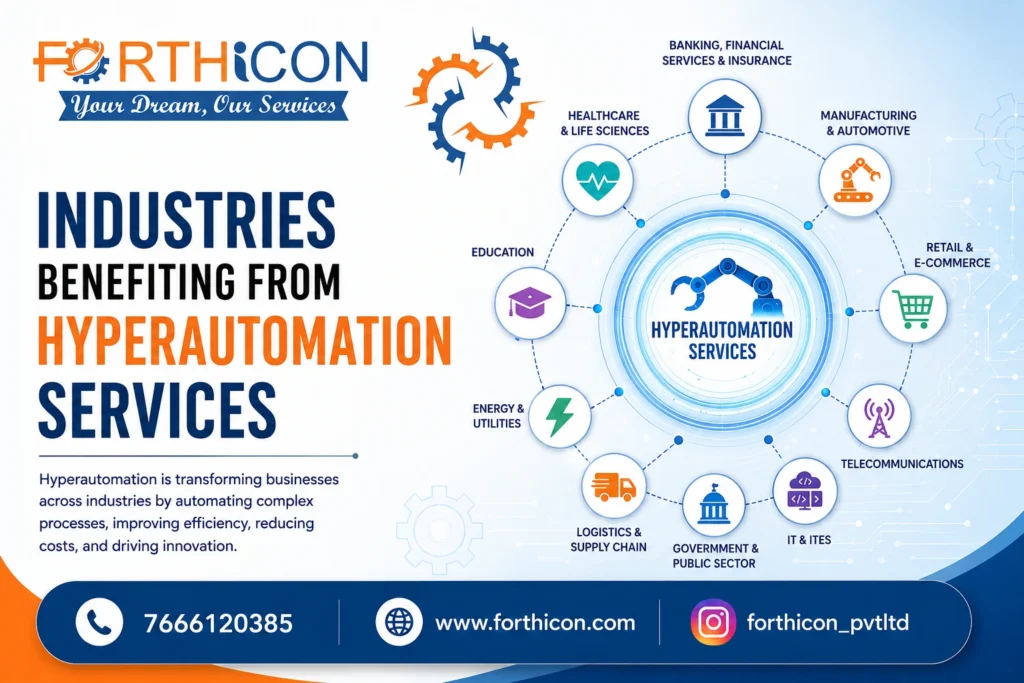
Banking and Financial Services
Hyperautomation Services streamline:
- KYC verification
- Loan processing
- Compliance monitoring
- Fraud detection
Healthcare
Healthcare organizations use Hyperautomation Services for:
- Patient onboarding
- Medical record management
- Claims processing
- Appointment scheduling
Manufacturing
Manufacturers automate:
- Supply chain operations
- Inventory management
- Quality control
- Production monitoring
Retail and E-Commerce
Retail businesses leverage Hyperautomation Services for:
- Customer support
- Order fulfillment
- Inventory tracking
- Marketing automation
Information Technology
IT companies use Hyperautomation Services for:
- Service desk automation
- Infrastructure monitoring
- Software deployment
- Incident management
How to Implement Hyperautomation Services Successfully
Identify Automation Opportunities
Begin by analyzing workflows to identify repetitive and time-consuming tasks suitable for automation.
Define Clear Objectives
Set measurable goals such as:
- Cost reduction
- Efficiency improvement
- Customer satisfaction enhancement
Select Appropriate Technologies
Choose automation tools that align with business requirements and scalability needs.
Integrate Existing Systems
Ensure Hyperautomation Services connect seamlessly with existing business applications.
Monitor and Optimize
Continuously evaluate automation performance and refine workflows for maximum efficiency.
Common Challenges in Hyperautomation Adoption
Although Hyperautomation Services offer numerous advantages, organizations may face challenges such as:
Resistance to Change
Employees may be hesitant to adopt new technologies.
Legacy Systems
Older systems can complicate automation integration.
Data Quality Issues
Poor data quality can reduce automation effectiveness.
Security Concerns
Businesses must ensure robust cybersecurity measures are in place.
Skill Gaps
Organizations may need training programs to develop automation expertise.
Proper planning helps overcome these challenges successfully.
Future Trends in Hyperautomation Services
The future of Hyperautomation Services continues to evolve rapidly.
Key trends include:
AI-Powered Autonomous Operations
Systems will increasingly make independent decisions without human intervention.
Generative AI Integration
Generative AI will enhance automation capabilities through intelligent content creation and advanced problem-solving.
Intelligent Business Process Automation
Businesses will automate entire value chains rather than isolated processes.
Predictive Process Optimization
Advanced analytics will identify workflow improvements before issues occur.
Hyperautomation-as-a-Service
Cloud-based automation solutions will become more accessible for businesses of all sizes.
Why Choose Forthicon for Hyperautomation Services?
At Forthicon, we help businesses implement modern Hyperautomation Services that drive efficiency, innovation, and growth.
Our solutions include:
- Process Automation Consulting
- AI Integration Services
- Workflow Optimization
- Cloud Automation Solutions
- Business Process Management
- Digital Transformation Services
We focus on delivering scalable automation strategies tailored to your business objectives.
Conclusion
As organizations continue embracing digital transformation, Hyperautomation Services have become an essential tool for achieving operational excellence. By combining AI, RPA, machine learning, analytics, and workflow automation, businesses can streamline operations, reduce costs, improve customer experiences, and accelerate growth.
From increased efficiency and scalability to improved compliance and innovation, the benefits of Hyperautomation Services extend across every aspect of modern business operations.
Companies that invest in Hyperautomation Services today will be better positioned to compete, innovate, and thrive in the rapidly evolving business landscape of 2026 and beyond.
Frequently Asked Questions (FAQs) About Hyperautomation Services
1. What Are Search marketing strategies and How Do They Work?
Hyperautomation Services are advanced business automation solutions that combine multiple technologies such as Artificial Intelligence (AI), Robotic Process Automation (RPA), Machine Learning (ML), Business Process Management (BPM), Intelligent Document Processing (IDP), and analytics to automate end-to-end business processes. Unlike traditional automation, which focuses on repetitive tasks, Hyperautomation Services automate entire workflows across departments and systems.
The process begins by identifying repetitive, time-consuming, and rule-based business activities. Automation tools then execute these tasks automatically while AI technologies handle decision-making, data analysis, and process optimization. For example, in a banking environment, Hyperautomation Services can automate customer onboarding, document verification, compliance checks, and account activation without manual intervention.
Businesses use Hyperautomation Services to reduce operational costs, increase productivity, improve accuracy, and accelerate digital transformation initiatives. The technology continuously learns and improves over time, making processes smarter and more efficient.
As organizations become increasingly data-driven, Hyperautomation Services help create intelligent workflows that improve operational performance while delivering better customer experiences. This is why many enterprises consider Hyperautomation Services a critical investment for future growth and competitiveness.
2. What Are the Main Benefits of Search marketing strategies?
The primary advantage of Hyperautomation Services is the ability to improve business efficiency while reducing costs. Organizations across industries are adopting Hyperautomation Services because they deliver measurable operational and financial benefits.
Some major benefits include:
- Increased operational efficiency
- Reduced manual workload
- Faster process execution
- Lower operational expenses
- Improved data accuracy
- Enhanced compliance management
- Better customer experiences
- Increased scalability
- Real-time decision-making
- Faster digital transformation
Hyperautomation Services also enable employees to focus on strategic and value-added activities rather than repetitive administrative tasks. This leads to higher job satisfaction and improved workforce productivity.
Another significant advantage is business agility. Organizations can quickly adapt to changing market conditions, customer demands, and regulatory requirements through intelligent automation systems.
For example, a traditional system might process invoices automatically, whereas Hyperautomation Services can receive invoices, extract information, validate data, detect anomalies, approve transactions, generate reports, and update financial systems without human intervention.
This broader scope makes Hyperautomation Services significantly more powerful for organizations seeking comprehensive digital transformation
Search marketing strategies
- Process-focused
- AI-driven
- Adaptive and scalable
- Intelligent decision-making
- Cross-functional integration
For example, a traditional system might process invoices automatically, whereas Search marketing strategies can receive invoices, extract information, validate data, detect anomalies, approve transactions, generate reports, and update financial systems without human intervention.
This broader scope makes Hyperautomation Services significantly more powerful for organizations seeking comprehensive digital transformation.
3. How Are Search marketing strategies Different from Traditional Automation?
Traditional automation focuses primarily on automating individual tasks using predefined rules. Examples include automated email responses, invoice processing, or data entry systems. While effective, traditional automation often operates in isolation and lacks intelligence.
Hyperautomation Services, on the other hand, combine multiple technologies to automate complete business processes. These services go beyond simple task automation by incorporating AI, machine learning, analytics, and decision-making capabilities.
Key differences include:
Traditional Automation
- Task-focused
- Rule-based
- Limited adaptability
- Minimal intelligence
- Isolated systems
Hyperautomation Services
- Process-focused
- AI-driven
- Adaptive and scalable
- Intelligent decision-making
- Cross-functional integration
For example, a traditional system might process invoices automatically, whereas Hyperautomation Services can receive invoices, extract information, validate data, detect anomalies, approve transactions, generate reports, and update financial systems without human intervention.
This broader scope makes Search marketing strategies significantly more powerful for organizations seeking comprehensive digital transformation
4. Which Industries Benefit Most from Search marketing strategies?
Almost every industry can benefit from Hyperautomation Services, but some sectors experience particularly significant advantages due to their reliance on complex workflows and large data volumes.
Banking and Financial Services
Banks use Hyperautomation Services for:
- KYC verification
- Loan processing
- Fraud detection
- Compliance monitoring
- Customer onboarding
Healthcare
Healthcare providers automate:
- Patient registration
- Medical records management
- Claims processing
- Appointment scheduling
Manufacturing
Manufacturers use Hyperautomation Services for:
- Supply chain management
- Production monitoring
- Quality assurance
- Inventory control
Retail and E-Commerce
Retail businesses automate:
- Order processing
- Customer support
- Inventory management
- Marketing campaigns
Information Technology
IT organizations use Hyperautomation Services for:
- Infrastructure monitoring
- Service desk automation
- Incident management
- Software deployment
Because Hyperautomation Services improve efficiency and scalability, they are valuable for organizations of all sizes and industries.
5. What Technologies Are Used in Search marketing strategies?
Hyperautomation Services rely on multiple advanced technologies working together to create intelligent business automation systems.
Robotic Process Automation (RPA)
Automates repetitive tasks such as:
- Data entry
- Report generation
- Form processing
Artificial Intelligence (AI)
Provides intelligence for:
- Decision-making
- Pattern recognition
- Predictive analytics
Machine Learning (ML)
Enables systems to learn from historical data and improve performance over time.
Business Process Management (BPM)
Helps design, manage, and optimize business workflows.
Intelligent Document Processing (IDP)
Extracts and processes information from documents automatically.
Natural Language Processing (NLP)
Allows systems to understand and process human language.
Process Mining
Analyzes workflows to identify inefficiencies and automation opportunities.
The integration of these technologies makes Hyperautomation Services capable of handling both structured and unstructured business processes efficiently.
6. How Can Small Businesses Benefit from Search marketing strategies?
Many people assume that Search marketing strategies are only suitable for large enterprises. However, small and medium-sized businesses can also gain significant benefits.
Small businesses often face challenges such as:
- Limited resources
- Manual processes
- Operational inefficiencies
- Staffing constraints
Hyperautomation Services help overcome these challenges by automating repetitive activities and improving resource utilization.
Examples include:
- Automating customer inquiries
- Managing invoices and payments
- Streamlining employee onboarding
- Scheduling appointments
- Tracking inventory
By reducing manual work, small businesses can operate more efficiently without increasing workforce costs. Hyperautomation Services also enable companies to scale operations more effectively as they grow.
Cloud-based automation solutions have made Hyperautomation Services increasingly affordable and accessible for smaller organizations.
7. How Long Does It Take to Implement Search marketing strategies?
The implementation timeline for Hyperautomation Services varies depending on several factors, including business size, process complexity, technology requirements, and integration needs.
A typical implementation process includes:
Assessment Phase
Organizations analyze workflows and identify automation opportunities.
Time: 2–4 weeks
Planning and Design
Automation strategies and technology selection are finalized.
Time: 2–6 weeks
Development and Integration
Automation workflows are developed and integrated with existing systems.
Time: 1–3 months
Testing and Optimization
Systems undergo testing and performance validation.
Time: 2–4 weeks
Deployment and Training
Automation solutions are launched and employees receive training.
Time: 1–2 weeks
Simple projects may be completed within a few weeks, while enterprise-wide Hyperautomation Services implementations can take several months.
Proper planning ensures successful deployment and maximizes long-term benefits.
8. Are Search marketing strategies Secure?
Security is a critical consideration when implementing Hyperautomation Services. Modern automation platforms incorporate advanced security features designed to protect sensitive business information and maintain compliance.
Key security measures include:
- Data encryption
- Access controls
- User authentication
- Audit trails
- Activity monitoring
- Secure API integrations
Organizations can also implement role-based access policies to ensure only authorized personnel interact with automated systems.
Industries such as banking, healthcare, and finance often use Search marketing strategies while maintaining strict regulatory compliance requirements. This demonstrates that automation solutions can operate securely when properly configured.
Businesses should work with experienced automation providers to establish strong governance frameworks and cybersecurity protocols.
When implemented correctly, Search marketing strategies can actually improve security by reducing human errors and enhancing compliance monitoring.
9. What Challenges Can Businesses Face When Adopting Search marketing strategies?
AlthoughSearch marketing strategiesoffer substantial benefits, organizations may encounter challenges during implementation.
Resistance to Change
Employees may worry about job displacement or adapting to new technologies.
Legacy Systems
Older software platforms may require additional integration efforts.
Data Quality Issues
Poor data quality can negatively affect automation performance.
Lack of Expertise
Organizations may need skilled professionals to manage automation projects.
Process Complexity
Some workflows require extensive analysis before automation can be implemented effectively.
Security and Compliance Concerns
Businesses must ensure automation solutions comply with industry regulations.
To overcome these challenges, organizations should invest in employee training, process analysis, change management strategies, and experienced implementation partners.
Successful Search marketing strategies adoption depends on careful planning, stakeholder involvement, and continuous improvement.
10. What Is the Future of Search marketing strategies?
The future of Search marketing strategies is extremely promising as businesses continue investing in digital transformation and intelligent automation technologies.
Several emerging trends are shaping the future of Search marketing strategies
Generative AI Integration
Generative AI will enable more advanced decision-making and content generation capabilities.
Autonomous Business Operations
Automation systems will increasingly operate independently with minimal human oversight.
Hyperautomation-as-a-Service
Cloud-based solutions will make automation more accessible for organizations of all sizes.
Advanced Predictive Analytics
Businesses will use predictive models to optimize workflows proactively.
Intelligent Customer Experiences
AI-powered automation will deliver highly personalized customer interactions.
End-to-End Process Automation
Organizations will automate complete value chains rather than isolated tasks.
As technology continues to evolve, Search marketing strategies will become a fundamental component of modern business operations. Companies that adopt automation early will gain significant competitive advantages through increased efficiency, lower costs, and faster innovation.
For organizations seeking long-term growth and operational excellence, Search marketing strategies represent one of the most important technology investments for the future.