Table of Contents
Introduction
In today’s fast-paced digital world, businesses require technology solutions that align perfectly with their unique workflows, objectives, and growth strategies. While off-the-shelf software can meet general requirements, it often falls short when organizations need specialized features, scalability, and flexibility. This is where Custom Software becomes a game-changer.
Custom software development involves designing, developing, and deploying software applications specifically tailored to a business’s unique needs. Whether you’re a startup, small business, or large enterprise, investing in custom software can improve efficiency, automate processes, enhance customer experiences, and provide a significant competitive advantage.
At Forthicon, we provide professional Custom Software Development Services in Pune, helping businesses transform ideas into innovative digital solutions that drive growth and long-term success.
What Is Software Platforms?
Custom Software refers to software applications that are specifically developed to meet the unique requirements of a particular organization or business. Unlike generic software products designed for a broad audience, custom solutions are built with your business processes, goals, and users in mind.
Examples of custom software include:
- Customer Relationship Management (CRM) Systems
- Enterprise Resource Planning (ERP) Software
- Inventory Management Systems
- Human Resource Management Systems
- E-commerce Platforms
- Healthcare Management Software
- Learning Management Systems (LMS)
- Mobile Applications
- Workflow Automation Tools
- Industry-Specific Business Applications
These solutions help businesses operate more efficiently while addressing challenges that standard software cannot solve effectively.
Why Businesses Need Custom Software in 2026
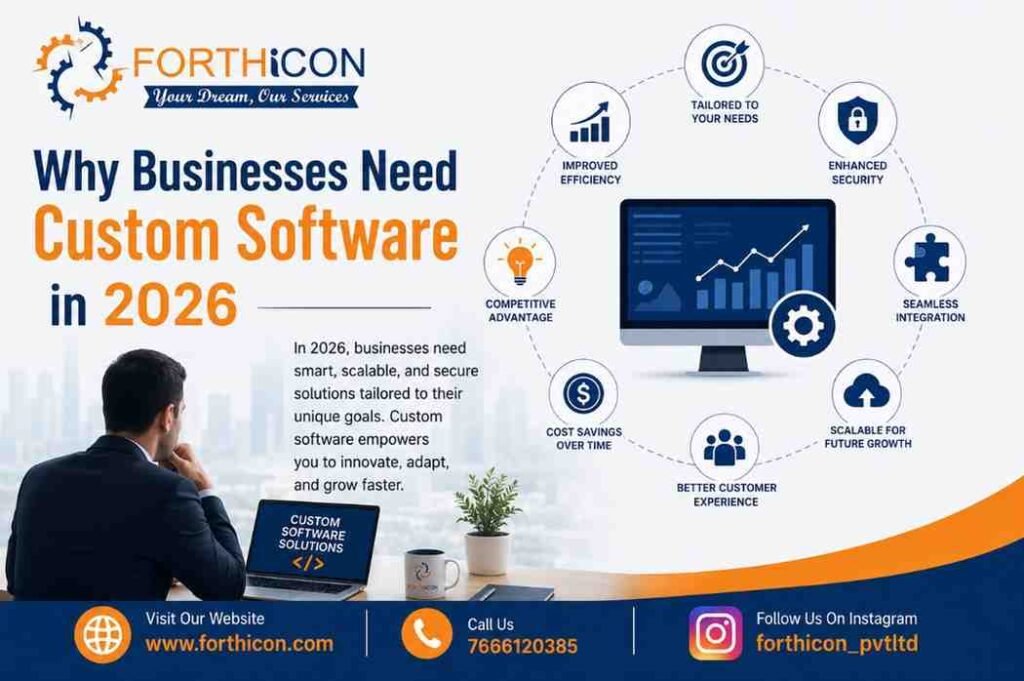
Technology continues to evolve rapidly, and businesses need flexible solutions that can adapt to changing market demands. Custom software offers organizations the ability to innovate and stay ahead of competitors.
1. Tailored to Business Needs
Every organization operates differently. Custom software is designed around your specific processes, ensuring maximum efficiency and usability.
2. Improved Productivity
Automating repetitive tasks reduces manual work, minimizes errors, and allows employees to focus on high-value activities.
3. Better Integration
Custom software can seamlessly integrate with existing systems such as accounting software, CRM platforms, ERP systems, and third-party applications.
4. Scalability
As your business grows, your software can evolve with additional features, users, and functionalities.
5. Enhanced Security
Custom applications can incorporate advanced security measures tailored to your organization’s requirements, reducing vulnerabilities associated with widely used software.
6. Competitive Advantage
Unique software capabilities can help businesses differentiate themselves and deliver superior customer experiences.
Benefits of Investing in Software Platforms
Greater Operational Efficiency
Software Platforms eliminates unnecessary features and focuses on the functionality your team actually needs. This streamlined approach enhances workflow efficiency and reduces operational bottlenecks.
Cost Savings Over Time
Although Software Platforms may require a larger initial investment, it often proves more cost-effective in the long run by reducing licensing fees, increasing productivity, and minimizing dependency on multiple software solutions.
Enhanced Customer Experience
Businesses can provide personalized services, faster response times, and improved customer interactions through customized applications.
Real-Time Data Access
Custom solutions provide centralized access to critical business data, enabling informed decision-making and better performance tracking.
Increased Flexibility
Organizations can modify and update software according to changing business requirements without being restricted by vendor limitations.
Industries Benefiting from Software Platforms Development
Healthcare
Healthcare providers use Software Platforms for patient management, appointment scheduling, telemedicine platforms, and medical record systems.
Retail and E-commerce
Retail businesses leverage Software Platforms for inventory management, online sales, customer engagement, and analytics.
Manufacturing
Manufacturers utilize custom applications for production planning, quality control, supply chain management, and equipment monitoring.
Education
Educational institutions implement Software Platforms for online learning, student management, assessments, and communication.
Finance
Financial organizations require secure software for transactions, compliance management, reporting, and customer relationship management.
Real Estate
Real estate companies use Software Platforms to manage property listings, customer inquiries, documentation, and sales processes.
Key Features of Modern Software Platforms Solutions
User-Friendly Interface
A clean and intuitive interface improves user adoption and enhances productivity.
Cloud Integration
Cloud-based solutions enable remote access, improved collaboration, and reduced infrastructure costs.
Mobile Compatibility
Modern Software Platforms supports smartphones and tablets, allowing users to work from anywhere.
Data Analytics and Reporting
Advanced analytics provide valuable insights into business performance and customer behavior.
Automation Capabilities
Automation reduces manual effort and improves operational efficiency.
Security and Compliance
Modern software incorporates encryption, role-based access control, secure authentication, and compliance standards.
API Integrations
Custom applications can integrate with external platforms and services to create a unified digital ecosystem.
Software Platforms Development Process
1. Requirement Analysis
The development process begins with understanding business goals, challenges, and functional requirements.
2. Planning and Strategy
A detailed roadmap is created, outlining project scope, timelines, technologies, and deliverables.
3. UI/UX Design
User-centric designs are developed to ensure an engaging and intuitive user experience.
4. Software Development
Developers build the application using modern technologies and best coding practices.
5. Testing and Quality Assurance
Comprehensive testing ensures the software performs reliably and meets quality standards.
6. Deployment
The application is launched and integrated into the organization’s operations.
7. Maintenance and Support
Continuous monitoring, updates, and support ensure optimal performance and security.
Technologies Used in Software Platforms Development
Successful software solutions are built using modern technologies that ensure scalability, security, and performance.
Popular technologies include:
Front-End Technologies
- HTML5
- CSS3
- JavaScript
- React
- Angular
- Vue.js
Back-End Technologies
- PHP
- Laravel
- Node.js
- Python
- Django
- ASP.NET
Database Solutions
- MySQL
- PostgreSQL
- MongoDB
- SQL Server
Cloud Platforms
- AWS
- Microsoft Azure
- Google Cloud Platform
Mobile Development
- Flutter
- React Native
- Android
- iOS
How Software Platforms Supports Digital Transformation
Digital transformation is no longer optional for businesses aiming to remain competitive. Custom software plays a critical role in this transformation by enabling organizations to:
- Digitize manual processes
- Improve customer engagement
- Increase operational efficiency
- Enhance collaboration
- Utilize business intelligence
- Support remote work environments
- Improve decision-making through data analytics
Organizations that embrace digital transformation through custom software are better positioned to adapt to evolving market conditions and customer expectations.How Custom Software Supports Digital Transformation
Digital transformation is no longer optional for businesses aiming to remain competitive. Custom software plays a critical role in this transformation by enabling organizations to:
- Digitize manual processes
- Improve customer engagement
- Increase operational efficiency
- Enhance collaboration
- Utilize business intelligence
- Support remote work environments
- Improve decision-making through data analytics
Organizations that embrace digital transformation through custom software are better positioned to adapt to evolving market conditions and customer expectations.
How Custom Software Supports Digital Transformation
Digital transformation is no longer optional for businesses aiming to remain competitive. Custom software plays a critical role in this transformation by enabling organizations to:
- Digitize manual processes
- Improve customer engagement
- Increase operational efficiency
- Enhance collaboration
- Utilize business intelligence
- Support remote work environments
- Improve decision-making through data analytics
Organizations that embrace digital transformation through custom software are better positioned to adapt to evolving market conditions and customer expectations.
Why Choose Custom Software Over Off-the-Shelf Solutions?
| Feature | Custom Software | Off-the-Shelf Software |
|---|---|---|
| Customization | High | Limited |
| Scalability | Excellent | Moderate |
| Integration | Seamless | Restricted |
| Security | Enhanced | Standard |
| Ownership | Full Control | Vendor Controlled |
| Long-Term Value | High | Moderate |
Custom software offers greater flexibility and alignment with business objectives, making it a strategic investment for organizations seeking sustainable growth.
Why Choose Forthicon for Technology Solutions Development Services in Pune?
Forthicon specializes in delivering innovative and scalable custom software solutions tailored to diverse business requirements.
Our Expertise Includes:
- Business Process Automation
- CRM Development
- ERP Development
- Web Application Development
- Mobile Application Development
- Cloud-Based Solutions
- Enterprise Software Development
- API Integration Services
- Software Maintenance and Support
What Sets Us Apart?
- Experienced Development Team
- Customer-Centric Approach
- Modern Technology Stack
- Agile Development Methodology
- Transparent Communication
- Affordable Pricing
- Ongoing Technical Support
We work closely with clients to understand their goals and deliver software solutions that drive measurable business outcomes.
Future Trends in Technology Solutions Development
As technology advances, custom software development continues to evolve.
Key trends shaping the future include:
Artificial Intelligence Integration
AI-powered applications improve automation, customer service, and predictive analytics.
Machine Learning Solutions
Machine learning enables intelligent decision-making and personalized user experiences.
Cloud-Native Applications
Cloud-first development improves scalability and flexibility.
Low-Code Development
Low-code platforms accelerate application development and deployment.
Cybersecurity Enhancements
Organizations are investing heavily in advanced security measures to protect data and systems.
Internet of Things (IoT)
IoT-enabled software allows businesses to connect devices and collect real-time operational data.
Conclusion
The demand for Custom Software continues to grow as businesses seek tailored solutions that improve efficiency, enhance customer experiences, and support long-term growth. Unlike generic software products, custom applications are designed specifically around your organization’s needs, providing greater flexibility, scalability, and competitive advantage.
Whether you need a CRM system, ERP platform, mobile application, workflow automation solution, or enterprise software, investing in custom software can transform the way your business operates.
If you’re looking for reliable Custom Software Development Services in Pune, Forthicon is your trusted technology partner. Our team of experienced developers delivers innovative, secure, and scalable software solutions that help businesses achieve their digital transformation goals and succeed in 2026 and beyond.
Frequently Asked Questions (FAQs) About Custom Software Development Services
1. What is Custom Software and how does it differ from off-the-shelf software?
Custom Software is a software solution specifically designed and developed to meet the unique requirements of a business or organization. Unlike off-the-shelf software, which is created for a broad audience with standardized features, customized applications are tailored to match specific workflows, operational processes, and business goals.
For example, a retail company may need a specialized inventory management system integrated with its existing sales platform, while a healthcare provider may require a patient management solution with unique compliance features. A tailored approach ensures that businesses only pay for the functionalities they need while gaining greater flexibility and efficiency.
Custom-built solutions can also be modified and expanded as business requirements change, making them a long-term investment that supports growth and innovation.
2. Why should businesses invest in custom software development?
Businesses invest in custom software development because it provides solutions that align perfectly with their operations and objectives. Generic software often requires organizations to adapt their processes to fit the software, whereas tailored solutions are designed around existing workflows.
Key benefits include improved productivity, better integration with current systems, enhanced security, and increased scalability. Organizations can automate repetitive tasks, reduce manual errors, and improve collaboration across departments.
Additionally, businesses gain complete ownership and control over the application, allowing them to implement updates, enhancements, and new features whenever necessary without relying on third-party vendors.
3. How much does custom software development cost?
The cost of software development depends on several factors, including project complexity, required features, technology stack, integration requirements, design specifications, and development timeline.
A simple business application may require a relatively modest investment, while enterprise-grade platforms with advanced functionalities such as artificial intelligence, automation, cloud integration, and real-time analytics can involve larger budgets.
Rather than focusing solely on initial costs, businesses should evaluate the long-term value provided by a tailored solution. Increased efficiency, reduced operational expenses, and improved customer experiences often deliver a significant return on investment over time.
Working with an experienced development company helps ensure accurate project estimation and cost-effective implementation.
4. How long does it take to develop a custom software solution?
Development timelines vary depending on project size and complexity. Small applications with limited features may take a few weeks to complete, while large-scale enterprise platforms can require several months of planning, development, testing, and deployment.
The typical development process includes requirement analysis, project planning, user interface design, coding, testing, deployment, and ongoing support. Each phase contributes to delivering a reliable and high-performing application.
Agile development methodologies allow businesses to receive incremental updates and functionality throughout the project lifecycle, ensuring transparency and flexibility while reducing development risks.
Proper planning and clear communication between stakeholders and developers play a crucial role in meeting project deadlines successfully.
5. Which industries can benefit from custom software development services?
Almost every industry can benefit from tailored technology solutions. Organizations across healthcare, education, manufacturing, retail, finance, logistics, hospitality, and real estate use specialized applications to streamline operations and improve efficiency.
Healthcare providers implement patient management systems and telemedicine platforms. Educational institutions utilize learning management systems and student portals. Retail businesses deploy inventory management and e-commerce solutions.
Manufacturers benefit from production monitoring systems, while financial institutions use secure applications for compliance management and transaction processing. Real estate companies leverage customized platforms for property management and client communication.
Because every industry faces unique challenges, tailored applications provide targeted solutions that generic software often cannot deliver effectively.
6. Is custom software secure?
Security is one of the biggest advantages of custom-developed applications. Since these solutions are built specifically for an organization, developers can implement security measures based on the company’s requirements and risk profile.
Security features may include encrypted data storage, multi-factor authentication, role-based access control, secure APIs, data backup systems, and compliance with industry regulations.
Unlike mass-market software products that are frequently targeted by cybercriminals due to their widespread use, customized systems present a smaller attack surface because their architecture is unique.
Regular security audits, software updates, vulnerability assessments, and monitoring further enhance protection against evolving cyber threats. Businesses handling sensitive customer or financial information often choose tailored solutions to strengthen their cybersecurity posture.
7. Can custom software integrate with existing business systems?
Yes, modern software solutions are designed to integrate seamlessly with existing business tools and platforms. Integration capabilities are among the most valuable benefits of a customized application.
Organizations often use multiple systems such as CRM platforms, accounting software, ERP solutions, payment gateways, cloud services, inventory management tools, and customer support systems. A tailored solution can connect these platforms to create a centralized ecosystem.
This integration eliminates data silos, improves information flow, reduces duplicate data entry, and enhances operational efficiency. Employees can access accurate, real-time information from a single interface, improving decision-making and productivity.
Businesses should discuss integration requirements during the planning stage to ensure smooth implementation and compatibility.
8. What technologies are commonly used in custom software development?
Modern development projects utilize a wide range of technologies depending on business goals, performance requirements, scalability needs, and project scope.
Front-end technologies often include HTML5, CSS3, JavaScript, React, Angular, and Vue.js for creating engaging user interfaces. Back-end development may involve PHP, Laravel, Python, Django, Node.js, .NET, or Java.
Databases such as MySQL, PostgreSQL, MongoDB, and SQL Server store and manage business data efficiently. Cloud platforms like AWS, Microsoft Azure, and Google Cloud support scalability and remote accessibility.
For mobile applications, technologies such as Flutter, React Native, Android, and iOS development frameworks are widely used. Selecting the right technology stack is essential for ensuring long-term performance and reliability.
9. How does custom software support business growth?
As businesses grow, their operational requirements become increasingly complex. Customized applications help organizations scale efficiently by automating workflows, improving collaboration, and providing valuable business insights.
These solutions can accommodate increased user numbers, expanded product offerings, additional business locations, and evolving customer expectations without major disruptions.
Advanced reporting and analytics capabilities enable leadership teams to monitor performance, identify trends, and make data-driven decisions. Automation reduces administrative workload, allowing employees to focus on strategic activities.
By supporting innovation, efficiency, and adaptability, tailored software becomes a critical asset for sustainable business growth and competitive advantage in today’s digital marketplace.
10. Why choose Forthicon for Custom Software Development Services in Pune?
Forthicon specializes in delivering innovative software solutions designed to meet the unique needs of businesses across various industries. With a strong focus on quality, scalability, and customer satisfaction, the company helps organizations transform ideas into powerful digital products.
The development team follows industry best practices, modern technologies, and agile methodologies to ensure successful project execution. Services include business process automation, web application development, mobile app development, cloud solutions, CRM systems, ERP platforms, API integrations, and ongoing technical support.
Forthicon works closely with clients throughout every stage of the project, from initial consultation and planning to deployment and maintenance. This collaborative approach ensures that the final solution aligns with business objectives and delivers measurable results.
Organizations seeking reliable, secure, and future-ready technology solutions can benefit from partnering with an experienced software development company that understands the evolving demands of modern businesses.