
Table of Contents
Introduction
Businesses are rapidly adopting artificial intelligence to improve customer interactions, streamline operations, and increase profitability. One of the most impactful innovations transforming modern organizations is AI Chatbot Development. From customer service and sales support to lead generation and business automation, AI-powered chatbots are helping companies deliver faster, smarter, and more personalized experiences.
As digital transformation accelerates across industries, customers expect instant responses and seamless communication. Traditional support systems often struggle to meet these expectations, leading to delays, increased operational costs, and reduced customer satisfaction. This is where AI Chatbot Development provides a competitive advantage.
Modern AI chatbots use natural language processing (NLP), machine learning, and conversational intelligence to understand user queries and provide accurate responses in real time. Whether integrated into websites, mobile apps, social media platforms, or messaging applications, AI chatbots can significantly improve customer engagement while reducing workload for human teams.
In 2026, organizations across retail, healthcare, banking, education, real estate, and e-commerce sectors are investing heavily in AI-powered conversational solutions. Understanding the benefits of AI Chatbot Development can help businesses make informed decisions about implementing intelligent automation.
What Is AI Chatbot Development?
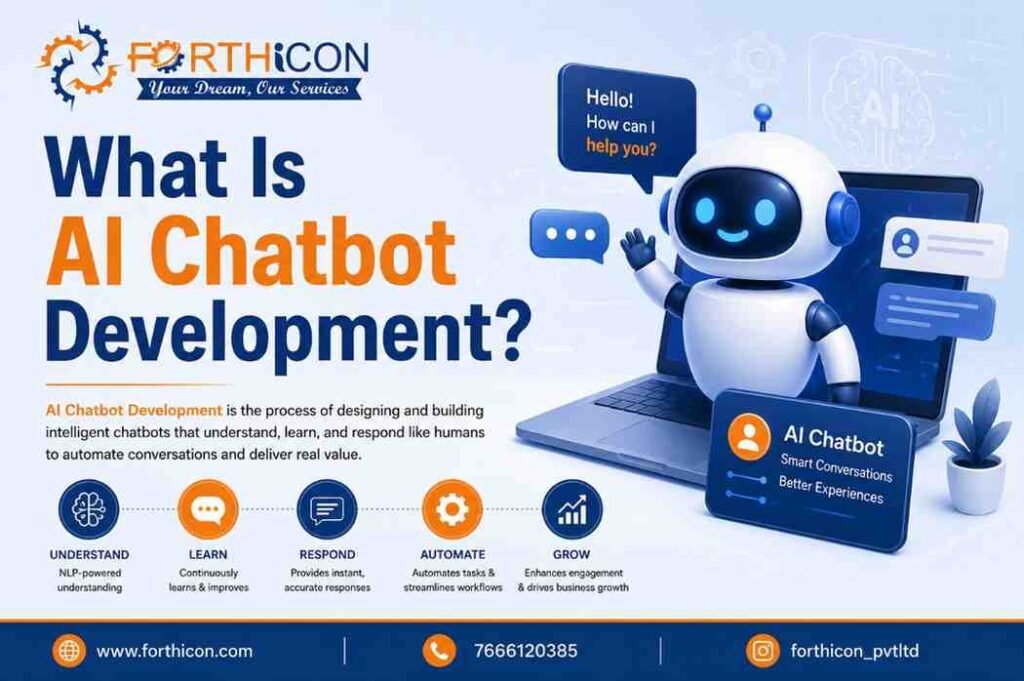
AI Chatbot Development refers to the process of designing, building, deploying, and maintaining intelligent conversational software that interacts with users through text or voice communication. These chatbots use artificial intelligence technologies such as Natural Language Processing (NLP), Machine Learning (ML), and Deep Learning to understand and respond to human queries in a more natural and meaningful way.
Unlike traditional rule-based chatbots that follow predefined scripts, AI-powered chatbots can understand natural language, learn from past interactions, analyze customer intent, and deliver personalized responses. They continuously improve over time by adapting to user behavior and conversation patterns.
AI chatbots are widely used across industries such as e-commerce, healthcare, banking, education, and customer support. They help businesses automate repetitive tasks, reduce response time, and provide 24/7 customer assistance without human intervention. This improves operational efficiency while enhancing customer satisfaction.
Why AI Chatbots Are Essential in 2026
The digital economy demands instant communication. Customers expect businesses to be available whenever they need assistance.
Key factors driving chatbot adoption include:
- Growing customer expectations
- Increased online competition
- Rising support costs
- Need for automation
- Expansion of e-commerce
- Demand for personalized experiences
- Remote customer engagement
Companies implementing AI-powered conversational solutions often experience improved operational efficiency and stronger customer relationships.
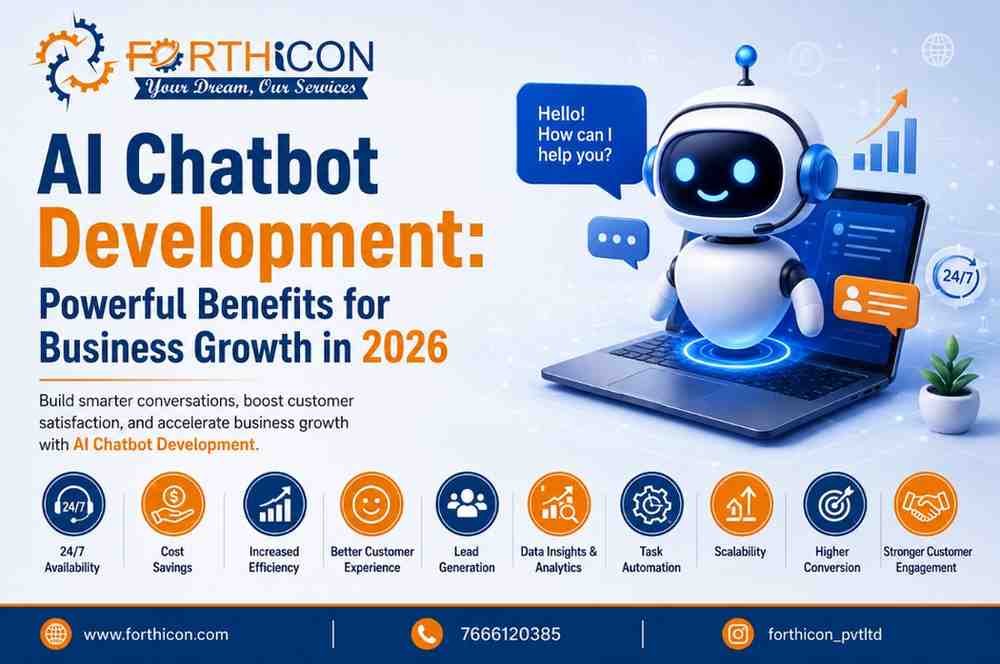
1. 24/7 Customer Support Availability
One of the biggest advantages of AI Chatbot Development is round-the-clock customer support.
Unlike human agents, chatbots never require breaks, holidays, or shifts. They remain available 24 hours a day, seven days a week.
Benefits include:
- Instant responses
- Reduced waiting times
- Improved customer satisfaction
- Global customer support
- Better service consistency
Customers appreciate immediate assistance regardless of time zones or business hours.
2. Reduced Operational Costs
Hiring and training large support teams can be expensive.
AI-powered chatbots help organizations reduce costs by automating repetitive customer interactions.
Common tasks automated by chatbots include:
- Frequently asked questions
- Appointment scheduling
- Product recommendations
- Order tracking
- Account inquiries
- Customer onboarding
Businesses can redirect human resources toward more strategic and revenue-generating activities.
3. Improved Customer Experience
Customer experience plays a crucial role in business success.
Modern chatbot solutions provide:
- Personalized conversations
- Quick problem resolution
- Context-aware interactions
- Consistent communication
- Multi-language support
When customers receive accurate and timely assistance, trust and satisfaction increase significantly
4. Faster Lead Generation
Generating qualified leads remains a priority for businesses across industries.
AI chatbots can engage visitors instantly and collect valuable information such as:
- Name
- Contact details
- Business requirements
- Product interests
- Budget expectations
This automated qualification process helps sales teams focus on high-potential prospects.
Benefits include:
- More qualified leads
- Faster follow-ups
- Increased conversions
- Better sales productivity
5. Enhanced Sales Performance
Modern chatbots act as virtual sales assistants.
They can:
- Recommend products
- Answer purchase-related questions
- Compare products
- Offer discounts
- Guide customers through the buying process
By assisting users during critical decision-making stages, chatbots help improve conversion rates and revenue generation.
6. Personalized Customer Interactions
Personalization has become a major factor in customer engagement.
Advanced chatbot systems analyze:
- User behavior
- Purchase history
- Browsing patterns
- Customer preferences
- Previous interactions
Based on this information, they deliver highly relevant recommendations and responses.
Personalized communication improves:
- Customer loyalty
- Engagement rates
- Purchase frequency
- Retention rates
7. Improved Employee Productivity
Employees often spend significant time answering repetitive questions.
AI chatbot solutions automate routine interactions, allowing staff members to focus on:
- Strategic planning
- Complex customer issues
- Innovation
- Relationship building
- Revenue-generating activities
This increases overall organizational productivity and efficiency.
8. Better Data Collection and Insights
Every customer interaction provides valuable business intelligence.
AI chatbots gather data related to:
- Customer preferences
- Common inquiries
- Purchase behavior
- Product feedback
- Service issues
Businesses can analyze this information to make informed decisions and improve their offerings.
Data-driven insights support:
- Marketing optimization
- Product development
- Customer retention
- Service improvement
9. Scalability for Business Growth
As businesses grow, customer inquiries increase.
Expanding customer support teams can become expensive and difficult to manage.
AI-powered chatbot systems can handle thousands of conversations simultaneously without compromising service quality.
This scalability helps organizations:
- Support growing customer bases
- Manage seasonal demand spikes
- Expand globally
- Maintain service consistency
Scalable solutions ensure long-term operational efficiency.
10. Competitive Advantage in Digital Markets
Businesses adopting AI technologies often gain a competitive edge.
Companies using advanced conversational systems benefit from:
- Faster customer support
- Better engagement
- Improved lead generation
- Higher customer satisfaction
- Increased operational efficiency
Organizations that embrace intelligent automation are often better positioned for long-term success.
Key Features of Modern AI Chatbot Solutions
Successful AI Chatbot Development involves integrating powerful features that enhance performance and user experience.
Important features include:
Natural Language Processing (NLP)
NLP enables chatbots to understand and interpret human language naturally.
Machine Learning
Machine learning allows chatbots to improve performance through continuous learning.
Multi-Channel Integration
Chatbots can operate across:
- Websites
- Mobile applications
- Facebook Messenger
- Telegram
- Customer portals
Voice Assistance
Voice-enabled bots provide hands-free communication experiences.
Analytics Dashboard
Detailed reporting helps businesses monitor chatbot performance and customer interactions.
CRM Integration
Chatbots can connect with customer relationship management systems for seamless data management.
Industries Benefiting from AI Chatbot Solutions
E-Commerce
- Product recommendations
- Order tracking
- Customer support
- Abandoned cart recovery
Healthcare
- Appointment scheduling
- Patient inquiries
- Health information
- Follow-up reminders
Banking and Finance
- Account assistance
- Loan inquiries
- Transaction support
- Customer onboarding
Education
- Student support
- Admission assistance
- Course recommendations
- Learning guidance
Real Estate
- Property inquiries
- Lead qualification
- Appointment booking
- Virtual assistance
Emerging Trends in AI Chatbot Technology for 2026
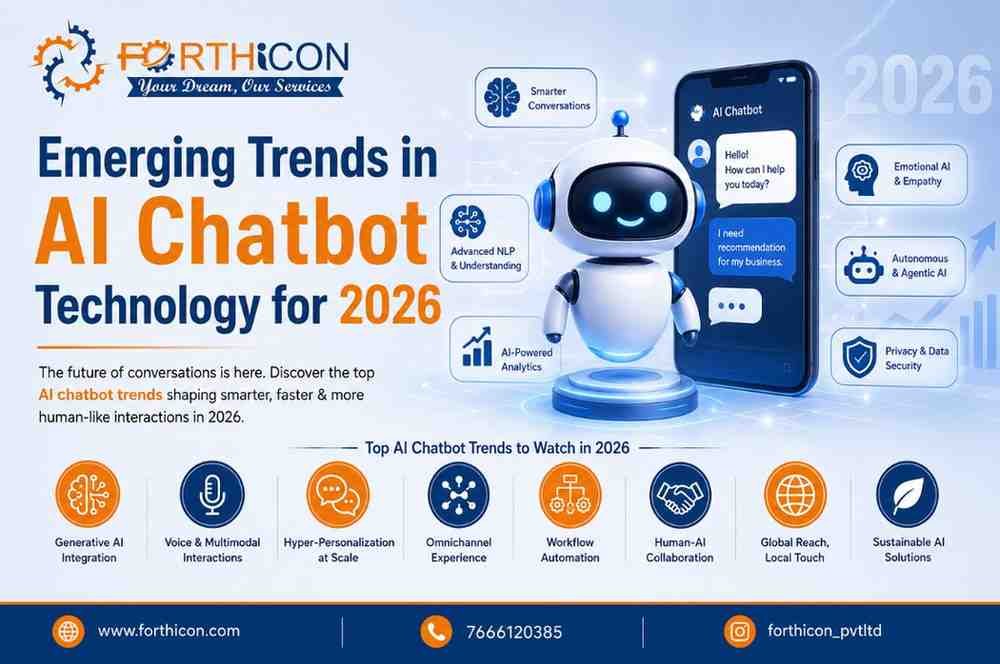
Several innovations are shaping the future of chatbot technology.
Generative AI Integration
Large language models are making conversations more natural and intelligent.
Voice AI
Voice-enabled chatbots are becoming increasingly popular across industries.
Hyper-Personalization
AI systems deliver highly customized customer experiences.
Emotional Intelligence
Advanced chatbots can analyze sentiment and adjust responses accordingly.
Omnichannel Communication
Customers expect seamless interactions across multiple platforms.
Predictive Assistance
Future chatbot systems will proactively assist customers before issues arise.
Challenges in AI Chatbot Adoption
While chatbot technology offers significant advantages, businesses may encounter challenges such as:
- Data privacy concerns
- Integration complexity
- Training requirements
- Initial implementation costs
- User adoption issues
Proper planning and professional development services can help overcome these challenges.
How Professional AI Chatbot Development Services Help
Professional development partners provide expertise in:
- Custom chatbot design
- AI model implementation
- Platform integration
- Security compliance
- Performance optimization
- Ongoing maintenance
Working with experienced developers ensures higher-quality results and faster deployment.
Conclusion
The future of business communication is increasingly driven by intelligent automation, and AI Chatbot Development is at the center of this transformation. From improving customer support and lead generation to reducing operational costs and enhancing user experiences, AI-powered chatbots offer measurable advantages for organizations of all sizes.
As businesses continue embracing digital transformation in 2026, investing in advanced conversational AI solutions can provide significant competitive benefits. Companies that implement intelligent chatbot systems today are better positioned to meet customer expectations, improve efficiency, and drive sustainable growth in an increasingly digital marketplace.
By leveraging modern AI Chatbot Development solutions, businesses can create smarter customer experiences.
FAQ On AI Chatbot Development
FAQ 1: What is AI Chatbot Development?
AI Chatbot Development is the process of designing and building intelligent conversational systems that can interact with users through text or voice. Unlike rule-based bots that follow fixed scripts, AI chatbots use technologies such as Natural Language Processing (NLP), Machine Learning (ML), and Generative AI to understand user intent and respond naturally. These chatbots are widely used in customer support, e-commerce, healthcare, education, and banking. The goal is to automate communication, reduce manual workload, and provide instant responses to users. In 2026, AI chatbots have become more advanced, capable of handling complex conversations and delivering human-like interactions across multiple platforms.
FAQ 2: How do AI chatbots work?
AI chatbots work by analyzing user input, identifying intent, and generating appropriate responses. When a user sends a message, the chatbot first processes the text using NLP techniques to understand meaning and context. Then, machine learning models compare the input with trained data to determine the best response. Advanced chatbots use large language models (LLMs) to generate real-time replies. They also integrate with databases, APIs, and CRM systems to fetch accurate information. Over time, the chatbot improves through continuous learning from conversations, making responses more accurate and relevant.
FAQ 3: What are the benefits of AI Chatbot Development for businesses?
AI chatbots offer several benefits for businesses of all sizes. They provide 24/7 customer support, ensuring users always receive assistance. They reduce operational costs by minimizing the need for large support teams. Chatbots also improve response time, leading to higher customer satisfaction. Additionally, they help generate and qualify leads automatically, increasing sales opportunities. Businesses can also deliver personalized experiences by analyzing customer data and behavior. Overall, AI chatbots improve efficiency, scalability, and customer engagement while supporting business growth in a competitive digital environment.
FAQ 4: Which industries use AI chatbots the most?
AI chatbots are used across multiple industries due to their flexibility and automation capabilities. In e-commerce, they assist customers with product recommendations and order tracking. In healthcare, they help with appointment booking and basic medical queries. Banking and finance sectors use chatbots for balance inquiries, transaction alerts, and fraud detection support. Education platforms use them for student assistance and learning guidance. Travel and hospitality industries use chatbots for bookings and customer support. Even real estate and IT services rely heavily on chatbots to manage leads and customer communication efficiently.
FAQ 5: What technologies are used in AI Chatbot Development?
AI Chatbot Development uses a combination of advanced technologies. Natural Language Processing (NLP) helps understand human language. Machine Learning (ML) enables chatbots to learn from data and improve over time. Deep learning models enhance conversation accuracy and context understanding. Generative AI and Large Language Models (like GPT-based systems) generate human-like responses. Chatbots also integrate with APIs, cloud platforms, and databases for real-time data access. Popular frameworks include Dialogflow, Microsoft Bot Framework, Rasa, and OpenAI APIs. Together, these technologies create intelligent and scalable chatbot systems.
FAQ 6: How much does AI Chatbot Development cost?
The cost of AI Chatbot Development varies depending on complexity, features, and platform integration. Basic chatbots with simple automation can be relatively affordable, while advanced AI-powered systems with NLP, CRM integration, and multi-channel support are more expensive. Costs also depend on whether the chatbot is custom-built or developed using existing platforms. Maintenance, training data, and updates add to long-term expenses. However, businesses often recover costs quickly due to reduced support expenses and improved conversion rates, making chatbots a cost-effective investment.
FAQ 7: Can AI chatbots replace human customer support agents?
AI chatbots cannot fully replace human agents but can significantly reduce their workload. Chatbots are excellent at handling repetitive and routine queries such as FAQs, order tracking, and basic troubleshooting. However, complex or emotionally sensitive issues still require human intervention. The best approach is a hybrid model where chatbots handle initial interactions and escalate complex issues to human agents. This combination improves efficiency while maintaining a high-quality customer experience. In 2026, businesses prefer this balanced approach for optimal performance.
FAQ 8: How secure are AI chatbots?
AI chatbots are designed with multiple security layers to protect user data. They use encryption protocols to secure communication and comply with data protection regulations like GDPR. Advanced systems also include authentication mechanisms to verify users before sharing sensitive information. However, security also depends on proper implementation and regular updates. Businesses must ensure secure API integrations and avoid storing unnecessary sensitive data. With the right setup, AI chatbots are highly secure and safe for business use.
FAQ 9: What is the future of AI Chatbot Development?
The future of AI chatbot development is highly advanced and promising. Chatbots are expected to become more human-like, emotionally intelligent, and context-aware. Integration with voice assistants, AR/VR environments, and IoT devices will expand their use cases. Multilingual support will improve global communication. Businesses will also rely more on predictive AI, where chatbots anticipate user needs before they ask. As AI technology evolves, chatbots will become central to digital customer interaction strategies across all industries.
FAQ 10: How can businesses get started with AI Chatbot Development?
Businesses can start AI chatbot development by identifying their goals, such as customer support, lead generation, or sales automation. The next step is selecting the right platform or development framework. Companies should then design conversation flows and train the chatbot using relevant data. Integration with websites, apps, or CRM systems is essential for functionality. Testing and optimization ensure smooth performance before deployment. Partnering with an experienced AI development company can also help businesses build scalable and efficient chatbot solutions tailored to their needs.