Table of Contents
Introduction
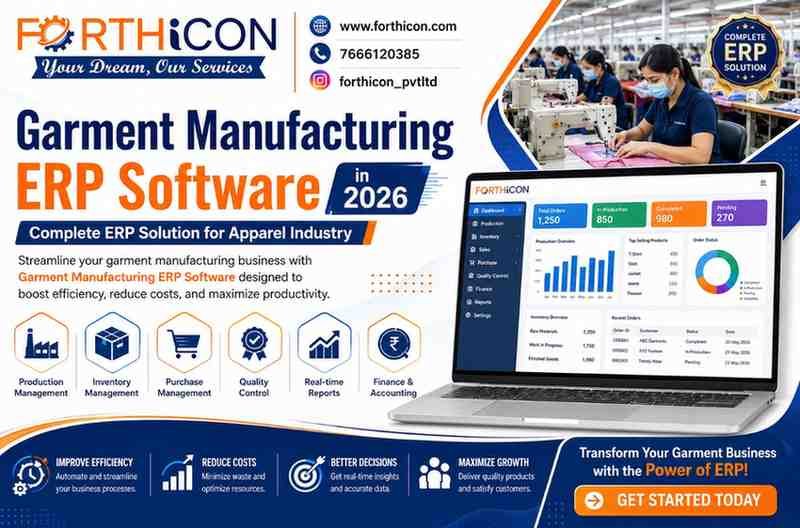
The garment and apparel industry is evolving rapidly in 2026. Increasing customer demands, shorter fashion cycles, inventory management challenges, and rising operational costs have made it essential for manufacturers to adopt advanced digital solutions. One of the most effective ways to manage these challenges is by implementing Garment Manufacturing ERP Software.
Enterprise Resource Planning (ERP) software is designed to integrate and automate various business processes, including production planning, inventory management, procurement, quality control, sales, finance, and reporting. For garment manufacturers, an ERP system acts as a centralized platform that improves visibility, efficiency, and profitability.
In this comprehensive guide, we will explore everything you need to know about Garment Manufacturing ERP Software, its benefits, features, implementation process, and why it has become a necessity for apparel businesses in 2026.
What is Garment Manufacturing ERP Software?
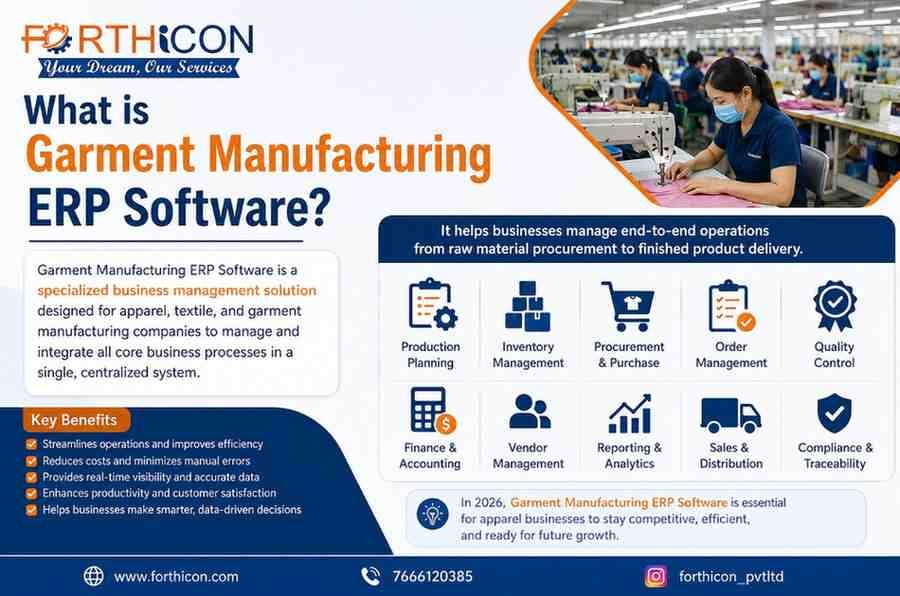
Garment Manufacturing ERP Software is a specialized enterprise management solution developed specifically for apparel, textile, and garment manufacturing companies. It helps businesses manage their end-to-end operations from raw material procurement to finished product delivery.
Unlike generic ERP systems, garment ERP software is tailored to address industry-specific requirements such as:
- Style management
- Color and size matrix handling
- Bill of Materials (BOM)
- Production planning
- Inventory tracking
- Vendor management
- Purchase management
- Quality control
- Order processing
- Financial management
The software provides real-time data and analytics, enabling manufacturers to make informed decisions and optimize operations.
Why the Apparel Industry Needs ERP Software in 2026
The garment industry faces numerous operational challenges that traditional management systems cannot efficiently handle.
Common Challenges
- Inventory inaccuracies
- Production delays
- Material wastage
- Lack of real-time visibility
- Inefficient supply chain management
- Poor communication between departments
- Manual reporting errors
- Difficulty in demand forecasting
A modern Garment Manufacturing ERP Software addresses these challenges by providing centralized control and automation across all business processes.
Key Features of Garment Manufacturing ERP Software
1. Production Planning and Scheduling
Production planning is one of the most critical functions in garment manufacturing.
ERP software helps manufacturers:
- Plan production schedules
- Allocate resources effectively
- Monitor work orders
- Track production progress
- Reduce bottlenecks
This ensures timely order fulfillment and maximum resource utilization.
2. Inventory Management
Inventory management plays a crucial role in garment manufacturing.
The software enables businesses to:
- Track raw materials
- Monitor finished goods
- Manage warehouse stock
- Reduce excess inventory
- Prevent stock shortages
Real-time inventory tracking improves operational efficiency and minimizes losses.
3. Bill of Materials (BOM) Management
Garment products often involve multiple components such as fabric, buttons, zippers, labels, and accessories.
ERP systems simplify BOM management by:
- Creating product structures
- Tracking material consumption
- Managing revisions
- Calculating production costs
This helps manufacturers maintain accurate cost estimates.
4. Procurement Management
Efficient procurement ensures uninterrupted production.
ERP software allows organizations to:
- Manage suppliers
- Generate purchase orders
- Track deliveries
- Monitor vendor performance
- Control procurement costs
This leads to better supplier relationships and cost savings.
5. Order Management
Customer orders must be processed accurately and efficiently.
ERP software helps businesses:
- Manage sales orders
- Track order status
- Schedule production
- Coordinate shipments
- Improve customer satisfaction
This results in faster order fulfillment and better customer experiences.
Quality Control and Compliance
Quality is essential in the garment industry.
ERP software includes quality management features such as:
- Inspection tracking
- Quality checkpoints
- Defect analysis
- Compliance reporting
- Corrective action management
These capabilities help maintain product consistency and reduce returns.
Financial Management and Accounting
Managing finances becomes easier with integrated ERP software.
Features include:
- General ledger
- Accounts payable
- Accounts receivable
- Cost tracking
- Budget management
- Tax compliance
Real-time financial reporting improves decision-making and transparency.
Supply Chain Management
A strong supply chain is vital for apparel businesses.
ERP software helps manage:
- Supplier relationships
- Procurement workflows
- Logistics operations
- Distribution processes
- Inventory movement
Improved supply chain visibility reduces delays and improves efficiency.
Benefits of Garment Manufacturing ERP Software
Improved Operational Efficiency
Automation eliminates repetitive tasks and reduces manual effort.
Benefits include:
- Faster workflows
- Reduced paperwork
- Better productivity
- Improved collaboration
Real-Time Business Visibility
ERP dashboards provide instant access to critical business information.
Managers can monitor:
- Production status
- Inventory levels
- Financial performance
- Sales activities
This enables faster and more informed decision-making.
Reduced Production Costs
ERP software helps identify inefficiencies and minimize waste.
Cost-saving areas include:
- Material utilization
- Labor management
- Inventory control
- Procurement optimization
Enhanced Customer Satisfaction
Timely deliveries and accurate order processing improve customer trust and loyalty.
Satisfied customers are more likely to become repeat buyers.
Better Demand Forecasting
ERP systems use historical data and analytics to forecast future demand.
This helps businesses:
- Plan production accurately
- Avoid stockouts
- Reduce excess inventory
How ERP Software Improves Garment Production
Streamlined Workflow Management
Every department can access the same information from a centralized platform.
This improves coordination between:
- Production
- Procurement
- Inventory
- Sales
- Finance
Reduced Lead Times
Automated planning and scheduling shorten production cycles.
Benefits include:
- Faster order completion
- Improved delivery performance
- Increased customer satisfaction
Accurate Resource Allocation
ERP systems ensure optimal utilization of:
- Machinery
- Labor
- Raw materials
This improves overall productivity.
ERP Software for Small, Medium, and Large Garment Manufacturers
Small Businesses
Small manufacturers benefit from:
- Better inventory control
- Automated accounting
- Improved order tracking
Medium-Sized Companies
Growing businesses gain:
- Process standardization
- Production optimization
- Supply chain visibility
Large Enterprises
Enterprise-level manufacturers benefit from:
- Multi-location management
- Advanced analytics
- Global supply chain coordination
Cloud-Based Garment Manufacturing ERP Software
Cloud ERP solutions are becoming increasingly popular in 2026.
Advantages of Cloud ERP
- Lower upfront costs
- Easy scalability
- Remote accessibility
- Automatic updates
- Enhanced security
Cloud-based systems enable businesses to manage operations from anywhere.
Choosing the Right Garment Manufacturing ERP Software
Selecting the right ERP solution is crucial for long-term success.
Industry-Specific Features
Ensure the ERP software supports:
- Size and color matrix management
- Apparel production workflows
- Textile inventory tracking
Scalability
Choose a solution that can grow with your business.
User-Friendly Interface
Employees should be able to learn and use the system easily.
Customization Options
Every garment manufacturer has unique requirements.
A flexible ERP system should allow customization.
Integration Capabilities
The software should integrate seamlessly with:
- CRM systems
- Accounting software
- E-commerce platforms
- Logistics solutions
ERP Implementation Best Practices
Successful implementation requires careful planning.
Define Business Objectives
Identify your goals before implementation.
Examples:
- Improve inventory accuracy
- Reduce production costs
- Increase operational efficiency
Train Employees
Proper training ensures successful adoption.
Employees should understand:
- System workflows
- Reporting tools
- Data entry processes
Monitor Performance
Track key performance indicators (KPIs) such as:
- Production efficiency
- Inventory turnover
- Order fulfillment rates
Regular monitoring helps maximize ERP benefits.
Future Trends in Garment Manufacturing ERP Software
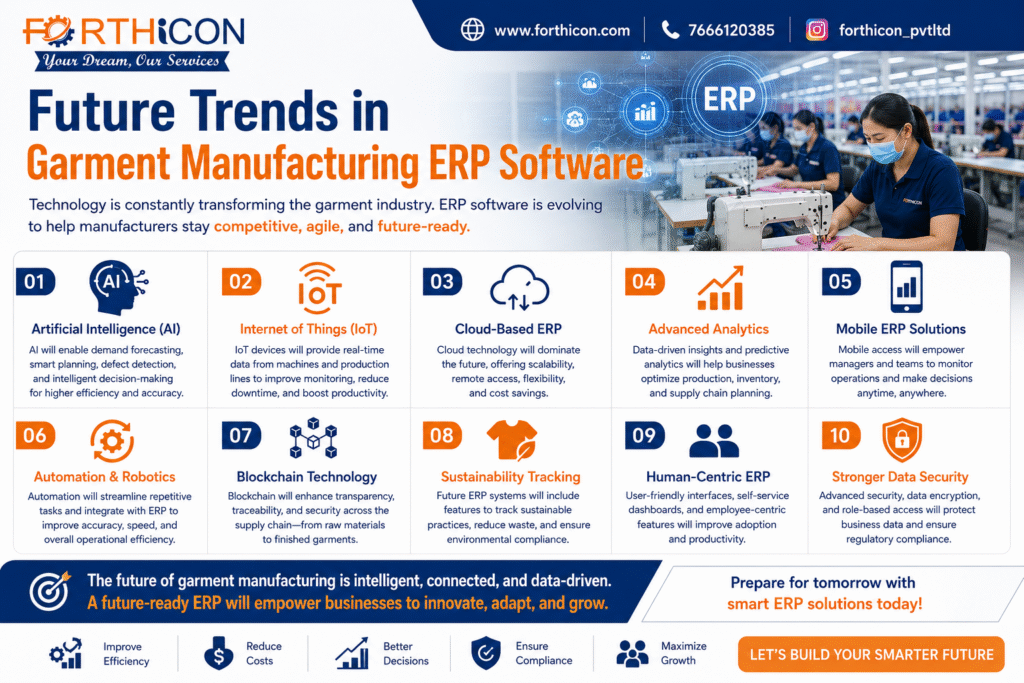
Artificial Intelligence (AI)
AI-powered ERP systems help with:
- Demand forecasting
- Predictive maintenance
- Intelligent reporting
Internet of Things (IoT)
IoT devices provide real-time machine and production data.
Benefits include:
- Equipment monitoring
- Reduced downtime
- Improved productivity
Advanced Analytics
Modern ERP systems provide powerful business intelligence tools.
Manufacturers can gain deeper insights into:
- Sales trends
- Production performance
- Inventory management
Mobile ERP Applications
Mobile accessibility enables managers to monitor operations from smartphones and tablets.
Why Invest in Garment Manufacturing ERP Software in 2026?
The garment industry continues to become more competitive and customer-driven. Businesses relying on manual processes often struggle with inefficiencies, delays, and higher operational costs.
Investing in Garment Manufacturing ERP Software helps organizations:
- Increase productivity
- Improve inventory control
- Optimize production planning
- Enhance customer satisfaction
- Reduce operational costs
- Gain real-time business insights
Whether you are a small garment workshop or a large apparel manufacturing enterprise, ERP software provides the digital foundation needed for sustainable growth and success.
Conclusion
In 2026, Garment Manufacturing ERP Software has become an essential business tool for apparel and textile manufacturers seeking efficiency, profitability, and scalability. By integrating production, inventory, procurement, quality control, sales, and finance into a single platform, ERP software enables businesses to streamline operations and make data-driven decisions.
As competition in the apparel industry continues to increase, manufacturers that embrace digital transformation through ERP solutions will be better positioned to meet customer demands, reduce costs, improve productivity, and achieve long-term growth.
If you’re looking to modernize your apparel manufacturing processes, investing in a reliable Garment Manufacturing ERP Software solution can be one of the most impactful decisions for your business in 2026.
Frequently Asked Questions (FAQs) About Garment Manufacturing ERP Software
1. What is Garment Manufacturing ERP Software?
Garment Manufacturing ERP Software is a specialized business management solution designed for apparel, textile, and garment manufacturing companies. It integrates multiple business functions such as production planning, inventory management, procurement, quality control, sales, finance, and reporting into a single centralized platform.
Unlike traditional software systems that manage only one department, ERP software connects all business operations and provides real-time visibility across the organization. This helps garment manufacturers improve efficiency, reduce manual work, minimize errors, and make better business decisions.
In 2026, garment manufacturers face increasing pressure to manage complex supply chains, shorter fashion cycles, and rising customer expectations. ERP software addresses these challenges by automating workflows and providing accurate data across departments.
Key areas managed by garment ERP software include:
- Production planning and scheduling
- Raw material management
- Fabric and accessory tracking
- Purchase management
- Inventory control
- Sales and order processing
- Financial accounting
- Vendor management
- Quality assurance
- Business analytics
Whether you operate a small garment factory or a large apparel manufacturing enterprise, ERP software can help streamline operations and improve profitability.
2. Why is Garment Manufacturing ERP Software important for apparel businesses?
Garment manufacturing involves multiple processes, departments, suppliers, and production stages. Managing these operations manually often leads to delays, errors, inventory issues, and higher operational costs.
Garment Manufacturing ERP Software is important because it provides complete visibility and control over business operations. It eliminates information silos and ensures that all departments work with accurate, real-time data.
Benefits include:
- Improved production efficiency
- Reduced inventory wastage
- Better order management
- Faster decision-making
- Enhanced customer satisfaction
- Lower operational costs
- Improved financial tracking
ERP software also helps businesses adapt to changing market demands by providing forecasting tools, reporting dashboards, and performance analytics.
In today’s competitive apparel industry, manufacturers that use ERP systems gain a significant advantage over businesses relying on spreadsheets and manual processes.
3. What features should a Garment Manufacturing ERP Software include?
A modern garment ERP solution should offer industry-specific features that support apparel production and supply chain management.
Important features include:
Production Management
- Production planning
- Work order management
- Capacity planning
- Shop floor control
Inventory Management
- Raw material tracking
- Finished goods management
- Warehouse management
- Stock monitoring
Bill of Materials (BOM)
- Product specifications
- Material requirements
- Cost calculations
Procurement Management
- Supplier management
- Purchase orders
- Vendor evaluation
Quality Control
- Inspection tracking
- Defect management
- Compliance reporting
Sales and Order Management
- Customer order processing
- Shipment tracking
- Delivery scheduling
Accounting and Finance
- General ledger
- Accounts payable
- Accounts receivable
- Financial reporting
Analytics and Reporting
- Business dashboards
- KPI monitoring
- Demand forecasting
Choosing ERP software with these capabilities ensures smooth operations and long-term business growth.
4. How does Garment Manufacturing ERP Software improve production planning?
Production planning is one of the most critical activities in apparel manufacturing. Poor planning can result in missed deadlines, excess inventory, production bottlenecks, and increased costs.
ERP software improves production planning by providing real-time information about:
- Available raw materials
- Production capacity
- Machine utilization
- Workforce allocation
- Customer demand
The system helps manufacturers create accurate production schedules and allocate resources efficiently.
Benefits include:
- Reduced production delays
- Improved resource utilization
- Faster order fulfillment
- Better production visibility
- Lower operational costs
Managers can monitor production progress in real time and quickly address issues before they affect delivery timelines.
This leads to higher productivity and improved customer satisfaction.
5. Can Garment Manufacturing ERP Software help with inventory management?
Yes. Inventory management is one of the most valuable functions of Garment Manufacturing ERP Software.
Garment manufacturers often deal with large quantities of fabrics, accessories, trims, packaging materials, and finished products. Managing inventory manually can lead to stock shortages or overstocking.
ERP software helps businesses:
- Track inventory in real time
- Monitor stock levels
- Reduce inventory carrying costs
- Prevent material shortages
- Improve warehouse efficiency
- Manage multiple storage locations
The software automatically updates inventory records whenever materials are purchased, consumed, transferred, or sold.
Advanced ERP systems also provide alerts for low-stock items and help optimize inventory replenishment.
As a result, manufacturers can reduce waste, improve cash flow, and maintain uninterrupted production.
6. Is Garment Manufacturing ERP Software suitable for small businesses?
Absolutely. Modern ERP solutions are available for businesses of all sizes, including small garment manufacturers and startups.
Many cloud-based ERP systems offer affordable pricing models that make implementation easier for smaller businesses.
Benefits for small manufacturers include:
- Automated business processes
- Better inventory control
- Improved order tracking
- Accurate financial management
- Reduced paperwork
- Enhanced productivity
Small businesses often face challenges due to limited resources and manpower. ERP software helps automate routine tasks, allowing teams to focus on growth and customer service.
Additionally, scalable ERP solutions can grow alongside the business, making them a long-term investment.
Even a small garment manufacturing company can significantly improve operational efficiency by adopting ERP technology.
7. What are the benefits of cloud-based Garment Manufacturing ERP Software?
Cloud ERP solutions have become increasingly popular in 2026 because they offer flexibility, scalability, and cost savings.
Unlike traditional on-premise systems, cloud ERP software is hosted online and can be accessed from anywhere with an internet connection.
Benefits include:
Lower Initial Investment
Businesses do not need expensive hardware or servers.
Remote Accessibility
Managers and employees can access data from any location.
Automatic Updates
Software providers regularly update the system with new features and security enhancements.
Scalability
Businesses can easily add users and functionalities as they grow.
Enhanced Security
Cloud providers invest heavily in cybersecurity measures.
Faster Deployment
Cloud ERP systems are generally quicker to implement than traditional ERP solutions.
These advantages make cloud ERP an ideal choice for modern apparel manufacturers.
8. How long does it take to implement Garment Manufacturing ERP Software?
The implementation timeline depends on several factors, including:
- Company size
- Number of users
- Business complexity
- Required customizations
- Data migration needs
For small garment manufacturers, implementation may take a few weeks.
For medium and large enterprises, implementation can take several months.
Typical ERP implementation stages include:
Requirement Analysis
Understanding business needs and objectives.
System Configuration
Customizing workflows and settings.
Data Migration
Transferring existing data into the ERP system.
Employee Training
Teaching staff how to use the software effectively.
Testing
Ensuring all processes work correctly.
Go-Live
Launching the system across the organization.
A well-planned implementation strategy helps ensure successful adoption and maximum return on investment.
9. How does Garment Manufacturing ERP Software improve quality control?
Maintaining consistent product quality is essential for apparel manufacturers. Poor quality can lead to customer complaints, returns, and brand reputation damage.
ERP software improves quality control by integrating inspection and compliance processes into production workflows.
Key capabilities include:
- Quality checkpoints
- Defect tracking
- Inspection reporting
- Corrective action management
- Supplier quality monitoring
- Compliance documentation
The system allows manufacturers to identify quality issues early and take corrective actions before products reach customers.
Benefits include:
- Reduced defects
- Improved customer satisfaction
- Better compliance with industry standards
- Lower return rates
- Enhanced brand reputation
Quality data can also be analyzed to identify recurring issues and improve manufacturing processes.
10. How do I choose the best Garment Manufacturing ERP Software for my business?
Selecting the right ERP solution is a critical decision that can significantly impact business performance.
Consider the following factors:
Industry Expertise
Choose software specifically designed for garment and apparel manufacturing.
Feature Set
Ensure the solution includes production, inventory, procurement, finance, and quality management modules.
Scalability
Select software that can grow with your business.
Ease of Use
A user-friendly interface improves employee adoption.
Integration Capabilities
The ERP should integrate with existing systems such as CRM, accounting software, and eCommerce platforms.
Cloud Availability
Cloud-based solutions provide flexibility and lower infrastructure costs.
Customer Support
Reliable technical support is essential for smooth operations.
Customization Options
Every garment business has unique requirements, so flexibility is important.
Reporting and Analytics
Advanced dashboards and reports help improve decision-making.
Total Cost of Ownership
Evaluate implementation, licensing, training, and maintenance costs before making a decision.
The best Garment Manufacturing ERP Software is one that aligns with your business goals, operational requirements, and future growth plans.