
Table of Contents
Digital KYC Process India is rapidly transforming how businesses verify customer identities in today’s digital-first economy. With the rise of online banking, fintech platforms, and paperless services, traditional verification methods are becoming outdated.
The Digital KYC Process India enables organizations to onboard customers quickly, securely, and in full compliance with regulatory requirements. By leveraging technologies like Aadhaar authentication, video verification, and AI-based validation, businesses can streamline operations while enhancing customer experience.
What is Digital KYC?
Digital KYC Process India refers to a fully electronic method of verifying a customer’s identity without requiring any physical paperwork or in-person interaction. KYC (Know Your Customer) is a mandatory compliance process for banks, NBFCs, fintech companies, and other financial institutions to prevent fraud, money laundering, and identity theft. With the rapid growth of digital services, the traditional KYC system has evolved into a faster, more secure, and highly efficient digital format.
In simple terms, Digital KYC allows businesses to confirm that a customer is genuine by using online tools, government databases, and advanced technologies. Instead of visiting a branch or submitting physical documents, customers can now complete the entire verification process from their smartphone or computer within minutes.
How Digital KYC Works
The Digital KYC Process India works by collecting customer information digitally and validating it through secure systems. This process typically involves multiple layers of authentication to ensure accuracy and compliance.
Here are the key technologies used:
Aadhaar-Based Verification:
Customers verify their identity using Aadhaar through OTP or biometric authentication. This is one of the fastest and most widely used KYC methods in India.
PAN Card Validation:
PAN details are verified against government databases to confirm financial identity and prevent duplication.
OTP Authentication:
A one-time password is sent to the registered mobile number to verify ownership and consent.
Video KYC (V-CIP):
Customers complete a live video session where their face and documents are verified in real-time by an agent or AI system.
AI-Based Face Recognition:
Advanced algorithms match the customer’s face with their submitted documents to detect fraud or impersonation.
The Digital KYC Process India is regulated by RBI and ensures that businesses can verify customers quickly while maintaining high security standards.
Why Digital KYC is Important in India
The demand for the Digital KYC Process India has increased significantly due to:
1. Growing Digital Economy
India’s digital ecosystem is expanding rapidly with online banking, UPI, and fintech services.
2. Faster Customer Onboarding
Digital KYC reduces onboarding time from days to minutes.
3. Regulatory Compliance
Businesses must follow RBI guidelines to avoid penalties.
4. Enhanced Security
Advanced encryption and AI reduce fraud risks.
5. Cost Efficiency
Eliminates paperwork, physical visits, and manual verification costs.
Types of Digital KYC in India
Understanding different types of Digital KYC Process India helps businesses choose the right method.
1. Aadhaar eKYC
- Uses Aadhaar authentication
- OTP or biometric-based
- Instant verification
2. Video KYC (V-CIP)
- Live video interaction with customer
- Face matching with documents
- Fully RBI compliant
3. OTP-Based KYC
- Uses mobile number linked with Aadhaar
- Quick and simple process
4. Offline KYC
- XML or QR code-based verification
- No need to share Aadhaar number
Documents Required for Digital KYC
To complete the Digital KYC Process India, customers typically need:
- PAN Card
- Aadhaar Card
- Passport (optional)
- Driving License (optional)
- Voter ID
Businesses must ensure that documents are valid and verified as per compliance standards.
Step-by-Step Digital KYC Process in India
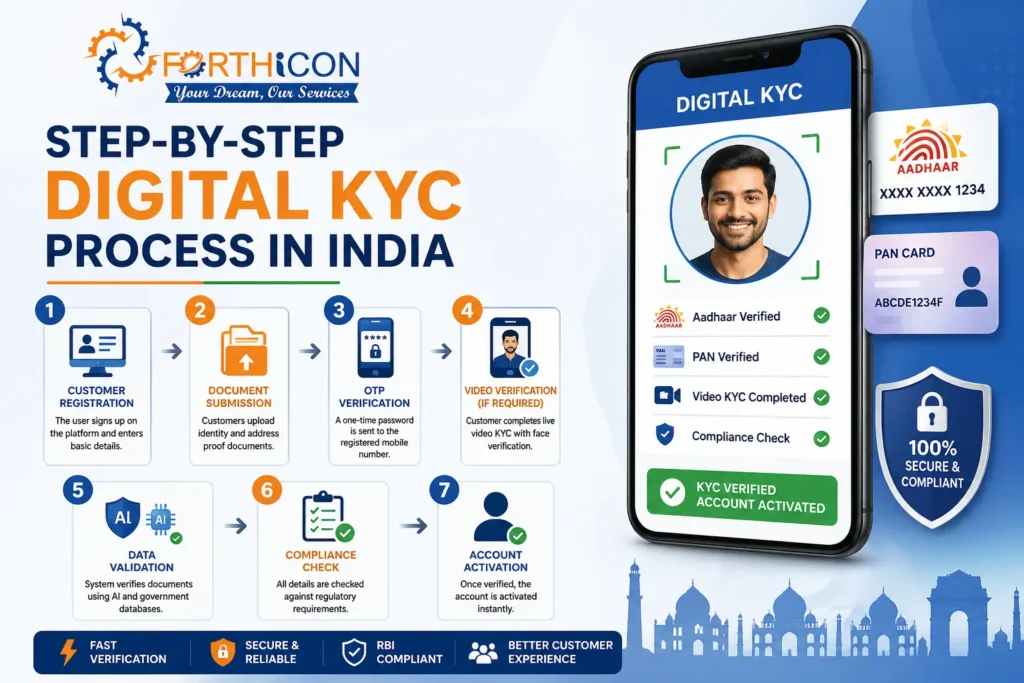
Here is a complete breakdown of the Digital KYC Process India:
Step 1: Customer Registration
The user signs up on the platform and enters basic details.
Step 2: Document Submission
Customers upload identity and address proof documents.
Step 3: OTP Verification
A one-time password is sent to the registered mobile number.
Step 4: Video Verification (if required)
Customer completes live video KYC with face verification.
Step 5: Data Validation
System verifies documents using AI and government databases.
Step 6: Compliance Check
All details are checked against regulatory requirements.
Step 7: Account Activation
Once verified, the account is activated instantly.
RBI Guidelines for Digital KYC in India
The Digital KYC Process India is governed by strict RBI regulations to ensure security and transparency.
Key guidelines include:
- Mandatory customer consent
- Secure data storage
- Geo-tagging during verification
- Live photo capture
- Audit trail maintenance
Non-compliance can lead to heavy penalties, making it crucial for businesses to follow all guidelines.
Benefits of Digital KYC for Businesses
1. Faster Processing
Reduces onboarding time to minutes.
2. Scalability
Businesses can onboard thousands of customers daily.
3. Reduced Costs
Eliminates physical verification expenses.
4. Better Customer Experience
Smooth and hassle-free onboarding.
5. Fraud Prevention
AI tools detect fake documents and identities.
Benefits for Customers
The Digital KYC Process India is equally beneficial for customers:
- No need to visit branches
- Quick account activation
- Secure data handling
- Paperless process
- 24/7 accessibility
Challenges in Digital KYC
Despite its advantages, the Digital KYC Process India has some challenges:
1.Data Privacy Concerns
Customers worry about misuse of personal data.
2.Internet Dependency
Requires stable internet connectivity.
3.Technical Issues
System errors may delay verification.
4.Fraud Attempts
Cybercriminals may try identity theft.
How to Ensure Secure Digital KYC
Businesses can strengthen the Digital KYC Process India by:
- Using encrypted platforms
- Implementing AI fraud detection
- Conducting regular audits
- Training staff
- Following RBI compliance strictly
Industries Using Digital KYC in India
The Digital KYC Process India is widely used across:
- Banks
- NBFCs
- FinTech companies
- Insurance firms
- Stock market platforms
- Payment wallets
Understanding RBI Regulations for Digital KYC
The Digital KYC Process India is regulated by the Reserve Bank of India to ensure a secure and transparent verification system. These regulations are designed to protect both businesses and customers by establishing clear rules for identity verification. By following RBI guidelines, companies can reduce fraud risks, maintain compliance, and build trust in digital onboarding processes.
Future of Digital KYC in India
The future of the Digital KYC Process India looks promising with:
- AI-based identity verification
- Blockchain for data security
- Biometric authentication
- Real-time global KYC systems
As technology evolves, digital KYC will become even faster, safer, and more efficient.
Why Choose Professional KYC Services?
Outsourcing the Digital KYC Process India to experts helps businesses:
- Save time and resources
- Ensure full compliance
- Improve accuracy
- Focus on core operations
Professional service providers offer end-to-end solutions including verification, compliance, and support.
Importance of Geo-Tagging and Live Verification
The Digital KYC Process India includes advanced measures like geo-tagging and live verification to enhance authenticity and prevent fraud. Geo-tagging ensures that the customer’s location is captured at the time of verification, confirming that the process is conducted within permitted regions. Along with this, live photo capture and real-time video verification help validate that the person submitting documents is physically present and matches the identity proof. These steps significantly reduce the chances of identity theft, fake profiles, or misuse of digital platforms. By combining location tracking with live verification, businesses can create a more secure and reliable onboarding process.
Role of Video KYC in Compliance
Video KYC has become a vital part of the Digital KYC Process India, especially under the guidelines of the Reserve Bank of India. It allows financial institutions to verify customers through a live video interaction, where the individual shows original documents and completes face verification. This method not only ensures compliance but also offers convenience by eliminating the need for physical visits. The entire session is recorded and stored securely for future audits, making the process transparent and traceable. Video KYC bridges the gap between physical and digital verification, providing a balance of efficiency and security for modern businesses.
Compliance Requirements and Security Measures
To successfully implement the Digital KYC Process India, businesses must adhere to strict compliance and security measures defined by RBI. This includes secure data storage using encryption, capturing live photographs during verification, and using geo-tagging to confirm the customer’s location. Additionally, institutions are required to maintain detailed audit trails of every KYC transaction, ensuring complete transparency and accountability. Video KYC (V-CIP) has also become a key component, allowing real-time identity verification through live interaction. Non-compliance with these regulations can result in heavy penalties, legal consequences, and loss of customer trust. Therefore, organizations must invest in secure technologies, regular audits, and proper staff training to ensure full compliance and maintain the integrity of their KYC processes.
The Digital KYC Process India is playing a crucial role in accelerating the country’s shift toward a digital-first economy. As more financial services move online, businesses need reliable and scalable verification systems to onboard customers quickly. Digital KYC not only reduces the time required for verification but also minimizes human errors that are common in manual processes. This allows organizations to improve efficiency while maintaining strict compliance with regulatory standards.
Conclusion
The Digital KYC Process India has transformed the way businesses verify customer identities, making the process faster, more secure, and highly efficient. In today’s digital era, where speed and convenience are critical, traditional KYC methods are no longer practical. Digital KYC offers a seamless, paperless solution that allows customers to complete verification anytime and from anywhere, improving overall user experience.
For businesses, implementing the Digital KYC Process India brings significant advantages such as reduced operational costs, faster onboarding, and improved scalability. It also ensures compliance with regulations set by the Reserve Bank of India, helping organizations avoid penalties and maintain trust. Advanced technologies like AI, OTP authentication, and video verification further enhance accuracy and reduce the risk of fraud.
From a customer perspective, digital KYC eliminates the need for physical visits and lengthy paperwork. This convenience not only saves time but also makes financial services more accessible, especially in remote and underserved areas. As a result, it plays a key role in promoting financial inclusion across India.
In conclusion, the Digital KYC Process India is more than just a compliance requirement—it is a vital tool for growth and innovation. Businesses that adopt digital KYC can improve efficiency, enhance security, and deliver better customer experiences. As digital adoption continues to rise, this process will remain a cornerstone of India’s financial ecosystem.
FAQs on Digital KYC Process India
What is the Digital KYC Process India?
The Digital KYC Process India is a modern, paperless method of verifying a customer’s identity using online technologies and government-approved systems. Instead of submitting physical documents or visiting a branch, customers can complete their KYC through digital platforms using Aadhaar authentication, PAN verification, OTP validation, and video-based identification. This process is designed to make customer onboarding faster, more convenient, and highly secure. It is widely used by banks, NBFCs, fintech companies, and other financial institutions to ensure compliance while delivering a seamless user experience.
Is Digital KYC mandatory in India?
Yes, KYC is mandatory for financial institutions operating in India, as per the regulations set by the Reserve Bank of India. While traditional KYC methods are still allowed, digital KYC has become the preferred approach due to its efficiency and scalability. RBI has provided clear guidelines for digital verification methods such as Video KYC (V-CIP) and Aadhaar-based eKYC. Businesses must comply with these regulations to avoid penalties and ensure legal operations. Digital KYC helps institutions meet compliance requirements while improving customer onboarding speed.
How long does the Digital KYC process take?
The Digital KYC Process India is designed to be fast and efficient, often completing within a few minutes. Basic methods like OTP-based Aadhaar verification can be completed almost instantly, while Video KYC may take slightly longer depending on the verification process. In most cases, customers can expect their KYC to be completed within minutes to a few hours. This is a significant improvement compared to traditional KYC, which could take several days. Faster processing helps businesses onboard more customers and improves overall operational efficiency.
Is Digital KYC safe and secure?
Yes, the Digital KYC Process India is highly secure when implemented according to regulatory standards. It uses advanced technologies such as data encryption, AI-based identity verification, and real-time validation to protect customer information. Security measures like live photo capture, face recognition, and geo-tagging help prevent fraud and impersonation. Additionally, strict guidelines from regulatory authorities ensure that customer data is handled responsibly and stored securely. As a result, digital KYC offers a high level of safety for both businesses and customers.
Can Digital KYC be done from home?
Absolutely, one of the biggest advantages of the Digital KYC Process India is that it can be completed entirely from home. Customers only need a smartphone or computer with an internet connection to complete the process. Through online platforms, they can upload documents, verify their identity using OTP, and even complete video KYC without visiting any physical location. This convenience not only saves time but also makes financial services more accessible, especially for people in remote or rural areas.