Table of Contents
Introduction
Full Stack Development Services are essential for businesses looking to build powerful, scalable, and end-to-end digital solutions. In today’s competitive digital landscape, companies need applications that are fast, secure, and user-friendly. Full stack development covers both frontend and backend technologies, ensuring seamless functionality across all layers of an application.
Whether you are a startup, SME, or enterprise, leveraging professional Full Stack Development Services can help you create high-performance web and mobile applications tailored to your business needs.
💡What are Full Stack Development Services?
Full Stack Development Services refer to the complete development of both the client-side (frontend) and server-side (backend) of an application. A full stack developer has expertise in multiple technologies and can handle everything from UI design to database management.
Key Components:
- Frontend Development: User interface and user experience (UI/UX)
- Backend Development: Server, APIs, and logic
- Database Management: Data storage and retrieval
- DevOps & Deployment: Hosting and maintenance
This holistic approach ensures that all parts of your application work together smoothly.
⚙️Technologies Used in Full Stack Development
Modern Full Stack Development Services use a wide range of technologies:
🔹 Frontend Technologies
- React.js
- Angular
- Vue.js
🔹 Backend Technologies
- Node.js
- Python
- .NET
🔹 Databases
- MySQL
- MongoDB
🔹 Cloud & DevOps
- AWS
- Microsoft Azure
- Google Cloud
Using the right tech stack ensures scalability, performance, and security.
🚀Benefits of Full Stack Development Services
1.End-to-End Development
Full Stack Development Services provide complete, end-to-end solutions that cover every stage of application development—from initial planning and UI/UX design to backend architecture, deployment, and ongoing maintenance. Instead of coordinating between multiple teams for frontend, backend, and database management, businesses can rely on a single unified team that understands the entire system. This ensures better communication, faster decision-making, and a more cohesive product. With a streamlined workflow, companies can reduce errors, maintain consistency across all layers, and launch fully functional applications that meet both technical and business requirements.
2.Faster Development
Speed is a major advantage of Full Stack Development Services. Since full stack developers are skilled in handling both frontend and backend technologies, they can work more efficiently without waiting for dependencies between different teams. This significantly reduces development time and accelerates project delivery. Agile methodologies further enhance this process by enabling continuous development, testing, and improvements. Faster development means businesses can launch their products quickly, respond to market changes, and stay ahead of competitors in a rapidly evolving digital landscape.
3.Cost-Effective
One of the biggest benefits of Full Stack Development Services is cost efficiency. Hiring separate specialists for frontend, backend, database, and DevOps can be expensive and resource-intensive. Full stack developers, on the other hand, can manage multiple aspects of development, reducing the need for a large team. This not only lowers hiring costs but also minimizes project management overhead. Additionally, faster development cycles mean reduced time-to-market, which ultimately leads to better return on investment (ROI) for businesses.
4.Scalability
Scalability is a crucial factor for any growing business, and Full Stack Development Services are designed to support it. Full stack developers build applications with future growth in mind, ensuring that systems can handle increasing users, data, and functionality without performance issues. By using modern frameworks, cloud infrastructure, and scalable databases, businesses can easily expand their applications as demand grows. This flexibility allows companies to start small and scale efficiently without needing a complete system overhaul.
5.Better Performance
Applications developed through Full Stack Development Services are optimized for performance because all components are designed to work together seamlessly. From frontend responsiveness to backend processing speed and database efficiency, every layer is carefully integrated. This results in faster load times, smoother user experiences, and improved overall functionality. Additionally, continuous monitoring and optimization ensure that applications perform consistently even under high traffic. Better performance not only enhances user satisfaction but also contributes to higher engagement and conversion rates.
🔄Full Stack Development Process
A well-defined and structured approach is essential for delivering high-quality digital solutions, and this is where Full Stack Development Services stand out. By following a systematic development process, businesses can ensure that their applications are efficient, scalable, and aligned with their goals. Each stage of the process plays a crucial role in building a robust and reliable product.
1.Requirement Analysis
The first step in Full Stack Development Services is understanding the client’s business objectives, target audience, and technical requirements. This phase involves detailed discussions, market research, and feasibility analysis to define the project scope clearly. Developers and stakeholders collaborate to identify key features, functionalities, and performance expectations. A well-executed requirement analysis helps avoid confusion later and ensures that the final product meets business needs effectively.
2.UI/UX Design
Once the requirements are clear, the next step in Full Stack Development Services is designing the user interface and user experience. Designers create wireframes, prototypes, and visual layouts that focus on usability and engagement. The goal is to ensure that the application is not only visually appealing but also easy to navigate. A strong UI/UX design improves user satisfaction and plays a significant role in the overall success of the application.
3.Development
The development phase is the core of Full Stack Development Services, where both frontend and backend components are built. Frontend developers focus on creating responsive and interactive user interfaces, while backend developers handle server logic, databases, and APIs. Modern frameworks and agile methodologies are used to ensure flexibility and continuous improvement. This phase often involves collaboration between teams to ensure seamless integration of all components.
4.Testing
Testing is a critical step in Full Stack Development Services to ensure that the application is free from bugs and performs efficiently. Various types of testing, including functional testing, performance testing, and security testing, are conducted to identify and fix issues. Continuous testing throughout the development cycle helps maintain high quality and reliability, ensuring that the final product delivers a smooth user experience.
5.Deployment
After successful testing, the application is deployed on secure servers as part of Full Stack Development Services. This involves configuring hosting environments, setting up databases, and ensuring that the application runs smoothly in a live environment. Proper deployment ensures minimal downtime and a seamless transition from development to production, allowing users to access the application without any issues.
6.Maintenance
The final step in Full Stack Development Services is ongoing maintenance and support. After deployment, applications require regular updates, performance monitoring, and security enhancements. Maintenance ensures that the application remains up-to-date with the latest technologies and continues to perform efficiently as user demands grow. This phase also includes fixing bugs, adding new features, and improving overall functionality to keep the application competitive in the market.
🧩Types of Applications Built
Full Stack Development Services are highly versatile and enable businesses to build a wide range of digital products tailored to different industries and use cases. From simple websites to complex enterprise systems, full stack development ensures that every application is scalable, secure, and performance-driven. Below are the major types of applications that can be developed using full stack expertise:
🌐Business Websites
Business websites are the foundation of any company’s online presence, and Full Stack Development Services play a crucial role in building responsive, fast, and visually appealing websites. These websites are designed to represent a brand, showcase services, and generate leads. Full stack developers ensure seamless integration between frontend design and backend functionality, enabling features like contact forms, content management systems, and analytics tracking. A well-developed business website not only enhances credibility but also improves customer engagement and conversions.
💻 Web Applications
Web applications are more dynamic and interactive than traditional websites, and Full Stack Development Services are ideal for building such platforms. These applications can include dashboards, booking systems, CRM tools, and custom business solutions. Full stack developers handle everything from user interface development to server-side logic and database management. This ensures that the application is scalable, secure, and capable of handling real-time data processing, making it suitable for businesses that require advanced functionality.
📱Mobile Applications
With the growing use of smartphones, mobile apps have become essential for businesses, and Full Stack Development Services support cross-platform app development. Using frameworks like React Native and Flutter, developers can create apps that work seamlessly on both Android and iOS platforms. Full stack development ensures smooth integration between mobile interfaces and backend systems, enabling features like user authentication, push notifications, and real-time updates. Mobile apps help businesses reach a wider audience and provide a more personalized user experience.
🛒 E-commerce Platforms
E-commerce platforms require robust architecture, and Full Stack Development Services are perfect for building secure and scalable online stores. These platforms include features such as product catalogs, shopping carts, payment gateways, order management, and user accounts. Full stack developers ensure that both frontend and backend components work seamlessly to deliver a smooth shopping experience. Additionally, performance optimization and security measures are implemented to handle high traffic and protect customer data.
☁️ SaaS (Software as a Service) Products
SaaS applications are cloud-based solutions that allow users to access software through the internet, and Full Stack Development Services are widely used to build such platforms. These products often include subscription models, multi-user access, and real-time data synchronization. Full stack developers design scalable architectures that can support thousands of users simultaneously while maintaining high performance and security. SaaS solutions are ideal for businesses looking to offer digital services globally without heavy infrastructure investments.
🏢 Enterprise Solutions
Large organizations require complex systems to manage operations, and Full Stack Development Services help build enterprise-grade applications. These solutions include ERP systems, HR management tools, financial software, and large-scale data platforms. Full stack developers ensure that these systems are highly secure, scalable, and capable of integrating with existing tools and technologies. Enterprise solutions are designed to streamline business processes, improve efficiency, and support long-term growth.
By leveraging Full Stack Development Services, businesses can build a wide variety of applications that are tailored to their specific needs. Whether it’s a simple website or a complex enterprise platform, full stack development provides the flexibility, performance, and scalability required to succeed in today’s digital world.
🏢 Why Businesses Need Full Stack Development
In today’s digital era, businesses must deliver seamless digital experiences. Full Stack Development Services help by:
- Reducing development time
- Improving user experience
- Ensuring faster time-to-market
- Enabling integration with third-party services
📈 Full Stack Development for Startups
Startups benefit greatly from Full Stack Development Services because:
- Faster MVP development
- Lower development cost
- Easy scalability
- Quick iteration and updates
🔐 Security in Full Stack Development
Security is a critical part of Full Stack Development Services:
- Data encryption
- Secure APIs
- Authentication & authorization
- Regular security testing
☁️ Role of Cloud in Full Stack Development
Cloud platforms enhance Full Stack Development Services by:
- Providing scalable infrastructure
- Ensuring high availability
- Reducing operational costs
- Enabling remote access
🔄 Full Stack vs Traditional Development
| Feature | Traditional Development | Full Stack Development |
|---|---|---|
| Teams | Multiple | Single/Unified |
| Speed | Slower | Faster |
| Cost | Higher | Lower |
| Flexibility | Limited | High |
💼 Choosing the Right Full Stack Development Partner
When selecting Full Stack Development Services, consider:
- Experience and expertise
- Technology stack
- Portfolio
- Client reviews
- Support and maintenance
🌍 Future of Full Stack Development
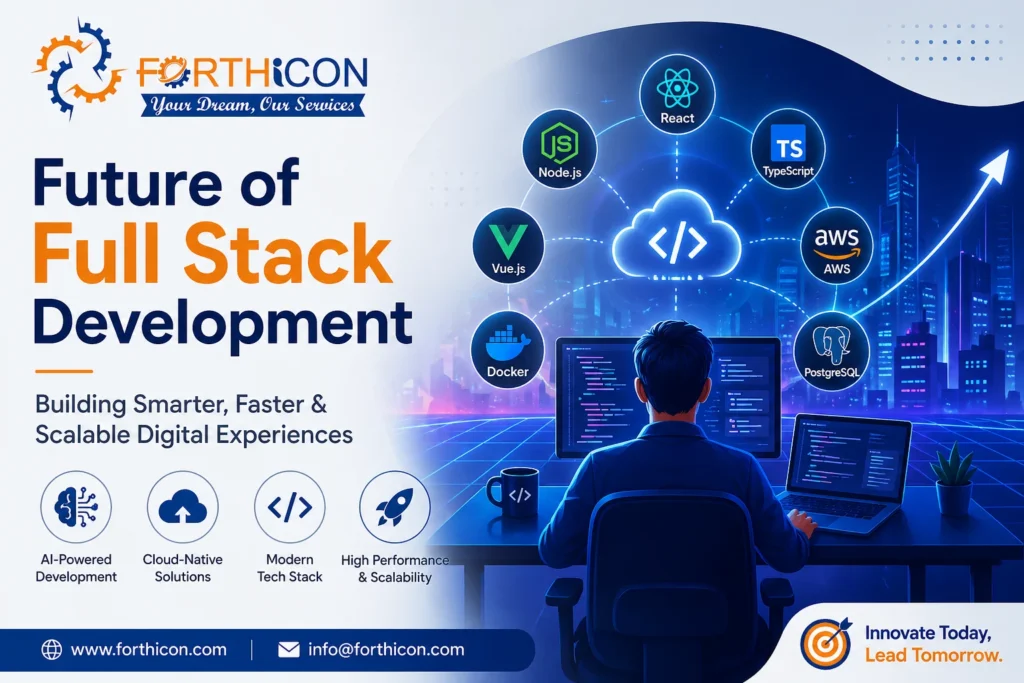
The future of Full Stack Development Services includes:
- AI-powered development
- Serverless architecture
- Progressive web apps
- Advanced automation
📣 Conclusion
Full Stack Development Services provide a complete solution for building modern, scalable, and high-performing applications. By combining frontend and backend expertise, businesses can create seamless digital experiences that meet user expectations and drive growth.
Investing in professional full stack development ensures faster delivery, reduced costs, and long-term scalability. Whether you are launching a startup or expanding your enterprise, full stack development is the key to success in today’s digital world.
FAQs
1. What are Full Stack Development Services?
They include frontend, backend, database, and deployment services for complete application development.
2. Why choose full stack development?
It offers faster development, cost efficiency, and complete solutions.
3. Which technologies are used?
React, Node.js, Python, .NET, MySQL, MongoDB, AWS, etc.
4. Is full stack development suitable for startups?
Yes, it is ideal for startups due to speed and cost-effectiveness.
5. How much time does development take?
It depends on project complexity, but full stack development reduces overall time.