
Table of Contents
Introduction
In today’s highly competitive business environment, having a strong sales team is no longer optional—it’s essential. Companies that invest in professional sales training consistently outperform their competitors by closing more deals, building better relationships, and maximizing revenue.
Sales is not just about pitching a product. It’s about understanding customer needs, building trust, and delivering value. Without the right training, even experienced sales professionals can struggle to achieve consistent results.
This is where professional sales training becomes a game-changer. By implementing the right techniques, businesses can transform average performers into top sales achievers.
In this blog, we will explore 7 powerful professional sales training techniques that deliver measurable results and help your team succeed in today’s dynamic market.
Why Professional Sales Training is Important
Before diving into techniques, let’s understand why professional sales training is crucial:
- Improves communication and persuasion skills
- Increases conversion rates and revenue
- Builds confidence among sales professionals
- Enhances customer relationship management
- Reduces sales cycle time
- Helps teams adapt to modern selling techniques
Companies that invest in professional sales training often see higher productivity and better long-term growth.
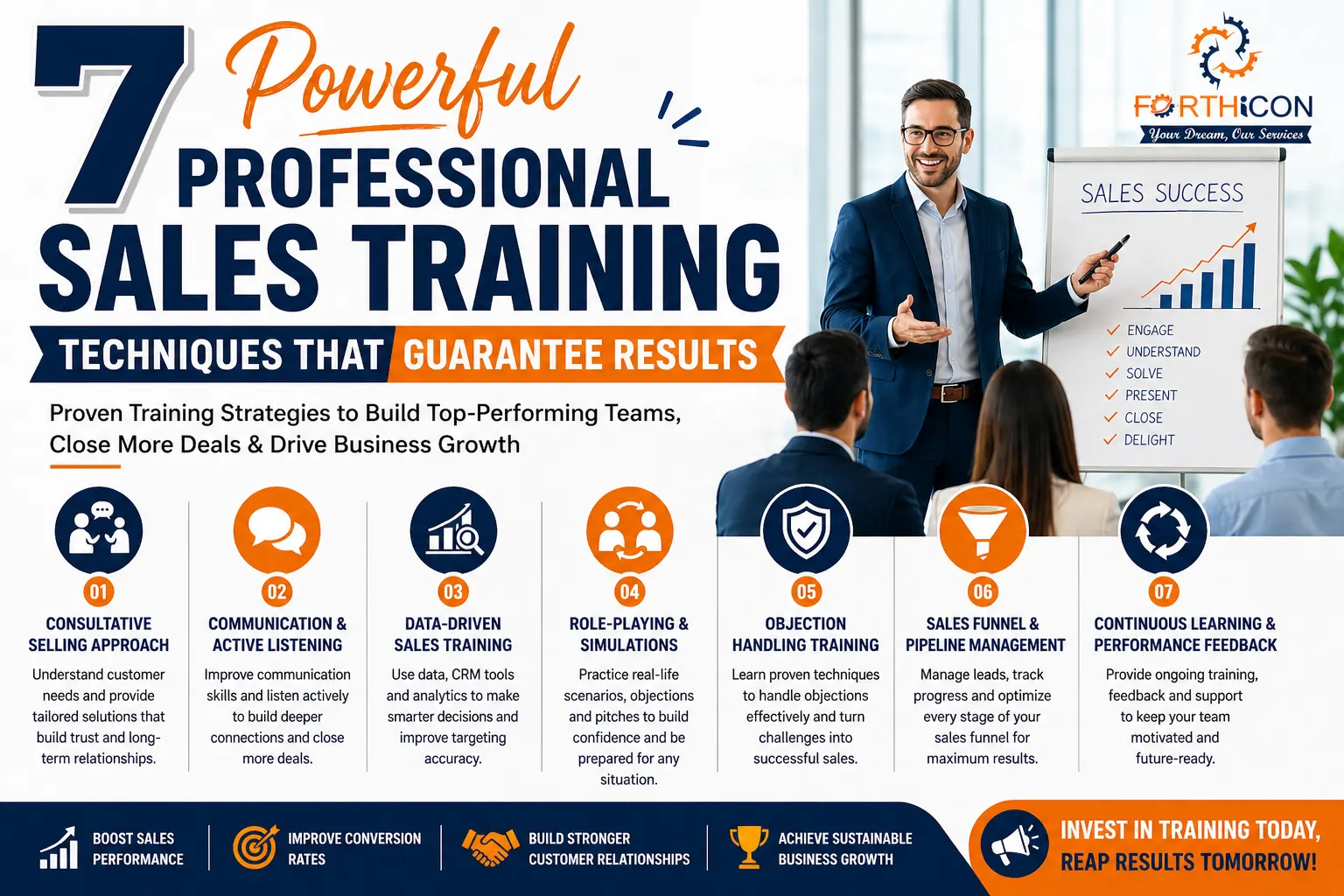
1.Consultative Selling Approach
One of the most effective professional sales training techniques is consultative selling.
What is it?
Instead of pushing products, sales professionals act as consultants who understand customer problems and provide tailored solutions.
Key Benefits:
- Builds trust and credibility
- Creates long-term customer relationships
- Increases customer satisfaction
How to Train:
- Teach active listening skills
- Encourage asking open-ended questions
- Focus on problem-solving instead of selling
This approach makes professional sales training more customer-centric and results-driven.
2.Communication & Active Listening Skills
Strong communication is the backbone of successful sales.
Why it matters:
Many deals fail because salespeople talk more than they listen.
Training Focus:
- Verbal and non-verbal communication
- Tone, clarity, and confidence
- Active listening techniques
Techniques:
- Repeat customer concerns for clarity
- Ask follow-up questions
- Avoid interrupting
By improving communication, professional sales training helps build deeper connections with customers.
3.Data-Driven Sales Training
Modern sales rely heavily on data and analytics.
What to include:
- CRM tools training
- Customer behavior analysis
- Performance tracking
Benefits:
- Better decision-making
- Accurate sales forecasting
- Improved targeting
With data integration, professional sales training becomes more strategic and measurable.
4.Role-Playing & Real-Life Simulations
Practical training is far more effective than theory.
Why it works:
Role-playing helps sales teams practice real-world scenarios in a safe environment.
Examples:
- Handling objections
- Closing deals
- Pitch presentations
Benefits:
- Builds confidence
- Improves problem-solving skills
- Prepares for real situations
Role-playing is a must-have in any professional sales training program.
5.Objection Handling Training
Every salesperson faces objections—but handling them correctly is the key to success.
Common objections:
- “It’s too expensive”
- “We need time to think”
- “We’re already working with someone else”
Training Strategy:
- Teach empathy and patience
- Provide proven response frameworks
- Practice objection scenarios
Result:
- Higher closing rates
- Reduced deal drop-offs
Effective objection handling is a core part of professional sales training.
6.Sales Funnel & Pipeline Management
Understanding the sales funnel is critical for consistent results.
Funnel Stages:
- Lead Generation
- Qualification
- Proposal
- Closing
- Follow-up
Training Focus:
- Managing leads effectively
- Tracking progress
- Identifying bottlenecks
Benefits:
- Improved conversion rates
- Better time management
- Increased efficiency
Professional sales training ensures that every stage of the funnel is optimized.
7.Continuous Learning & Performance Feedback
Sales training should never be a one-time event.
Why continuous learning matters:
Markets change, customer behavior evolves, and new tools emerge.
Best Practices:
- Regular training sessions
- Performance reviews
- One-on-one coaching
- Skill assessments
Benefits:
- Keeps teams updated
- Improves long-term performance
- Encourages growth mindset
Continuous improvement is the foundation of successful professional sales training.
Advanced Strategies in Professional Sales Training
Leveraging Emotional Intelligence in Sales
Emotional intelligence plays a crucial role in understanding customer behavior and building strong relationships. Sales professionals who can recognize emotions, respond appropriately, and create meaningful connections are more likely to close deals successfully. Professional sales training focuses on improving empathy, self-awareness, and communication to enhance customer interactions.
Using Storytelling to Influence Buying Decisions
Storytelling is a powerful sales technique that helps make your pitch more engaging and memorable. Instead of just presenting facts, sharing real-life examples and success stories builds trust and credibility. Professional sales training teaches how to craft compelling narratives that connect with customers and influence their decisions effectively.
How Businesses Benefit from Professional Sales Training
Investing in professional sales training delivers measurable business outcomes:
- 📈 Higher revenue growth
- 🎯 Better lead conversion rates
- 🤝 Stronger customer relationships
- ⏱️ Faster sales cycles
- 💡 Improved team productivity
Organizations that prioritize training create a competitive advantage in the market.
Implementing Sales Training in Your Business
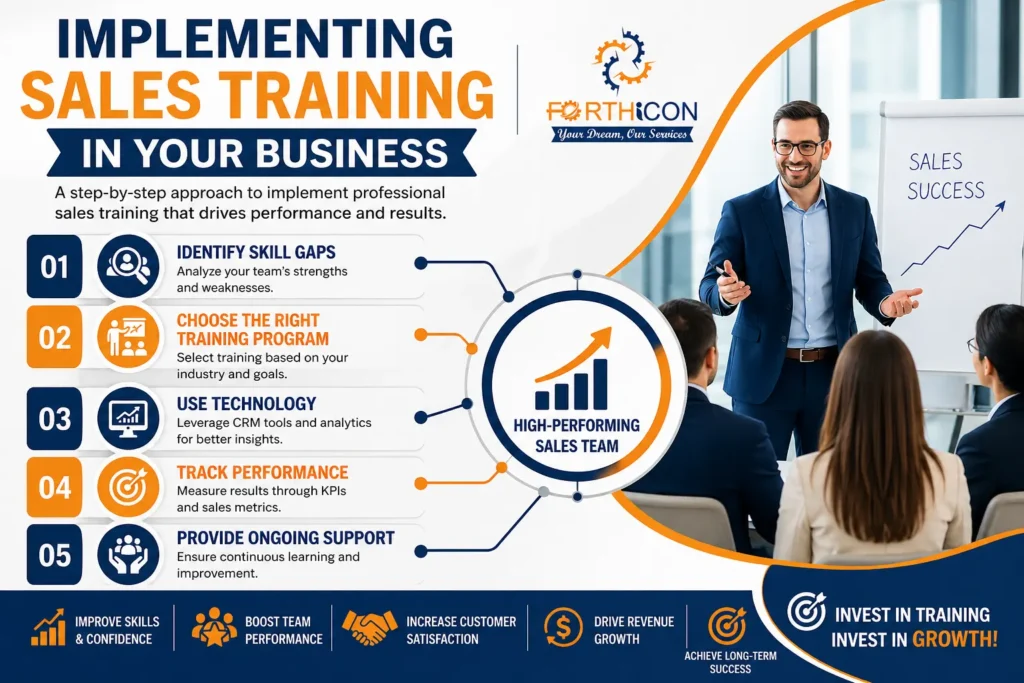
To successfully implement professional sales training, follow these steps:
1.Identify Skill Gaps
Analyze your team’s strengths and weaknesses.
2.Choose the Right Training Program
Select training based on your industry and goals.
3.Use Technology
Leverage CRM tools and analytics for better insights.
4. Track Performance
Measure results through KPIs and sales metrics.
5.Provide Ongoing Support
Ensure continuous learning and improvement.
Common Mistakes to Avoid
While implementing professional sales training, avoid these mistakes:
- One-time training without follow-up
- Ignoring individual learning needs
- Lack of practical training
- Not tracking performance metrics
- Overloading with theory
Avoiding these mistakes ensures better training outcomes.
Future Trends in Sales Training
The future of professional sales training is evolving rapidly:
- AI-powered sales tools
- Virtual training programs
- Personalized learning experiences
- Automation in lead management
- Data-driven decision making
Businesses that adapt to these trends will stay ahead in the competition.
Understanding Buyer Psychology in Sales
One of the most overlooked aspects of professional sales training is understanding how buyers think. Every purchasing decision is driven by emotions first and justified with logic later. Sales professionals who understand this psychology can position their product or service more effectively.
Customers often look for trust, value, and reassurance before making a decision. They want to feel confident that they are making the right choice. This is why emotional triggers like urgency, social proof, and perceived value play a major role in closing deals.
Professional sales training should focus on teaching teams how to identify customer pain points, motivations, and decision-making patterns. When salespeople align their pitch with customer psychology, they create stronger connections and significantly improve conversion rates.
The Role of Follow-Ups in Closing Sales
Many sales opportunities are lost simply because there is no proper follow-up. Studies show that most deals require multiple touchpoints before a customer makes a decision, yet many sales professionals give up after one or two attempts.
Professional sales training emphasizes the importance of structured follow-up strategies. This includes timely emails, phone calls, and personalized messages that keep the conversation alive without being pushy.
A good follow-up builds trust and shows commitment. It also keeps your brand top-of-mind when the customer is ready to make a decision. Sales teams that master follow-ups often outperform competitors by a significant margin.
Building Long-Term Customer Relationships
Sales is no longer just about closing deals—it’s about building relationships. In today’s competitive market, retaining customers is just as important as acquiring new ones.
Professional sales training teaches how to nurture long-term relationships by focusing on customer satisfaction, consistent communication, and post-sale support. Happy customers are more likely to return and refer others, creating a strong network of loyal clients.
Relationship-based selling also reduces dependency on constant lead generation, making the business more sustainable and profitable over time.
Time Management for Sales Professionals
Time is one of the most valuable resources in sales. Without proper time management, even the most skilled sales professionals can struggle to achieve their targets.
Professional sales training includes techniques to prioritize tasks, manage leads efficiently, and focus on high-value opportunities. This ensures that time is spent on activities that generate the highest returns.
Effective time management leads to increased productivity, reduced stress, and better overall performance. It allows sales teams to handle more opportunities without compromising quality.
Importance of Confidence in Sales
Confidence is a key factor that influences customer decisions. A confident salesperson creates a positive impression and builds trust instantly.
Professional sales training focuses on boosting confidence through practice, knowledge, and real-life simulations. When sales professionals believe in their product and their ability to deliver value, they naturally become more persuasive.
Confidence also helps in handling objections, negotiating deals, and closing sales effectively. It is one of the most important traits of successful salespeople.
Conclusion
In conclusion, professional sales training is essential for any business looking to grow and succeed in today’s competitive market. By implementing the right techniques—such as consultative selling, communication skills, data-driven strategies, and continuous learning—you can significantly improve your sales performance.
The 7 techniques discussed in this blog are proven to deliver real results when applied consistently. Whether you are a startup or an established company, investing in professional sales training will help you build a high-performing sales team that drives revenue and long-term success.
Frequently Asked Questions (FAQs)
1.What is professional sales training and how does it work?
Professional sales training is a structured learning program designed to enhance the skills, mindset, and performance of sales professionals. It focuses on key areas such as communication, lead generation, objection handling, negotiation, and closing techniques. The training usually includes a mix of theoretical knowledge, real-life case studies, role-playing exercises, and practical simulations to help individuals apply what they learn in real sales situations.
This type of training works by identifying gaps in a salesperson’s approach and providing proven strategies to improve performance. It also introduces modern tools and technologies that help streamline the sales process. Over time, consistent training helps sales teams become more confident, efficient, and results-driven, ultimately leading to higher conversions and better customer relationships.
2.How can professional sales training improve business growth?
Professional sales training plays a direct role in business growth by improving the efficiency and effectiveness of your sales team. When sales professionals are well-trained, they are better at understanding customer needs, presenting solutions clearly, and closing deals faster. This leads to increased revenue and a shorter sales cycle.
Additionally, trained sales teams are more skilled at building long-term relationships with clients, which improves customer retention and repeat business. They can also identify upselling and cross-selling opportunities more effectively. Over time, this creates a steady flow of revenue and strengthens the overall market position of the business.
3.What are the key skills covered in professional sales training?
Professional sales training covers a wide range of essential skills required for success in modern selling environments. These include communication skills, active listening, negotiation techniques, objection handling, and relationship building. It also focuses on understanding customer psychology and buying behavior, which is critical for influencing decisions.
In addition to these core skills, training programs often include time management, goal setting, and the use of digital sales tools such as CRM systems. Advanced programs may also cover storytelling, emotional intelligence, and data-driven decision-making. By developing these skills, sales professionals can handle complex sales situations with confidence and deliver better results consistently.
4.How long does it take to see results from professional sales training?
The timeline for seeing results from professional sales training can vary depending on the individual, the quality of the training program, and how consistently the learned techniques are applied. In many cases, businesses start noticing improvements in communication and customer engagement within a few weeks.
However, measurable outcomes such as increased conversions, higher revenue, and improved sales performance typically become visible within 1 to 3 months. Long-term success depends on continuous practice, regular feedback, and ongoing training. Organizations that invest in consistent skill development often achieve sustainable growth and long-lasting results.
5.Is professional sales training suitable for beginners and experienced professionals?
Yes, professional sales training is beneficial for both beginners and experienced professionals. For beginners, it provides a strong foundation by teaching basic sales principles, communication techniques, and confidence-building strategies. It helps them avoid common mistakes and develop a structured approach to selling from the start.
For experienced professionals, sales training offers advanced strategies, updated market insights, and new tools to enhance performance. It helps them refine their existing skills, adapt to changing customer behavior, and stay competitive in the market. Continuous learning ensures that even seasoned salespeople remain effective and capable of delivering high-quality results in a dynamic business environment.