Table of Contents
Introduction
In today’s fast-growing digital world, businesses need reliable, secure, and high-performing technology systems to stay competitive. IT Operations Management Services play a crucial role in helping organizations manage their IT infrastructure, monitor system performance, reduce downtime, improve productivity, and maintain smooth business operations. From server management and network monitoring to cloud infrastructure support and application performance optimization, professional IT Operations Management Services help businesses build a strong and dependable technology environment.
For businesses looking for IT Operations Management Services in Pune, choosing the right technology solutions can make a significant difference in operational efficiency and long-term growth. As Pune continues to develop as a major IT, manufacturing, education, and business hub, organizations increasingly depend on digital platforms, business applications, cloud computing, and connected networks. Without proper IT operations management, businesses may face unexpected system failures, network interruptions, security vulnerabilities, slow applications, and costly operational delays.
Forthicon helps businesses explore reliable IT solutions, including IT management, custom software development, web applications, cloud infrastructure support, and business technology solutions. With the right IT Operations Management Services, organizations can improve infrastructure visibility, streamline technical processes, maintain system availability, and support employees with more dependable technology. Proactive IT monitoring and maintenance can also help identify potential issues before they significantly affect daily operations.
Modern IT Operations Management Services in Pune go beyond traditional technical support. They involve infrastructure monitoring, incident management, IT asset management, software updates, backup planning, performance analysis, and continuous improvement. These activities help businesses maintain better control over their IT environments while preparing for changing operational requirements. Whether you operate a startup, small business, growing enterprise, or established organization, a structured IT operations strategy can help align technology with business objectives.
By investing in professional IT Operations Management Services, businesses can strengthen IT reliability, improve resource utilization, support digital transformation, and plan for future expansion. Forthicon focuses on technology-oriented solutions that help organizations evaluate their IT requirements and identify practical opportunities for improvement. If your business needs dependable IT Operations Management Services, scalable IT infrastructure, application support, or business technology solutions in Pune, the right approach can help create a more efficient, secure, and productive digital workplace.
What Are IT Operations Management Services?
IT operations management involves overseeing the technology systems, infrastructure, applications, and processes that support an organization’s daily operations. It includes monitoring IT assets, managing networks, maintaining servers, supporting users, resolving incidents, and ensuring that business-critical systems remain available.
IT Operations Management Services bring these activities together through structured processes and technology practices. Instead of responding only when a problem occurs, businesses can adopt proactive monitoring, regular maintenance, documented procedures, and performance reviews to identify potential issues earlier.
Typical IT operations activities include:
- Server and infrastructure monitoring
- Network performance management
- Application monitoring and troubleshooting
- Cloud infrastructure administration
- IT help desk and technical support
- Backup planning and recovery coordination
- Security patch and software update management
- Incident tracking and resolution
- IT asset and configuration management
- Capacity planning and performance reporting
The exact scope depends on the organization’s size, industry, internal IT team, infrastructure, and operational priorities.
Why Businesses Need Advanced IT Operations Management Services in Pune
As businesses increasingly depend on digital technology, maintaining reliable IT systems has become a priority for long-term success. IT Operations Management Services help organizations monitor their technology infrastructure, improve application performance, manage technical incidents, and maintain smooth daily operations. With professional IT management practices, businesses can reduce avoidable disruptions, improve resource utilization, and create a more dependable working environment.
Companies looking for IT Operations Management Services in Pune need solutions that can adapt to changing business requirements. Whether an organization uses cloud-based applications, internal business software, office networks, or customer-facing websites, every system requires appropriate monitoring and maintenance. Effective IT Operations Management Services help businesses identify performance issues, maintain updated systems, coordinate backups, and establish clear procedures for resolving technical problems.
Another important advantage of IT Operations Management Services is improved operational visibility. Businesses can use monitoring reports, incident records, and performance indicators to understand how their technology systems are functioning.
Forthicon provides technology-focused solutions that include IT management capabilities, custom software development, web applications, and cloud-related support. Businesses can evaluate these capabilities when planning their IT Operations Management Services strategy and identifying opportunities to improve their digital infrastructure. A well-planned approach can support scalability, improve system reliability, and help organizations respond more effectively to evolving technology needs.
For startups and established companies alike, IT Operations Management Services in Pune can contribute to better planning and more consistent technology performance. Regular maintenance, controlled software updates, infrastructure monitoring, and incident management help businesses maintain greater control over their IT environment. Organizations should also review access permissions, verify backup recovery procedures, and document important system configurations.
If your organization wants to improve its technology operations, consider partnering with a provider that understands your business requirements and can help you evaluate practical solutions. Forthicon can help you explore suitable IT Operations Management Services alongside software, application, and infrastructure-related solutions.
Why IT Operations Management Matters in 2026
Modern businesses rely on digital systems for communication, customer service, financial processes, sales, inventory, and reporting. Even a short technology interruption can delay employees, disrupt customer interactions, or affect business productivity.
1. Reduce Unplanned Downtime
System downtime can affect productivity, customer satisfaction, and revenue. Regular monitoring helps teams identify warning signs such as storage shortages, unusual network traffic, overloaded servers, or application errors.
A well-defined response process helps technical teams investigate incidents, prioritize business-critical systems, and restore services efficiently.
2. Improve Employee Productivity
Employees need dependable devices, applications, networks, and collaboration tools to complete their work. When these systems perform consistently, employees can spend less time dealing with technical problems.
Effective IT Operations Management Services can establish support workflows, issue tracking, maintenance schedules, and escalation procedures that help employees receive timely assistance.
3. Strengthen Technology Reliability
Reliable technology requires more than purchasing new equipment. It also involves configuration management, software updates, documentation, system testing, and ongoing performance reviews.
A structured approach helps businesses understand their infrastructure and maintain greater consistency across devices, applications, and environments.
4. Support Business Growth
As companies expand, their technology requirements change. More employees, larger databases, new applications, and additional locations can increase pressure on existing infrastructure.
Scalable IT operations help organizations plan for these changes instead of making emergency upgrades whenever systems reach their limits.
5. Improve Visibility and Control
Businesses need clear information about system health, recurring incidents, infrastructure capacity, and support performance. Monitoring dashboards and operational reports can help managers make informed decisions about technology investments.
Key Features of Professional IT Operations Management
Infrastructure Monitoring
Infrastructure monitoring tracks the performance and availability of servers, storage systems, networks, and other technology components. Alerts can notify responsible teams when performance crosses predefined thresholds.
Monitoring should focus on meaningful indicators, including system availability, processor usage, memory utilization, storage capacity, and network latency.
Network Management
Business networks connect employees, applications, offices, cloud services, and customers. Network management includes performance checks, configuration reviews, connectivity troubleshooting, and capacity planning.
A dependable network management process helps organizations maintain communication and identify recurring connectivity problems.
Server Administration
Servers support applications, databases, websites, internal platforms, and business files. Server administration includes monitoring resource usage, applying approved updates, reviewing logs, managing configurations, and coordinating backups.
Proper documentation is important because it helps technical teams understand system dependencies and troubleshoot issues more efficiently.
Application Performance Management
Slow or unreliable applications can disrupt everyday work. Application monitoring helps teams identify response-time problems, errors, resource bottlenecks, and integration failures.
Professional IT Operations Management Services can support a consistent process for tracking application performance, investigating recurring issues, and coordinating improvements with developers or software vendors.
Incident and Problem Management
Incident management focuses on restoring normal service after an interruption. Problem management investigates the underlying causes of recurring incidents.
For example, restarting a server might temporarily resolve an application issue, but investigating the root cause may reveal a memory leak, configuration error, or capacity problem. Addressing the underlying issue can reduce repeated interruptions.
Backup and Recovery Coordination
Data loss can occur because of accidental deletion, hardware failure, software problems, or security incidents. Businesses should define backup schedules, access controls, retention policies, and recovery procedures according to their operational requirements.
Backups should be tested periodically. A backup that cannot be restored when needed may not provide the protection a business expects.
IT Asset Management
IT asset management helps organizations maintain records of computers, servers, software licenses, network devices, and other technology resources. Accurate records support budgeting, maintenance planning, security reviews, and lifecycle management.
Patch and Update Management
Operating systems, applications, and infrastructure components require regular updates. A controlled patch management process identifies relevant updates, evaluates risks, schedules deployment, and verifies successful installation.
Critical security updates should be prioritized according to risk and business impact.
Benefits for Businesses in Pune
Pune has a diverse business environment that includes IT companies, manufacturing organizations, educational institutions, professional service providers, retailers, and emerging startups. These organizations depend on technology to coordinate work, serve customers, and manage information.
Reliable IT Operations Management Services in Pune can help businesses maintain operational consistency while adapting to new digital requirements.
Better Operational Efficiency
Clear responsibilities, monitoring procedures, and support workflows can reduce unnecessary delays. Employees know how to report technical issues, and support teams can prioritize requests based on business impact.
Improved Customer Experience
Websites, customer portals, communication tools, and business applications often support customer-facing activities. Maintaining these systems helps organizations provide more consistent service.
More Predictable IT Spending
Preventive maintenance and capacity planning can help businesses identify upcoming requirements before they become urgent. Although some incidents are unavoidable, structured planning may reduce avoidable emergency work.
Support for Hybrid and Remote Teams
Many organizations use a combination of office-based, remote, and hybrid work arrangements. IT operations can help maintain secure access, collaboration tools, endpoint updates, and consistent support for distributed employees.
Stronger Business Continuity
Business continuity planning helps organizations prepare for technology failures and other disruptions. Documented procedures, recovery priorities, tested backups, and clear responsibilities make it easier to respond when an unexpected event occurs.
How Forthicon Supports IT Operations
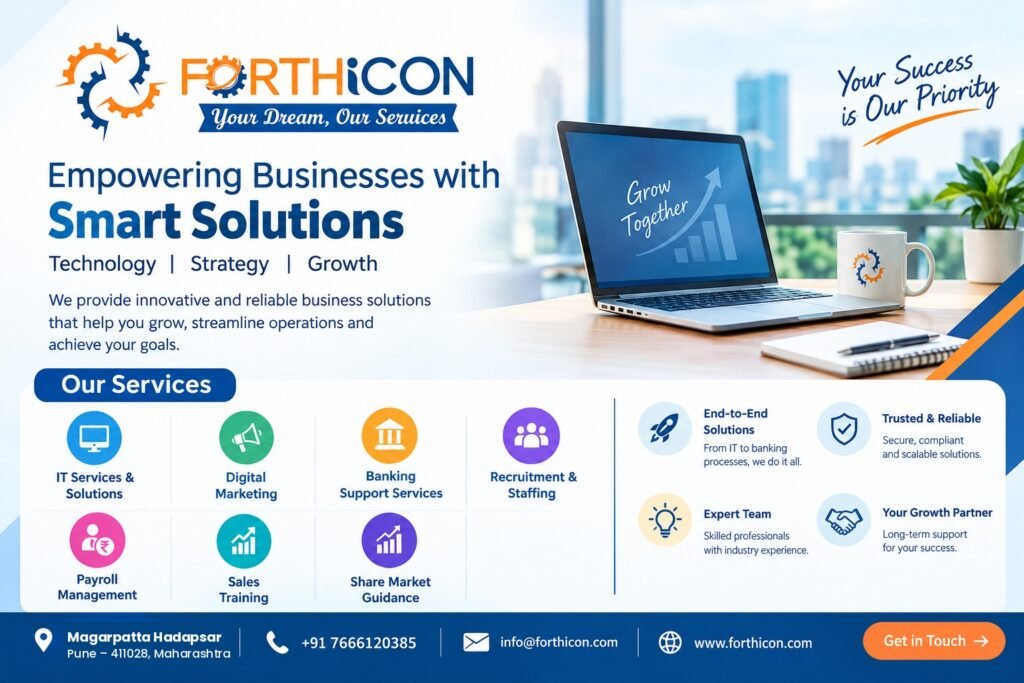
Forthicon provides business-oriented technology solutions, including custom software development, web applications, cloud infrastructure support, IT management, and digital services. These capabilities can help organizations evaluate their technology requirements and plan suitable operational improvements.
Technology Assessment and Planning
A useful starting point is to understand the existing IT environment. This may include reviewing hardware, software, applications, network dependencies, support procedures, and recurring technical problems.
The assessment can help establish priorities, identify outdated components, and develop a practical improvement roadmap.
Cloud and Infrastructure Support
Cloud environments can provide flexibility and scalability, but they still require appropriate configuration, monitoring, access management, cost control, and maintenance.
Forthicon’s technology capabilities can help businesses explore cloud-related requirements and identify suitable approaches for their applications and infrastructure.
Software and Application Support
Business applications often connect several departments and processes. Custom software development and application support can help organizations address specific operational needs, improve workflows, and plan future enhancements.
Process Improvement
Documented workflows make IT operations easier to manage. Examples include incident reporting, change approvals, software updates, backup verification, and service escalation.
Forthicon can help businesses consider technology and process improvements that align with their operational goals.
Scalable Technology Solutions
A small business may begin with a limited set of applications and devices, then gradually add new systems as it grows. Planning for scalability can help avoid unnecessary complexity and make future expansion easier.
How to Choose the Right IT Operations Partner
Selecting an IT operations partner requires more than comparing prices. Businesses should understand the scope of support, service expectations, technical capabilities, and responsibilities involved.
1. Define Your Business Requirements
Identify the systems that are essential to daily operations. These might include business applications, customer databases, websites, communication platforms, or cloud-hosted services.
Document recurring issues and determine which improvements would have the greatest business impact.
2. Review Technical Capabilities
Ask about the provider’s experience with the technologies used by your organization. Relevant areas may include networking, servers, cloud platforms, application monitoring, endpoint management, backups, and incident response.
3. Clarify Support Scope
Understand which services are included, what falls outside the agreed scope, how requests are submitted, and how incidents are escalated.
4. Discuss Security Responsibilities
Clarify how access is managed, how updates are handled, how logs are reviewed, and how security incidents are communicated. Security responsibilities should be documented rather than assumed.
5. Establish Performance Measures
Useful measures may include service availability, incident response time, resolution time, recurring incident frequency, backup success rate, and patch compliance. Targets should be agreed upon according to business requirements.
6. Check Documentation Practices
Good documentation records infrastructure configurations, system dependencies, procedures, and recovery steps. It also makes transitions between internal teams and external providers more manageable.
7. Plan for Future Growth
Choose a support model that can adapt as your organization adds users, applications, offices, and cloud resources.
Best Practices for Effective IT Operations
Businesses can improve IT operations by establishing consistent processes and reviewing them regularly.
- Monitor critical systems: Track availability and performance using relevant indicators.
- Prioritize incidents by impact: Address issues affecting essential business functions first.
- Maintain accurate documentation: Keep infrastructure records and operating procedures updated.
- Automate repetitive tasks carefully: Use automation for suitable routine checks, reporting, and approved maintenance.
- Test backups and recovery: Verify that important data and services can be restored.
- Review access permissions: Give users only the access required for their roles.
- Manage changes systematically: Test and document significant system changes.
- Track recurring incidents: Investigate root causes rather than repeatedly applying temporary fixes.
- Plan capacity in advance: Review resource usage and expected business growth.
- Review performance regularly: Use reports to identify trends and improvement opportunities.
These practices should be adapted to the organization’s size, infrastructure, compliance obligations, and available resources.
The Role of Automation in IT Operations
Automation can make IT operations more consistent by reducing repetitive manual tasks. Depending on the environment, automation may support log collection, scheduled checks, alert notifications, software deployment, routine reporting, and selected recovery procedures.
However, automation should be introduced with suitable safeguards. Businesses should test workflows, control permissions, maintain audit records, and define procedures for failures or unexpected results.
Automating a poorly designed process may simply make mistakes happen faster. Organizations should first understand the process, establish appropriate controls, and then identify tasks that are suitable for automation.
Common IT Operations Challenges
Organizations may face several recurring challenges as their technology environments grow.
Limited visibility: Systems spread across different platforms can make it difficult to understand overall performance. Consolidated monitoring and clear asset records can improve visibility.
Legacy infrastructure: Older systems may have limited support or compatibility. A planned modernization roadmap can help reduce operational risk.
Repeated incidents: Temporary fixes can hide underlying problems. Root-cause analysis helps teams identify and address recurring failures.
Uncontrolled changes: Unplanned changes may introduce outages or configuration errors. Change approval, testing, and documentation can reduce these risks.
Insufficient recovery planning: Backups alone are not enough without clear restoration procedures and periodic testing.
Unclear responsibilities: When ownership is uncertain, incidents can take longer to resolve. Defined roles and escalation paths help teams work more effectively.
A structured improvement plan can address these challenges in manageable stages rather than requiring every system to be changed at once.
Industries That Can Benefit from IT Operations Management
Different industries have different technology requirements. A suitable operational strategy should reflect the organization’s systems, workflows, security needs, and service expectations.
IT and Software Companies
Technology companies depend on development environments, cloud platforms, code repositories, databases, and collaboration tools. IT Operations Management Services can help these organizations monitor infrastructure, maintain service availability, and coordinate incident response.
Manufacturing Businesses
Manufacturers may use enterprise resource planning software, inventory systems, production applications, and connected devices. IT Operations Management Services can support system monitoring, network reliability, and maintenance planning for technology used in business operations.
Retail and E-Commerce
Retailers rely on websites, billing systems, inventory applications, and payment-related integrations. IT Operations Management Services can help maintain application performance and coordinate responses to outages that affect customer transactions.
Professional Service Providers
Consultancies, agencies, and other professional service firms use cloud storage, communication platforms, customer databases, and productivity software. IT Operations Management Services can help maintain dependable access and consistent support processes.
Educational Institutions
Educational organizations may depend on learning platforms, student management applications, communication systems, and administrative software. IT Operations Management Services can help support availability, updates, access management, and routine technical maintenance.
Measuring IT Operations Performance
Businesses should evaluate technology operations using practical measurements rather than relying on assumptions. Useful performance indicators can include:
- System availability: The percentage of time a service remains operational.
- Mean time to acknowledge: How long it takes a team to recognize an incident.
- Mean time to resolve: The average time needed to restore service.
- Incident recurrence: How frequently similar issues happen again.
- Patch compliance: The percentage of relevant systems updated according to the agreed policy.
- Backup verification: Whether scheduled backups complete and restoration tests succeed.
- User satisfaction: Feedback about technical support and service reliability.
IT Operations Management Services should use metrics that match business priorities. A small organization may focus on availability and response time, while a larger company may also need detailed capacity, security, and service-level reporting.
Regular reviews help leaders identify trends, adjust priorities, and decide where additional investment could improve reliability.
A Practical Implementation Roadmap
Businesses do not need to transform their entire IT environment in one step. A phased approach makes improvements easier to plan and evaluate.
Phase 1: Assess the current environment. Document critical systems, recurring incidents, infrastructure dependencies, existing controls, and business priorities.
Phase 2: Address urgent risks. Prioritize unsupported software, inadequate backup arrangements, serious performance problems, and weaknesses in administrative access.
Phase 3: Establish monitoring. Select meaningful performance indicators and configure alerts for critical services. Ensure alerts reach the appropriate people.
Phase 4: Standardize support processes. Document incident reporting, escalation, change approval, patching, and recovery procedures.
Phase 5: Improve through reviews. Analyze incident trends, verify recovery readiness, assess capacity, and update the improvement roadmap as requirements change.
Forthicon can help businesses explore technology solutions that support their IT management objectives, alongside its software development, web application, and cloud-related capabilities.
Why Consider Forthicon for IT Solutions in Pune?
Choosing a technology partner should begin with a clear understanding of your organization’s requirements. Businesses should look for relevant technical expertise, transparent service scope, clear communication, appropriate documentation, and a practical approach to future growth.
Forthicon offers technology-oriented business solutions designed to help organizations address changing digital needs. Companies evaluating IT Operations Management Services can discuss their infrastructure, application requirements, operational challenges, and plans for improvement to determine the most appropriate support model.
Frequently Asked Questions
1. What are IT Operations Management Services?
IT Operations Management Services involve monitoring, maintaining, and managing the infrastructure, applications, networks, and processes that support daily business operations. The goal is to improve reliability, performance, and operational consistency.
2. Why are IT operations important for businesses?
IT operations help businesses maintain access to essential systems, resolve technical incidents, manage updates, plan infrastructure capacity, and reduce avoidable disruption.
3. Can small businesses benefit from IT operations management?
Yes. Small businesses can benefit from structured monitoring, regular maintenance, asset management, backup verification, and clear support procedures. The scope can be tailored to the size and complexity of the business.
4. How do IT operations help reduce downtime?
Monitoring, preventive maintenance, incident response procedures, and root-cause analysis help teams detect issues, restore affected services, and reduce recurring problems.
5. Do IT operations include cloud management?
They can. Depending on the agreed scope, operations may include cloud resource monitoring, configuration management, performance reviews, access controls, cost monitoring, and recovery planning.
6. How can I choose an IT operations provider in Pune?
Review technical expertise, support scope, security practices, communication, documentation, reporting, and agreed response expectations. Choose a provider whose capabilities match your actual business requirements.
7. Are IT operations and cybersecurity the same?
No. They are closely related but distinct. IT operations focus on maintaining and managing technology services, while cybersecurity focuses on protecting systems, networks, and data. Operational practices often support security objectives.
Conclusion
In today’s competitive digital environment, IT Operations Management Services are essential for businesses that want to improve IT performance, minimize downtime, strengthen system reliability, and achieve sustainable growth. From infrastructure monitoring and network management to cloud support, application maintenance, incident management, and IT security practices, professional IT Operations Management Services help organizations maintain efficient and dependable technology systems.
For organizations searching for reliable IT Operations Management Services in Pune, Forthicon offers technology-focused solutions to support changing business requirements. With capabilities in IT management, custom software development, web applications, cloud infrastructure support, and business technology solutions, Forthicon helps businesses explore practical ways to improve their IT environments. Choosing the right IT Operations Management Services in Pune can help organizations manage technology more effectively, improve operational visibility, and align IT investments with their business goals.
Whether you operate a startup, small business, manufacturing company, IT organization, or growing enterprise, dependable IT Operations Management Services can help you manage daily technical challenges while focusing on your core business activities.
Forthicon understands the importance of reliable business technology and scalable IT solutions. By evaluating your infrastructure, application requirements, operational challenges, and long-term objectives, your organization can identify suitable improvements and establish a practical IT management strategy. If you are looking for IT Operations Management Services in Pune, consider a structured approach that prioritizes reliability, security, performance, and scalability.
Choose Forthicon to discuss your business technology requirements and explore suitable IT Operations Management Services for your organization.
Contact Forthicon today to explore IT management, cloud-related support, custom software development, and scalable business technology solutions in Pune.
For more updates do follow us on Instagram https://www.instagram.com/forthicon_pvtltd?igsh=MTRseDI1OTZyaGVlMg==