
Table of Contents
Introducion
Business Automation Services for Modern Enterprises
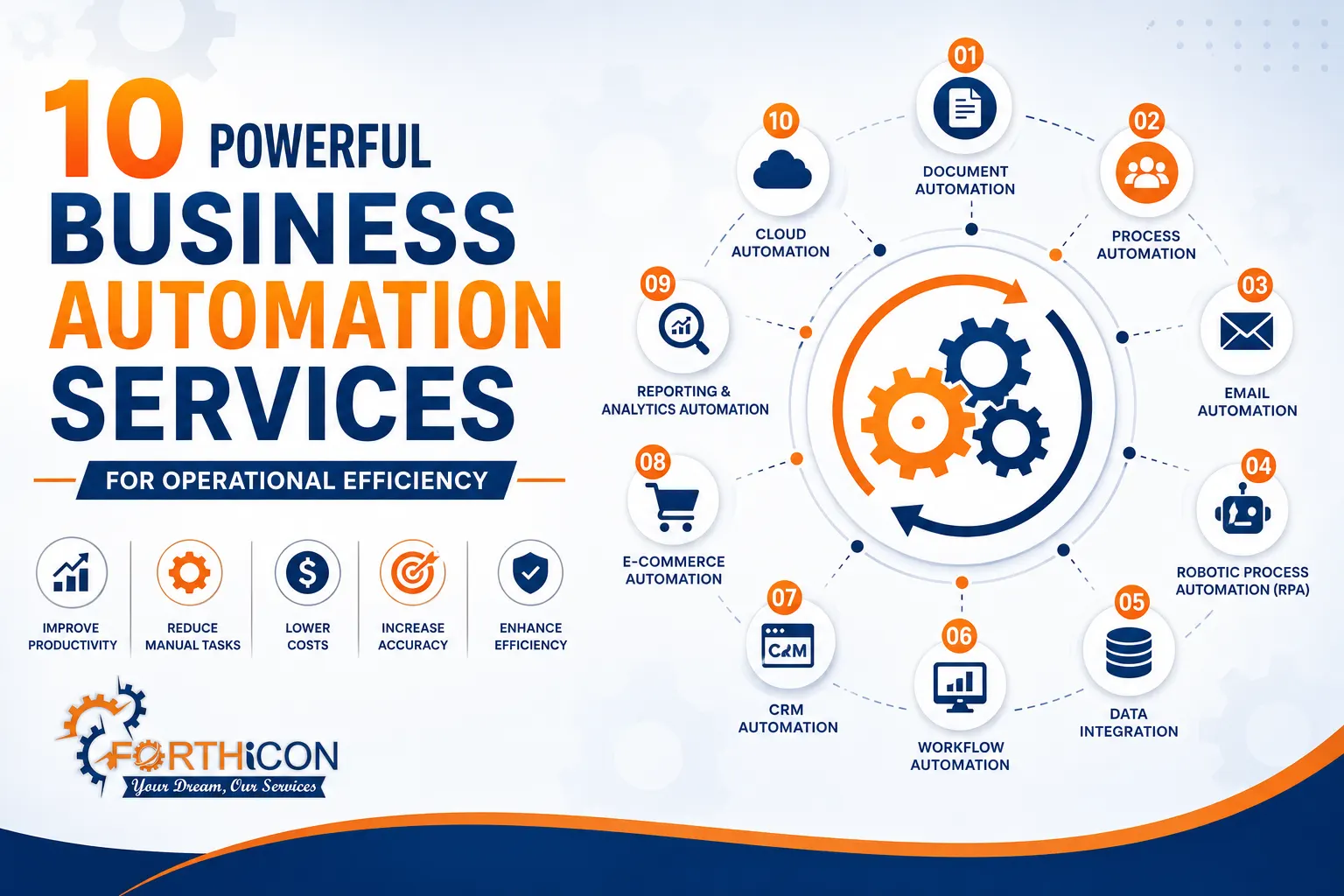
Business Automation Services are transforming how companies manage operations, customer interactions, employee productivity, and workflow efficiency. In today’s fast-moving digital economy, businesses need faster systems, reduced manual work, and improved operational accuracy to stay competitive. Modern automation technologies help organizations streamline repetitive tasks, improve communication, and enhance overall business performance.
From startups to large enterprises, companies across industries are investing in Business Automation Services to reduce operational costs, increase efficiency, and improve customer experiences. Automation not only saves time but also helps businesses focus on strategic growth, innovation, and decision-making.
Organizations using automation technologies can manage workflows, employee tasks, sales pipelines, customer support, inventory management, payroll systems, and data processing more effectively. Business automation improves productivity while minimizing human errors and operational delays.
What Are Business Automation Services?
Business Automation Services refer to the use of software, AI tools, cloud platforms, and digital technologies to automate manual business operations and repetitive processes. These services help companies optimize workflows, improve operational efficiency, and simplify day-to-day business management.
Automation solutions are commonly used in:
- Customer relationship management
- HR and payroll systems
- Sales and marketing automation
- Inventory and supply chain management
- Financial reporting
- IT infrastructure monitoring
- Customer support systems
- Data entry and analytics
- Workflow approvals
- Email communication systems
Business Automation Services enable organizations to improve productivity while reducing operational complexity and resource dependency.
Importance of Business Automation Services
In the modern digital marketplace, operational efficiency plays a critical role in business growth. Companies handling large volumes of data, customers, and internal processes often struggle with manual operations. Business Automation Services eliminate repetitive tasks and allow teams to focus on high-value activities.
Key benefits include:
- Faster business operations
- Improved employee productivity
- Reduced human errors
- Better customer experiences
- Enhanced workflow visibility
- Real-time reporting and analytics
- Lower operational costs
- Increased scalability
- Improved compliance management
- Better data accuracy
Businesses that implement automation technologies can respond faster to market demands while maintaining operational consistency.
Types of Business Automation Services
Workflow Automation
Workflow automation helps businesses automate approvals, task assignments, document processing, and operational workflows. This improves collaboration and reduces delays.
Marketing Automation
Marketing automation tools help businesses automate:
- Email campaigns
- Lead generation
- Customer segmentation
- Social media posting
- Customer engagement
- Sales funnel management
These systems improve marketing efficiency and customer targeting.
Sales Automation
Sales automation platforms help businesses manage customer pipelines, follow-ups, CRM systems, and reporting dashboards. Automated sales processes improve lead conversion and customer management.
HR Automation
HR automation systems simplify employee onboarding, payroll processing, attendance management, leave tracking, and recruitment workflows.
Financial Automation
Financial automation tools help businesses manage invoices, tax reporting, expense tracking, budgeting, and payment processing efficiently.
IT Process Automation
IT automation services monitor servers, cloud infrastructure, security systems, and network operations while reducing manual intervention.
How Business Automation Services Improve Productivity
Productivity improvement is one of the biggest advantages of Business Automation Services. Automated systems reduce repetitive manual tasks, enabling employees to focus on innovation and strategic work.
For example:
- Automated invoicing reduces accounting workload
- CRM automation improves customer communication
- HR automation speeds up employee onboarding
- IT automation improves system monitoring
- Marketing automation increases lead nurturing efficiency
By automating operational workflows, businesses improve time management and employee performance.
Role of Artificial Intelligence in Business Automation Services
Artificial Intelligence plays a major role in modern Business Automation Services. AI-powered systems help organizations analyze data, automate customer interactions, predict trends, and optimize decision-making.
AI automation solutions include:
- AI chatbots
- Predictive analytics
- Smart reporting dashboards
- Intelligent workflow automation
- AI customer support systems
- Automated recommendation engines
Businesses using AI-powered automation improve operational intelligence and customer engagement.
Cloud-Based Business Automation Services
Cloud technology has made automation more scalable and accessible for businesses of all sizes. Cloud-based Business Automation Services allow organizations to manage operations remotely while improving security and collaboration.
Advantages include:
- Remote accessibility
- Real-time data synchronization
- Scalable infrastructure
- Lower hardware costs
- Improved business continuity
- Faster deployment
Cloud automation solutions are highly beneficial for hybrid and remote work environments.
Industries Using Business Automation Services
Healthcare Industry
Healthcare organizations use automation for patient management, appointment scheduling, medical billing, and healthcare analytics.
Banking and Financial Services
Banks use automation for KYC verification, customer onboarding, fraud detection, and financial reporting.
Ecommerce Businesses
Ecommerce companies automate inventory tracking, order processing, customer communication, and marketing campaigns.
Manufacturing Industry
Manufacturers use automation for supply chain management, inventory optimization, and production monitoring.
IT Companies
IT businesses automate cloud management, software deployment, server monitoring, and cybersecurity operations.
Business Optimization Solutions for Small Businesses
Small businesses often face challenges such as limited staff, operational inefficiency, and time-consuming manual tasks. Business Automation Services help small businesses improve efficiency without increasing operational costs.
Small businesses can automate:
- Customer support
- Billing and invoicing
- Appointment scheduling
- Marketing campaigns
- Inventory management
- Payroll systems
Automation helps startups and growing businesses scale operations efficiently.
Features of Business Optimization Solutions Services
Real-Time Analytics
Modern automation systems provide live dashboards and reporting tools that improve business visibility and decision-making.
Integration Capabilities
Business automation platforms integrate with CRM systems, ERP software, cloud applications, and third-party business tools.
Security and Compliance
Advanced automation systems include data protection, access controls, and compliance management features.
Scalability
Automation platforms can grow with business expansion and operational demands.
Custom Workflow Management
Organizations can customize workflows based on industry-specific requirements and business goals.
Challenges in Business Automation Implementation
While automation provides multiple advantages, businesses may face some implementation challenges.
Common challenges include:
- High initial setup costs
- Employee training requirements
- Integration complexity
- Resistance to change
- Data migration issues
- Cybersecurity concerns
Choosing the right Business Automation Services provider helps organizations overcome these challenges effectively.
Future Trends in Business Optimization Solutions
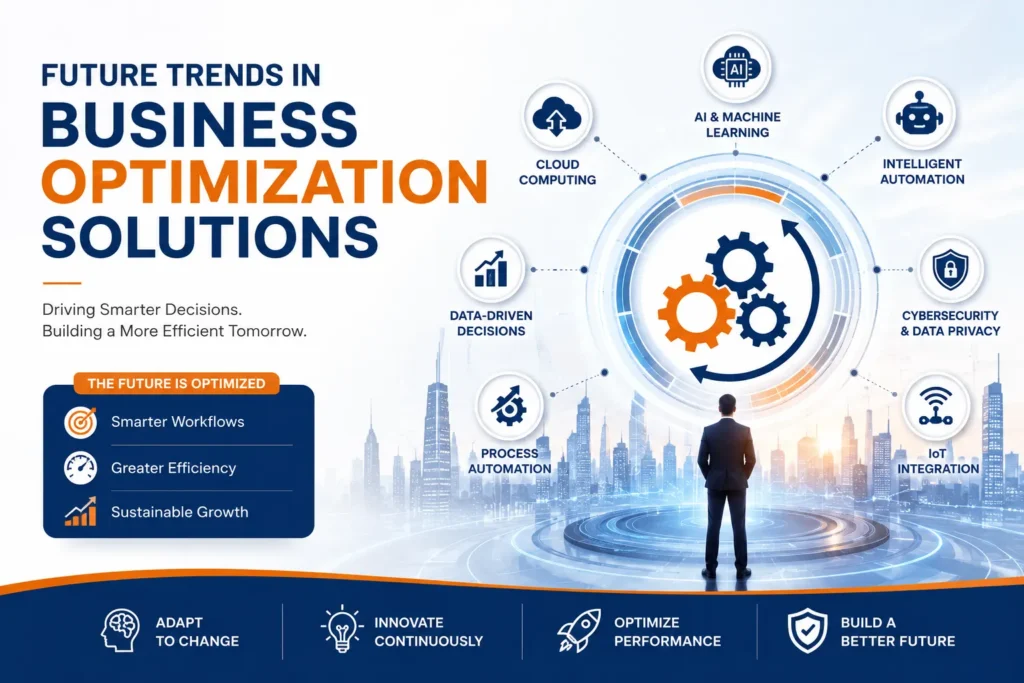
AI-Driven Automation
AI-powered systems will continue improving automation intelligence and predictive analytics.
Hyperautomation
Businesses are increasingly adopting hyperautomation strategies that combine AI, robotic process automation, and cloud technologies.
Low-Code Automation Platforms
Low-code platforms allow businesses to build automation workflows without extensive coding expertise.
IoT-Based Automation
IoT devices will improve operational monitoring and smart automation across industries.
Intelligent Customer Support
AI chatbots and automated support systems will improve customer engagement and response times.
Why Businesses Need Business Automation Services
Modern businesses operate in highly competitive environments where speed, accuracy, and operational efficiency directly impact growth. Manual processes reduce productivity and increase operational risks.
Business Automation Services help companies:
- Improve operational efficiency
- Enhance customer experiences
- Reduce manual errors
- Increase business scalability
- Improve data management
- Support digital transformation
- Boost profitability
Businesses adopting automation technologies gain long-term competitive advantages in the digital marketplace.
Choosing the Right Business Automation Services Provider
When selecting a Business Automation Services provider, businesses should consider:
- Industry experience
- Technology expertise
- Integration capabilities
- Security standards
- Customer support
- Scalability options
- Customization flexibility
A reliable automation partner ensures smooth implementation and long-term operational success.
Conclusion
Business Automation Services are becoming essential for organizations seeking operational efficiency, scalability, and digital transformation. Automation technologies simplify workflows, reduce operational costs, improve productivity, and enhance customer experiences across industries.
From AI-powered systems and cloud automation to workflow management and data analytics, modern automation solutions help businesses optimize operations and achieve sustainable growth. Companies investing in Business Automation Services can improve efficiency, accelerate decision-making, and stay competitive in the rapidly evolving digital economy.
As businesses continue embracing digital transformation, automation technologies will play an even more important role in shaping the future of operations, customer engagement, and business innovation.
Frequently Asked Questions For Bussiness Automation Services
1. What Are Business Automation Services and Why Are They Important?
Business Automation Services are technology-driven solutions that help organizations automate repetitive tasks, streamline workflows, and improve operational efficiency. Modern businesses handle multiple processes daily, including customer communication, payroll management, inventory tracking, reporting, and employee management. Managing these tasks manually often leads to delays, errors, and increased operational costs.
By implementing Business Automation Services, companies can reduce human intervention and improve accuracy across operations. Automation tools use software platforms, AI technologies, cloud systems, and digital workflows to manage tasks efficiently. Businesses can automate marketing campaigns, CRM systems, invoicing, HR management, and customer support operations.
The importance of automation is increasing because businesses now require faster decision-making, real-time analytics, and scalable infrastructure. Automation allows organizations to improve productivity while reducing operational overhead. It also improves customer experiences through faster response times and personalized interactions.
Business Automation Services are beneficial for startups, SMEs, and large enterprises because they help organizations adapt to changing market demands. Companies using automation technologies often experience improved operational consistency, better data management, and enhanced profitability.
Modern automation systems also improve collaboration between departments and simplify workflow management. As digital transformation continues growing globally, automation has become essential for maintaining competitiveness and operational efficiency.
2. How Do Business Automation Services Improve Productivity?
Business Automation Services significantly improve productivity by eliminating repetitive manual tasks and streamlining daily operations. Employees spend considerable time on data entry, approvals, reporting, and administrative work, which reduces overall efficiency. Automation systems handle these tasks automatically, allowing teams to focus on strategic activities and business growth.
For example, automated CRM systems manage customer follow-ups, email campaigns, and lead tracking without constant human involvement. HR automation platforms simplify payroll processing, attendance tracking, and employee onboarding. Financial automation systems generate invoices, manage expenses, and prepare reports quickly and accurately.
Automation reduces operational delays and human errors while improving workflow visibility. Businesses can monitor real-time progress, track performance metrics, and generate instant reports for better decision-making.
Productivity improvements also come from enhanced collaboration. Automated workflows ensure tasks are assigned correctly and completed on time. Notifications, reminders, and approval systems improve accountability and communication within teams.
Cloud-based Business Automation Services further enhance productivity by enabling remote access and real-time collaboration across multiple locations. Employees can manage operations from anywhere while maintaining workflow continuity.
Organizations using automation technologies often experience higher efficiency, reduced operational costs, improved customer satisfaction, and better employee performance. Automation helps businesses scale operations without proportionally increasing workforce requirements.
3. Which Industries Benefit Most from Business Automation Services?
Almost every industry can benefit from Business Automation Services because automation improves operational efficiency and reduces manual workload. However, some industries rely heavily on automation technologies due to large-scale operations and data-intensive workflows.
Healthcare Industry
Healthcare organizations use automation for patient scheduling, billing, medical records management, and appointment reminders. Automation improves patient experiences and administrative efficiency.
Banking and Financial Services
Banks use automation for KYC verification, fraud detection, customer onboarding, EMI processing, and compliance management. Automated financial systems improve security and operational speed.
Ecommerce Industry
Ecommerce businesses automate inventory management, order processing, payment systems, customer communication, and digital marketing campaigns.
Manufacturing Industry
Manufacturers use automation for supply chain management, production monitoring, equipment tracking, and warehouse operations.
IT Industry
IT companies automate software deployment, server monitoring, cybersecurity operations, and cloud management.
Human Resource Management
HR departments automate recruitment, payroll, attendance tracking, employee onboarding, and performance management systems.
Digital Marketing Agencies
Marketing agencies automate social media scheduling, lead generation, email marketing, campaign analytics, and customer segmentation.
Business Automation Services help organizations across industries improve efficiency, reduce costs, and achieve faster operational growth.
4. What Technologies Are Used in Business Automation Services?
Modern Business Automation Services use advanced technologies to improve operational efficiency and automate workflows. These technologies enable organizations to streamline business operations while improving scalability and security.
Artificial Intelligence
AI helps automate customer support, predictive analytics, intelligent reporting, and workflow optimization. AI-powered chatbots improve customer engagement and support operations.
Robotic Process Automation
RPA automates repetitive tasks such as data entry, invoice processing, document management, and reporting.
Cloud Computing
Cloud platforms enable businesses to manage operations remotely while ensuring scalability and real-time collaboration.
Machine Learning
Machine learning systems analyze business data to identify trends, improve decision-making, and optimize operational performance.
Internet of Things
IoT devices help automate industrial monitoring, asset tracking, and smart operational systems.
API Integration
API integration connects multiple software platforms and business applications for seamless data sharing and workflow management.
Business Intelligence Tools
BI platforms provide real-time analytics, dashboards, and performance reporting for strategic planning.
These technologies make Business Automation Services more intelligent, scalable, and efficient for modern enterprises.
5. Are Business Automation Services Suitable for Small Businesses?
Yes, Business Automation Services are highly beneficial for small businesses because they improve operational efficiency while reducing manual workload. Small businesses often operate with limited staff and resources, making automation essential for scaling operations effectively.
Automation helps small businesses manage:
- Customer communication
- Billing and invoicing
- Appointment scheduling
- Inventory management
- Marketing campaigns
- Payroll processing
- Employee attendance
- CRM systems
Cloud-based automation platforms provide affordable solutions for startups and SMEs without requiring large infrastructure investments.
Automation improves productivity by reducing repetitive tasks and allowing employees to focus on revenue-generating activities. Small businesses can improve customer service, reduce operational delays, and compete more effectively with larger enterprises.
Business Automation Services also improve scalability, enabling small businesses to manage growing workloads without significantly increasing operational costs. As businesses expand, automation systems can easily adapt to increased demands.
Modern automation platforms are user-friendly and customizable, making them suitable for organizations with limited technical expertise.
6. How Do Business Automation Services Reduce Costs?
Business Automation Services reduce operational costs by eliminating manual tasks, improving efficiency, and reducing human errors. Businesses that rely heavily on manual workflows often experience delays, resource wastage, and higher labor expenses.
Automation systems handle repetitive processes faster and more accurately than manual operations. This reduces the need for additional workforce resources while improving productivity.
Key cost-saving areas include:
- Reduced administrative workload
- Lower labor costs
- Improved resource allocation
- Faster workflow completion
- Reduced operational errors
- Lower infrastructure maintenance costs
- Improved inventory management
- Reduced paperwork
Cloud-based automation systems also reduce hardware and maintenance expenses because businesses can access services remotely without investing heavily in physical infrastructure.
Automation improves customer support efficiency, reducing customer service costs while improving satisfaction levels. AI-powered chatbots and automated ticketing systems help businesses manage support operations more effectively.
Overall, Business Automation Services help organizations maximize operational efficiency while minimizing unnecessary expenses.
7. What Are the Main Features of Business Automation Services?
Business Automation Services include several advanced features that improve workflow efficiency and operational management.
Workflow Automation
Automates approvals, task assignments, notifications, and document management processes.
Real-Time Analytics
Provides dashboards and reporting systems for better business visibility and decision-making.
CRM Integration
Improves customer relationship management through automated lead tracking and communication.
Cloud Accessibility
Allows remote access to automation systems and real-time collaboration.
Security Features
Includes access controls, data encryption, and compliance management systems.
AI-Powered Automation
Uses artificial intelligence for predictive analytics, chatbots, and intelligent workflows.
Integration Support
Connects multiple business applications using APIs and cloud platforms.
Scalability
Allows businesses to expand operations without major infrastructure changes.
These features help organizations improve productivity, operational consistency, and customer satisfaction.
8. What Challenges Can Businesses Face During Automation?
Although Business Automation Services provide many benefits, organizations may face several challenges during implementation.
Common challenges include:
- Employee resistance to change
- Integration complexity
- Initial implementation costs
- Data migration issues
- Cybersecurity concerns
- Training requirements
- Workflow customization challenges
Businesses can overcome these challenges by selecting experienced automation providers and implementing proper employee training programs.
Successful automation implementation requires strategic planning, workflow analysis, and ongoing support.
9. How Do AI and Cloud Technology Improve Business Automation Services?
AI and cloud computing are transforming Business Automation Services by making systems more intelligent, scalable, and efficient.
AI improves automation through predictive analytics, smart workflows, customer behavior analysis, and intelligent chatbots.
Cloud computing enables:
- Remote accessibility
- Real-time collaboration
- Scalable infrastructure
- Faster deployment
- Improved data security
Together, AI and cloud technologies create powerful automation ecosystems that improve business performance and operational flexibility.
10. What Is the Future of Business Automation Services?
The future of Business Automation Services is highly advanced and technology-driven. Businesses are rapidly adopting AI, machine learning, hyperautomation, and cloud technologies to improve operational efficiency.
Future trends include:
- AI-powered decision-making
- Intelligent workflow automation
- IoT-based business monitoring
- Predictive analytics
- Robotic process automation
- Low-code automation platforms
- Advanced cybersecurity automation
Automation will continue helping businesses reduce costs, improve productivity, and accelerate digital transformation across industries.