
Table of Contents
Introduction
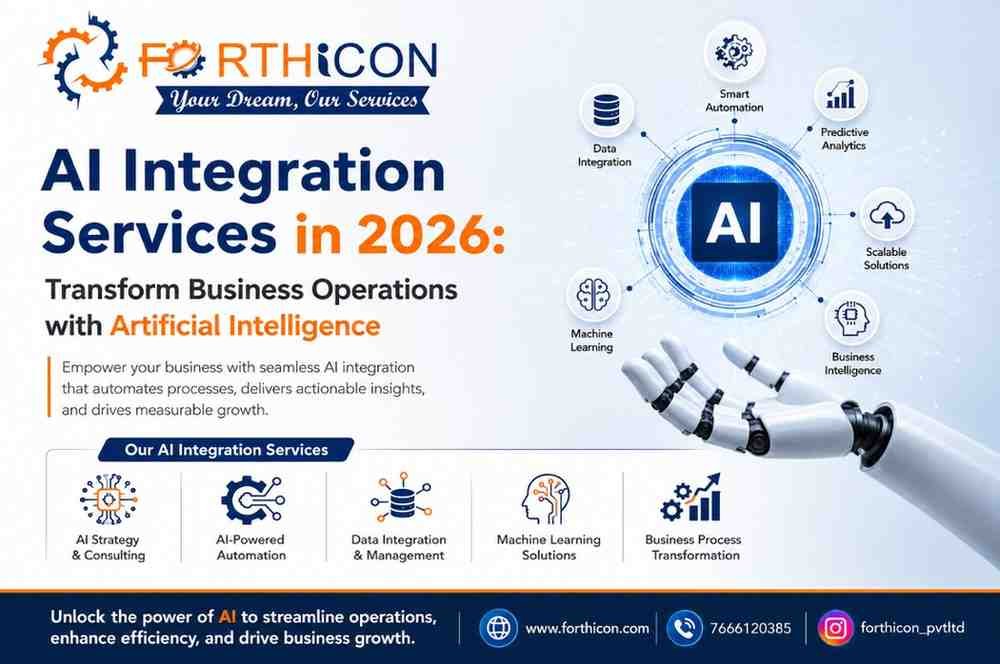
Artificial Intelligence (AI) has become one of the most transformative technologies in the modern business landscape. Organizations across industries are increasingly leveraging AI to improve operational efficiency, enhance customer experiences, automate repetitive tasks, and gain deeper business insights. As AI adoption continues to accelerate, the demand for professional AI Integration Services has grown significantly.
AI integration is no longer limited to large enterprises. Small and medium-sized businesses are also embracing artificial intelligence to remain competitive in a rapidly evolving digital world. From customer support chatbots and predictive analytics to intelligent automation and machine learning models, AI is revolutionizing how organizations operate.
In this comprehensive guide, we will explore everything you need to know about AI Integration Services, including their benefits, implementation process, applications, challenges, and future trends in 2026.
What Are AI Integration Services?
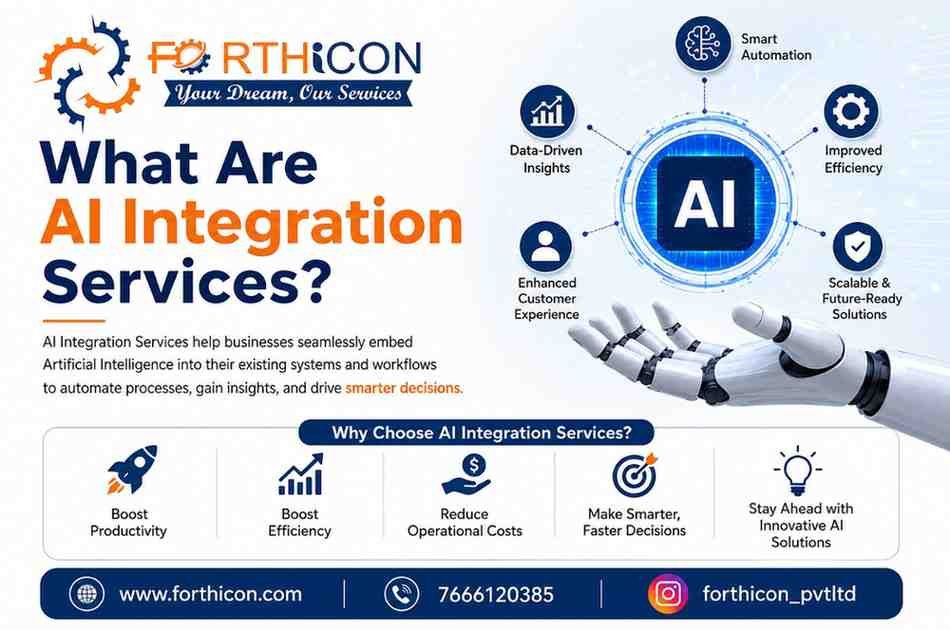
AI Integration Services involve incorporating artificial intelligence technologies into existing business systems, applications, workflows, and processes to enhance efficiency, productivity, and decision-making. Rather than replacing current infrastructure, these services enable organizations to seamlessly integrate AI capabilities into their existing technology ecosystem.
Modern businesses generate vast amounts of data every day, and AI helps transform this data into valuable insights. Through professional AI integration, organizations can automate repetitive tasks, improve customer experiences, optimize operations, and make more informed business decisions.
AI integration can include a wide range of technologies such as Machine Learning (ML) for predictive analysis, Natural Language Processing (NLP) for understanding and processing human language, Computer Vision for image and video recognition, Predictive Analytics for forecasting future trends, and Intelligent Automation for streamlining business processes. Other common applications include AI-powered chatbots, virtual assistants, recommendation engines, and speech recognition systems.
The primary objective of AI Integration Services is to connect advanced artificial intelligence solutions with existing business operations in a smooth and efficient manner. This allows organizations to improve operational accuracy, reduce manual workloads, increase productivity, and deliver better customer experiences. As businesses continue to embrace digital transformation in 2026, AI integration has become a strategic investment that helps organizations remain competitive, innovative, and prepared for future growth.
The goal is to seamlessly connect AI technologies with business processes to improve efficiency, accuracy, and decision-making.
Why Businesses Need AI Integration Services in 2026
In 2026, businesses are generating and processing more data than ever before. From customer interactions and sales transactions to operational metrics and market trends, organizations must handle massive volumes of information daily. Managing and analyzing this data manually is often slow, inefficient, and prone to errors. This is why AI Integration Services have become essential for modern businesses.
AI integration enables organizations to automate repetitive and time-consuming tasks, allowing employees to focus on strategic activities that drive growth. It also helps reduce operational costs by improving process efficiency and minimizing manual intervention. Businesses can use AI to enhance customer engagement through personalized experiences, intelligent chatbots, and faster support services.
Additionally, AI-powered systems generate actionable insights from large datasets, helping organizations make informed decisions and improve business forecasting. AI can identify patterns, predict future trends, and optimize resource allocation, leading to better productivity and scalability. As markets become increasingly competitive, companies that successfully implement AI gain a significant advantage by responding faster to customer needs and adapting quickly to changing conditions.nd improved operational performance.
How AI Integration Services Work
The AI integration process involves several stages designed to ensure successful implementation.
Business Assessment
The first step is understanding the organization’s goals and identifying opportunities where AI can add value.
Examples include:
- Customer service automation
- Sales forecasting
- Fraud detection
- Inventory optimization
A clear understanding of objectives ensures a successful implementation strategy.
Data Collection and Preparation
Artificial intelligence relies on high-quality data.
Organizations collect data from sources such as:
- CRM systems
- ERP platforms
- Websites
- Mobile applications
- Customer interactions
- IoT devices
Data cleaning and preparation are essential to ensure accurate AI outcomes.
AI Model Selection
Different business challenges require different AI technologies.
Examples include:
Machine Learning
Used for:
- Predictive analytics
- Demand forecasting
- Customer behavior analysis
Natural Language Processing
Used for:
- Chatbots
- Text analysis
- Sentiment analysis
Computer Vision
Used for:
- Image recognition
- Quality inspection
- Security monitoring
Selecting the right model is critical to achieving desired business outcomes.
System Integration
AI solutions are integrated into existing systems such as:
- ERP software
- CRM platforms
- Business applications
- E-commerce websites
- Customer service tools
This ensures seamless operation and data flow across departments.
Testing and Deployment
Before deployment, AI systems undergo extensive testing to ensure:
- Accuracy
- Reliability
- Security
- Performance
Once validated, the solution is launched within the business environment.
Continuous Optimization
AI systems require ongoing monitoring and improvement.
Organizations continuously:
- Analyze performance
- Update models
- Improve accuracy
- Adapt to changing business requirements
This ensures long-term success and value.
Key Benefits of AI Integration Services
Improved Operational Efficiency
One of the biggest advantages of AI is automation.
AI can handle repetitive tasks such as:
- Data entry
- Scheduling
- Reporting
- Customer inquiries
This allows employees to focus on strategic activities.
Enhanced Decision-Making
AI systems analyze large volumes of data quickly and accurately.
Businesses gain:
- Real-time insights
- Predictive analytics
- Data-driven recommendations
This leads to better business decisions.
Cost Reduction
Automation reduces manual labor requirements and operational expenses.
Organizations can lower costs through:
- Process optimization
- Resource allocation
- Reduced errors
- Improved efficiency
Better Customer Experience
AI-powered solutions improve customer interactions through:
- Personalized recommendations
- Faster support responses
- Virtual assistants
- Intelligent chatbots
This increases customer satisfaction and loyalty.
Increased Productivity
AI enables employees to complete tasks faster and more accurately.
Benefits include:
- Reduced workload
- Faster workflows
- Improved collaboration
Higher productivity contributes directly to business growth.
Applications of AI Integration Services
Customer Support Automation
AI-powered chatbots provide instant customer assistance.
Benefits include:
- 24/7 support availability
- Faster response times
- Reduced support costs
Customers receive immediate answers without waiting for human agents.
Sales and Marketing
AI improves marketing effectiveness through:
- Customer segmentation
- Personalized campaigns
- Predictive lead scoring
- Marketing automation
Organizations can target the right audience more effectively.
Human Resources
HR departments use AI for:
- Resume screening
- Candidate matching
- Employee engagement analysis
- Workforce planning
This streamlines recruitment and talent management.
Finance and Accounting
AI assists financial teams with:
- Fraud detection
- Expense management
- Financial forecasting
- Risk assessment
These capabilities improve financial accuracy and security.
Manufacturing
Manufacturers use AI for:
- Predictive maintenance
- Quality control
- Production planning
- Supply chain optimization
This increases efficiency and reduces downtime.
Healthcare
Healthcare organizations leverage AI for:
- Medical imaging analysis
- Patient monitoring
- Diagnosis support
- Treatment recommendations
AI helps improve patient outcomes and operational efficiency.
AI Integration Services for Small Businesses
Many small businesses believe AI is only for large enterprises.
However, modern AI solutions are more accessible and affordable than ever before.
Small businesses can use AI for:
- Customer support automation
- Sales forecasting
- Inventory management
- Marketing automation
- Business analytics
Cloud-based AI platforms have significantly lowered implementation costs.
This enables smaller organizations to benefit from artificial intelligence without major investments.
Challenges of AI Integration
Despite its benefits, AI integration can present several challenges.
Data Quality Issues
Poor-quality data can reduce AI effectiveness.
Organizations must ensure:
- Accurate data
- Consistent data
- Relevant information
Integration Complexity
Connecting AI solutions with legacy systems can be challenging.
Professional integration services help overcome technical obstacle
Security Concerns
AI systems often process sensitive business information.
Organizations must implement:
- Data encryption
- Access controls
- Security monitoring
Employee Resistance
Some employees may be hesitant to adopt new technologies.
Proper training and communication are essential.
Regulatory Compliance
Businesses must ensure AI systems comply with:
- Data privacy regulations
- Industry standards
- Ethical guidelines
Industries Benefiting from AI Integration Services
Retail and E-Commerce
Retailers use AI for:
- Product recommendations
- Inventory forecasting
- Customer analytics
Banking and Financial Services
Financial institutions use AI for:
- Fraud detection
- Credit scoring
- Risk management
Healthcare
Healthcare providers leverage AI to improve patient care and operational efficiency.
Manufacturing
Manufacturers use AI for predictive maintenance and process optimization.
Education
Educational institutions implement AI for:
- Personalized learning
- Student performance analysis
- Administrative automation
Logistics and Transportation
AI improves:
- Route optimization
- Fleet management
- Demand forecasting
Future Trends in AI Integration Services
Generative AI
Generative AI technologies are transforming content creation, customer service, and software development.
Businesses increasingly use AI-generated:
- Text
- Images
- Videos
- Code
Hyperautomation
Hyperautomation combines AI, machine learning, and robotic process automation.
This creates fully automated business workflows.
AI-Powered Cybersecurity
Advanced AI systems help detect and prevent cyber threats in real time
Predictive Analytics Expansion
Organizations will increasingly rely on AI to predict:
- Customer behavior
- Market trends
- Operational risks
AI and IoT Integration
Combining AI with Internet of Things devices enables smarter operations and real-time decision-making
Responsible AI
Businesses are focusing on ethical AI implementation, transparency, and fairness.
This trend will continue to grow in importance.
Best Practices for Successful AI Integration
To maximize the benefits of AI, organizations should:
Define Clear Objectives
Establish measurable goals before implementation.
Start with High-Impact Use Cases
Focus on areas where AI can deliver immediate value.
Invest in Data Quality
Accurate data improves AI performance.
Train Employees
Ensure staff understand how to use AI-powered systems.
Monitor Performance
Regularly evaluate outcomes and optimize models.
Work with Experienced Providers
Professional AI Integration Services reduce risks and accelerate implementation.
Why Invest in AI Integration Services in 2026?
Artificial intelligence is no longer a future technology—it is a business necessity.
Organizations that invest in AI Integration Services gain significant advantages, including:
- Improved efficiency
- Reduced operational costs
- Better customer experiences
- Enhanced decision-making
- Increased scalability
- Faster innovation
As competition intensifies across industries, businesses that embrace AI are better positioned for long-term success.
Conclusion
AI Integration Services are transforming how businesses operate in 2026. By incorporating artificial intelligence into existing systems and workflows, organizations can automate processes, enhance productivity, improve customer engagement, and make smarter decisions.
Whether you’re a startup, a growing company, or a large enterprise, AI integration provides the tools needed to stay competitive in a digital-first economy. From predictive analytics and intelligent automation to customer support and cybersecurity, AI offers endless opportunities for innovation and growth.
As technology continues to evolve, businesses that adopt professional AI Integration Services today will be better prepared to meet future challenges, seize new opportunities, and achieve sustainable success in the years ahead.
Frequently Asked Questions (FAQs) About AI Integration Services
1. What Are AI Integration Services?
AI Integration Services involve incorporating artificial intelligence technologies into existing business systems, applications, and workflows to improve efficiency, automation, and decision-making. Instead of replacing current software and infrastructure, AI integration enhances existing operations by adding intelligent capabilities.
These services may include technologies such as Machine Learning (ML), Natural Language Processing (NLP), Computer Vision, Predictive Analytics, Chatbots, Virtual Assistants, and Intelligent Automation. The goal is to enable organizations to leverage AI without disrupting their existing business processes.
Businesses use AI integration to automate repetitive tasks, analyze large volumes of data, improve customer interactions, and generate valuable insights. AI can be integrated into CRM platforms, ERP systems, websites, mobile applications, customer support tools, and operational workflows.
In 2026, AI has become a critical component of digital transformation strategies. Organizations across industries are investing in AI integration to increase productivity, reduce costs, and stay competitive. By implementing AI effectively, companies can improve operational performance and create better experiences for customers and employees alike.
2. Why Are AI Integration Services Important for Modern Businesses?
Modern businesses generate massive amounts of data from customers, operations, sales, and digital channels. Analyzing and utilizing this information manually can be time-consuming and inefficient. AI Integration Services help organizations transform raw data into actionable insights while automating complex processes.
AI enables businesses to:
- Automate repetitive tasks
- Improve operational efficiency
- Reduce human errors
- Enhance customer experiences
- Increase productivity
- Support data-driven decisions
- Improve forecasting accuracy
Organizations that implement AI can respond faster to market changes and customer demands. AI-powered systems can identify patterns, predict future outcomes, and provide recommendations that improve business performance.
Additionally, AI integration supports scalability by enabling businesses to handle growing workloads without significantly increasing resources. Whether a company wants to automate customer support, optimize inventory management, or improve marketing performance, AI provides valuable solutions.
As competition continues to increase in 2026, businesses that embrace AI gain a significant advantage over those relying solely on traditional processes.
3. What Technologies Are Commonly Used in AI Integration Services?
AI Integration Services involve a variety of advanced technologies that help organizations solve different business challenges.
Machine Learning (ML)
Machine Learning enables systems to learn from data and improve performance over time without explicit programming.
Natural Language Processing (NLP)
NLP allows computers to understand and process human language, making it possible to develop chatbots, virtual assistants, and sentiment analysis tools.
Computer Vision
Computer Vision enables machines to analyze images and videos for applications such as facial recognition, quality inspection, and security monitoring.
Predictive Analytics
Predictive Analytics uses historical data and algorithms to forecast future outcomes and trends.
Intelligent Automation
Combines AI with automation technologies to streamline workflows and reduce manual effort.
Speech Recognition
Allows systems to understand spoken language and convert it into actionable information.
Recommendation Engines
Used by businesses to suggest products, services, or content based on user behavior and preferences.
These technologies work together to create intelligent systems that improve business operations and customer experiences.
4. How Do AI Integration Services Improve Customer Experience?
Customer experience has become a major competitive differentiator for businesses. AI Integration Services help organizations deliver personalized, efficient, and responsive customer interactions.
AI-powered chatbots and virtual assistants provide instant support to customers 24/7. These systems can answer common questions, guide users through processes, and resolve issues without requiring human intervention.
AI also helps businesses personalize customer experiences by analyzing customer behavior, preferences, and purchase history. This enables companies to offer relevant product recommendations, customized marketing campaigns, and targeted promotions.
Additional benefits include:
- Faster response times
- Improved customer support availability
- Personalized recommendations
- Better customer engagement
- Increased customer satisfaction
By integrating AI into customer-facing systems, businesses can create seamless experiences that strengthen customer loyalty and improve overall brand perception.
5. Can Small Businesses Benefit from AI Integration Services?
Yes. AI is no longer limited to large enterprises with massive budgets. Cloud-based AI platforms and affordable AI solutions have made artificial intelligence accessible to businesses of all sizes.
Small businesses can use AI for:
- Customer service automation
- Marketing automation
- Lead generation
- Inventory management
- Sales forecasting
- Business analytics
For example, a small online store can implement AI-powered chatbots to handle customer inquiries and recommendation engines to increase sales. Service-based businesses can use AI scheduling tools and automated customer communication systems.
The benefits for small businesses include:
- Reduced operational costs
- Improved efficiency
- Better customer engagement
- Increased productivity
- Enhanced decision-making
AI Integration Services help small businesses compete more effectively with larger organizations by providing access to advanced technologies that improve performance and scalability.
6. What Are the Main Challenges of AI Integration?
Although AI offers significant benefits, organizations may face challenges during implementation.
Data Quality Issues
AI systems rely on accurate and relevant data. Poor-quality data can lead to inaccurate results and reduced effectiveness.
Integration Complexity
Connecting AI solutions with existing software and infrastructure may require specialized expertise.
Security Concerns
AI systems often process sensitive information, making cybersecurity a critical consideration.
Employee Resistance
Some employees may be hesitant to adopt AI technologies due to concerns about job roles and workflow changes.
Compliance Requirements
Businesses must ensure AI systems comply with data privacy regulations and industry standards.
Cost of Implementation
Although AI has become more affordable, organizations still need to invest in technology, training, and maintenance.
Working with experienced AI Integration Service providers can help businesses overcome these challenges and ensure successful implementation.
7. Which Industries Benefit Most from AI Integration Services?
AI Integration Services are valuable across a wide range of industries.
Healthcare
AI supports diagnostics, patient monitoring, treatment recommendations, and administrative automation.
Banking and Financial Services
Financial institutions use AI for fraud detection, risk assessment, customer service, and financial forecasting.
Retail and E-commerce
Retailers leverage AI for personalized recommendations, inventory management, and customer analytics.
Manufacturing
Manufacturers use AI for predictive maintenance, quality control, and production optimization.
Education
Educational institutions implement AI for personalized learning experiences and administrative efficiency.
Logistics and Transportation
AI helps optimize routes, manage fleets, forecast demand, and improve operational efficiency.
Human Resources
Organizations use AI for recruitment, employee engagement, and workforce planning.
Virtually any industry that generates data and seeks operational improvement can benefit from AI integration.
8. How Long Does It Take to Implement AI Integration Services?
The implementation timeline depends on several factors, including project complexity, business requirements, and system readiness.
Small AI projects such as chatbot deployment may take only a few weeks.
Medium-sized projects involving workflow automation and predictive analytics may require several months.
Large enterprise-level AI integrations involving multiple systems and departments can take six months or longer.
Typical implementation phases include:
Business Assessment
Identifying objectives and opportunities for AI adoption.
Data Preparation
Collecting and organizing relevant data.
Solution Development
Building or configuring AI models.
Integration
Connecting AI solutions with existing systems.
Testing
Validating performance and accuracy.
Deployment
Launching the solution into production environments.
Continuous Optimization
Monitoring and improving AI performance over time.
A well-planned implementation strategy ensures faster deployment and better results.
9. What Is the Future of AI Integration Services?
The future of AI integration is extremely promising. As artificial intelligence technologies continue to evolve, businesses will gain access to even more advanced capabilities.
Generative AI
Organizations are increasingly using generative AI for content creation, software development, customer support, and marketing.
Hyperautomation
AI combined with robotic process automation will create highly automated business workflows.
AI-Powered Cybersecurity
Advanced AI systems will improve threat detection and incident response capabilities.
Predictive Decision-Making
Organizations will rely more heavily on predictive analytics to forecast trends and optimize operations.
AI and IoT Integration
Combining AI with Internet of Things devices will enable real-time monitoring and intelligent decision-making.
Responsible AI
Businesses will focus on ethical AI practices, transparency, fairness, and compliance.
These innovations will make AI even more valuable for organizations seeking growth and competitive advantages.
10. How Do You Choose the Right AI Integration Services Provider?
Selecting the right provider is critical for achieving successful AI implementation.
Industry Experience
Choose a provider with expertise in your industry and business challenges.
Technical Expertise
Ensure the provider has experience with machine learning, automation, analytics, and AI technologies.
Customization Capabilities
Every business has unique requirements. The provider should offer tailored solutions.
Integration Experience
Look for providers that can seamlessly connect AI with your existing systems.
Security and Compliance
The provider should follow strong security practices and regulatory requirements.
Support and Maintenance
Ongoing support is essential for long-term success.
Scalability
Choose solutions that can grow with your business.
A reliable AI Integration Services provider helps organizations maximize the value of artificial intelligence while minimizing risks and implementation challenges.