Table of Contents
Introduction
In today’s rapidly evolving digital landscape, businesses must continuously adapt to changing technologies, customer expectations, and market demands. Many organizations still rely on outdated legacy systems that limit innovation, increase maintenance costs, and create operational inefficiencies. This is where Application Modernization Services become essential.
Application Modernization Services enable businesses to transform legacy applications into modern, scalable, secure, and high-performing solutions. By leveraging cloud technologies, automation, microservices architecture, and advanced development frameworks, organizations can improve operational efficiency and accelerate digital transformation.
As businesses pursue innovation and growth, modern applications have become critical assets. Companies that invest in Application Modernization Services gain a competitive advantage by improving agility, reducing technical debt, and delivering better user experiences.
What Are Application Modernization Services?
Application Modernization Services involve updating, redesigning, or rebuilding legacy software applications to align with modern business requirements and technological standards.
The modernization process may include:
- Cloud migration
- Legacy system transformation
- Microservices implementation
- API integration
- Database modernization
- UI/UX enhancement
- Security improvements
- Performance optimization
- DevOps integration
- Automation implementation
The goal of Application Modernization Services is to improve application performance, scalability, flexibility, and maintainability while reducing operational risks and costs.
Why Businesses Need Application Modernization Services
Many organizations continue operating critical applications built years ago. While these systems may still function, they often create challenges such as:
Rising Maintenance Costs
Legacy applications require continuous maintenance and specialized resources, increasing operational expenses.
Security Vulnerabilities
Older systems often lack modern security capabilities, making them vulnerable to cyber threats.
Limited Scalability
Traditional applications struggle to handle growing workloads and evolving customer demands.
Poor User Experience
Outdated interfaces negatively impact employee productivity and customer satisfaction.
Integration Challenges
Legacy systems often cannot integrate effectively with modern business tools and platforms.
Slow Innovation
Older technologies restrict the ability to introduce new features and adapt to changing market conditions.
Application Modernization Services address these challenges while creating opportunities for growth and innovation.
Key Benefits of Application Modernization Services
Improved Business Agility
Modern applications allow businesses to respond quickly to market changes and customer needs.
Enhanced Security
Security enhancements are a critical component of Application Modernization Services, helping protect sensitive data and maintain compliance.
Better User Experience
Modern interfaces improve usability, customer engagement, and employee productivity.
Reduced Operational Costs
Modernized applications require less maintenance and support, reducing long-term expenses.
Faster Time-to-Market
Organizations can deploy new features and services more quickly using modern development practices.
Increased Scalability
Modern applications can scale efficiently as business requirements evolve.
Improved System Reliability
Updated infrastructure and architecture enhance stability and minimize downtime.
Better Data Management
Modern systems improve data accessibility, analytics capabilities, and decision-making.
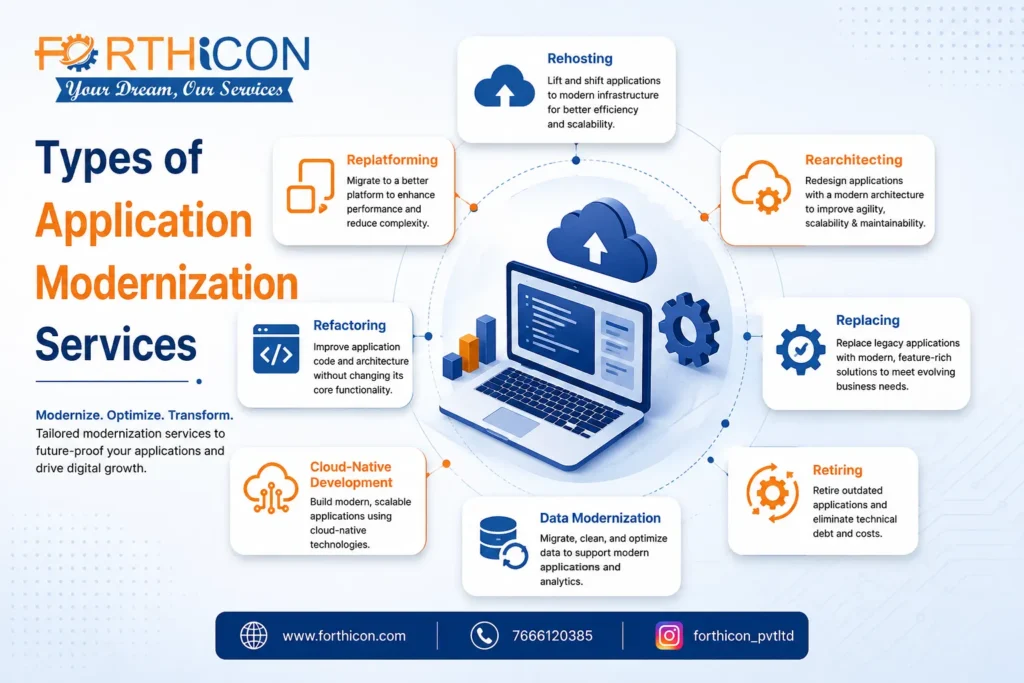
Types of Application Modernization Services
Rehosting
Often called “lift and shift,” rehosting moves applications to cloud environments without significant code changes.
Benefits include:
- Faster migration
- Lower infrastructure costs
- Improved scalability
Replatforming
Replatforming introduces minor modifications to optimize application performance on modern platforms.
Benefits include:
- Better cloud compatibility
- Enhanced efficiency
- Reduced maintenance costs
Refactoring
Refactoring involves restructuring application code while preserving existing functionality.
Benefits include:
- Improved performance
- Better maintainability
- Increased flexibility
Re-architecting
This approach redesigns application architecture using modern technologies such as microservices.
Benefits include:
- Higher scalability
- Improved resilience
- Greater agility
Rebuilding
Applications are rebuilt using modern frameworks and technologies.
Benefits include:
- Maximum flexibility
- Modern functionality
- Future-ready architecture
Replacing
Organizations replace outdated systems with modern software solutions.
Benefits include:
- Reduced technical debt
- Faster implementation
- Improved capabilities
Core Components of Application Modernization Services
Cloud Migration
Cloud migration is one of the most common modernization strategies.
Benefits include:
- Reduced infrastructure costs
- Improved flexibility
- Enhanced disaster recovery
Microservices Architecture
Breaking applications into smaller services improves scalability and maintainability.
Advantages include:
- Independent deployment
- Faster updates
- Better fault isolation
API Integration
Modern APIs enable seamless communication between systems.
Benefits include:
- Improved connectivity
- Better data exchange
- Increased operational efficiency
Database Modernization
Modern databases improve performance, scalability, and security.
Benefits include:
- Faster data processing
- Better analytics
- Enhanced reliability
User Interface Modernization
Improved interfaces enhance user engagement and productivity.
Benefits include:
- Better navigation
- Improved accessibility
- Enhanced customer experience
DevOps Implementation
DevOps practices support continuous integration and delivery.
Benefits include:
- Faster deployments
- Improved collaboration
- Higher software quality
Application Modernization and Digital Transformation
Digital transformation depends heavily on modern software infrastructure.
Application Modernization Services support digital transformation by:
- Enabling cloud adoption
- Improving customer experiences
- Supporting remote work
- Enhancing operational efficiency
- Driving innovation
- Strengthening competitiveness
Organizations that modernize applications are better positioned to adopt emerging technologies and remain competitive.
Industries Benefiting from Application Modernization Services
Banking and Financial Services
Modernized applications improve security, compliance, and customer experiences.
Healthcare
Healthcare organizations benefit from better patient management and data security.
Manufacturing
Modern applications support automation, supply chain optimization, and analytics.
Retail and Ecommerce
Retailers improve customer experiences through personalized digital services.
Education
Educational institutions modernize learning management systems and digital platforms.
Logistics
Modern applications enhance tracking, inventory management, and operational visibility.
Challenges in Application Modernization
Legacy Complexity
Older systems often contain complex architectures that require careful planning.
Data Migration Risks
Transferring large volumes of data can be challenging without proper strategies.
Budget Constraints
Modernization projects require investments in technology and expertise.
Skill Gaps
Organizations may lack internal resources with modernization expertise.
Change Management
Employees need training and support during modernization initiatives.
Experienced providers of Application Modernization Services help businesses overcome these challenges successfully.
Best Practices for Successful Application Modernization Services
Assess Existing Applications
Evaluate performance, scalability, and business value.
Define Clear Objectives
Establish measurable goals aligned with business strategy.
Prioritize Critical Applications
Focus on applications with the highest business impact.
Choose the Right Modernization Strategy
Select approaches that align with organizational needs.
Implement Security Early
Integrate security throughout the modernization process.
Adopt Cloud Technologies
Leverage cloud platforms for flexibility and scalability.
Use Agile Methodologies
Agile development accelerates modernization and reduces risks.
Monitor Performance Continuously
Track results and optimize applications regularly.
Future Trends in Application Modernization Services
Artificial Intelligence Integration
AI-powered applications will improve automation and decision-making.
Low-Code Development
Low-code platforms accelerate modernization projects.
Serverless Computing
Serverless architectures reduce infrastructure complexity.
Edge Computing
Applications will process data closer to users for better performance.
Advanced Cybersecurity
Security modernization will remain a top priority.
Cloud-Native Development
Cloud-native applications will become the standard for digital businesses.
These trends will continue shaping the future of Application Modernization Services.
Why Choose Professional Application Modernization Services?
Professional service providers offer:
- Technical expertise
- Proven methodologies
- Risk management
- Faster implementation
- Ongoing support
- Industry best practices
Working with experienced modernization specialists ensures successful digital transformation outcomes.
Conclusion
Modern businesses require agile, secure, and scalable applications to compete effectively in today’s digital economy. Application Modernization Services provide the foundation for digital transformation by upgrading legacy systems, improving operational efficiency, and enabling innovation.
Organizations that invest in Application Modernization Services benefit from enhanced security, reduced costs, improved customer experiences, and greater business agility. As technology continues evolving, modernization will remain a critical strategy for achieving long-term digital growth and maintaining a competitive advantage.
Businesses seeking sustainable success should prioritize Application Modernization Services as a key component of their digital transformation roadmap.
Frequently Asked Questions About Application Modernization Services
1. What are Application Modernization Services?
Application Modernization Services are specialized solutions that help businesses upgrade, transform, or rebuild legacy software applications using modern technologies, frameworks, and architectures. Many organizations rely on older applications that were developed years ago and no longer meet current business requirements. These systems often suffer from performance limitations, security vulnerabilities, integration challenges, and high maintenance costs.
Application modernization involves improving existing applications through cloud migration, microservices implementation, API integration, database modernization, user interface enhancements, and automation. The objective is to create applications that are scalable, secure, efficient, and capable of supporting future business growth.
By investing in Application Modernization Services, organizations can improve operational efficiency, enhance customer experiences, reduce technical debt, and remain competitive in an increasingly digital marketplace.
2. Why are Application Modernization Services important for businesses?
Modern businesses operate in rapidly changing environments where technology plays a critical role in success. Legacy systems often become obstacles to innovation because they are difficult to maintain, expensive to operate, and unable to support modern business needs.
Application Modernization Services help organizations overcome these challenges by transforming outdated applications into modern platforms. Modernized applications offer better performance, enhanced security, improved scalability, and seamless integration with other business systems.
These services are particularly important for businesses pursuing digital transformation initiatives. They enable organizations to adopt cloud technologies, leverage automation, improve data management, and respond quickly to market changes. Modernized applications also enhance employee productivity and customer satisfaction by providing faster, more reliable, and user-friendly experiences.
3. What are the key benefits of Application Modernization Services?
The benefits of Application Modernization Services extend across multiple areas of business operations.
One major advantage is improved application performance. Modern applications process data faster, respond more efficiently, and provide better user experiences. Security is another significant benefit, as modernized systems incorporate advanced cybersecurity features that protect sensitive information.
Cost reduction is also a key outcome. Legacy systems often require expensive maintenance and specialized support. Modern applications reduce these costs by leveraging cloud infrastructure and automation.
Additional benefits include increased scalability, enhanced reliability, better integration capabilities, faster deployment cycles, improved compliance, and greater business agility. Organizations that invest in application modernization are better positioned to innovate, compete, and grow in a digital economy.
4. What types of applications can be modernized?
Virtually any software application can benefit from Application Modernization Services. This includes enterprise resource planning systems, customer relationship management platforms, financial applications, inventory management systems, healthcare applications, manufacturing software, and custom business applications.
Many businesses have legacy applications developed using outdated programming languages and architectures. These systems can be modernized through various approaches such as rehosting, refactoring, replatforming, rebuilding, or replacing.
Organizations often prioritize applications that are critical to operations, customer engagement, or revenue generation. Modernization strategies are customized based on business goals, technical requirements, budget constraints, and long-term growth objectives.
5. How does cloud migration support Application Modernization Services?
Cloud migration is one of the most important components of Application Modernization Services. It involves moving applications, databases, and workloads from on-premise infrastructure to cloud environments.
Cloud platforms provide numerous benefits, including scalability, flexibility, cost efficiency, and enhanced security. Businesses can quickly increase or decrease resources based on demand without investing in expensive hardware.
Cloud migration also supports business continuity through advanced backup and disaster recovery capabilities. Organizations gain access to modern technologies such as artificial intelligence, machine learning, analytics, and automation.
By integrating cloud migration into application modernization initiatives, businesses can improve performance, reduce infrastructure costs, and accelerate digital transformation efforts.
6. How long does an Application Modernization Services project take?
The duration of an Application Modernization Services project depends on several factors, including application complexity, modernization goals, infrastructure requirements, data migration needs, and business priorities.
Small-scale modernization projects may take a few weeks or months, while large enterprise modernization initiatives can take six months to several years. The timeline also depends on the chosen modernization strategy.
For example, a simple cloud migration may be completed relatively quickly, while rebuilding a complex enterprise application requires extensive planning, development, testing, and deployment.
Experienced service providers conduct detailed assessments and create realistic project timelines that minimize disruption and ensure successful outcomes. Proper planning, stakeholder involvement, and phased implementation approaches help accelerate modernization efforts.
7. What challenges do businesses face during Application Modernization Services?
While Application Modernization Services provide significant benefits, organizations may encounter various challenges throughout the process.
One common challenge is legacy system complexity. Older applications often contain outdated code, undocumented features, and tightly coupled architectures that make modernization difficult.
Data migration presents another challenge, particularly when large volumes of business-critical information must be transferred securely and accurately. Organizations must also address integration requirements with existing systems and third-party platforms.
Budget constraints, resource limitations, employee resistance to change, and compliance requirements can further complicate modernization initiatives. However, these challenges can be effectively managed through careful planning, experienced technical expertise, and proven modernization methodologies.
8. How do Application Modernization Services improve cybersecurity?
Cybersecurity has become a top priority for businesses across all industries. Legacy applications often lack modern security features and are more vulnerable to cyberattacks, data breaches, ransomware, and unauthorized access.
Application Modernization Services strengthen security by implementing advanced authentication mechanisms, encryption technologies, access controls, monitoring systems, and compliance frameworks.
Modern applications are designed with security best practices integrated into every stage of development and deployment. Cloud-based security solutions provide continuous monitoring, threat detection, automated patching, and incident response capabilities.
Modernization also helps organizations meet regulatory requirements such as GDPR, HIPAA, PCI-DSS, and industry-specific compliance standards. Improved cybersecurity reduces risk, protects sensitive information, and builds trust with customers and stakeholders.
9. How do Application Modernization Services support digital transformation?
Digital transformation requires organizations to leverage technology to improve processes, customer experiences, and business outcomes. Application Modernization Services play a critical role in achieving these objectives.
Modernized applications provide the flexibility needed to adopt emerging technologies such as artificial intelligence, machine learning, robotic process automation, and advanced analytics. They also enable organizations to create seamless digital experiences across multiple channels.
By modernizing applications, businesses can automate workflows, improve collaboration, enhance decision-making, and accelerate innovation. Modern systems support remote work, mobile accessibility, and real-time data insights that drive competitive advantage.
Organizations pursuing digital transformation often view application modernization as a foundational investment that enables long-term growth and business success.
10. How do I choose the right provider for Application Modernization Services?
Selecting the right partner for Application Modernization Services is essential for project success. Businesses should evaluate providers based on their technical expertise, industry experience, modernization methodologies, and proven track record.
Look for service providers that offer comprehensive modernization capabilities, including cloud migration, software development, cybersecurity, infrastructure management, DevOps implementation, and ongoing support. Client testimonials, case studies, and certifications can help assess credibility and expertise.
A reliable modernization partner should conduct a thorough assessment of existing systems, understand business objectives, recommend appropriate strategies, and provide transparent project planning. They should also prioritize security, compliance, performance optimization, and long-term scalability.
Working with an experienced provider ensures that modernization projects are completed efficiently, risks are minimized, and business objectives are achieved successfully. Organizations that choose the right partner can maximize the value of their Application Modernization Services investment while accelerating digital growth and innovation.