Table of Contents
Introduction
Sales Training has become one of the most important investments for businesses that want to increase revenue, improve customer relationships, and build high-performing sales teams. In today’s highly competitive market, companies cannot rely only on products or services to achieve success. Organizations must also develop skilled sales professionals who understand customer behavior, communication strategies, negotiation methods, and modern selling techniques.
Businesses across industries face growing challenges related to changing customer expectations, digital transformation, market competition, and evolving buying patterns. Customers today are more informed than ever before. They research products online, compare services, read reviews, and expect personalized solutions before making purchasing decisions. Because of this shift, businesses must focus on continuous Sales Training to ensure their teams can effectively connect with customers and close deals successfully.
Modern Sales Training goes beyond traditional selling methods. It includes communication development, customer psychology, data-driven sales strategies, CRM usage, social selling, lead generation, consultative selling, and performance analysis. Effective sales training programs help employees improve confidence, build trust with customers, and deliver better buying experiences.
Organizations that invest in professional Sales Training often experience:
- Higher conversion rates
- Increased customer retention
- Better revenue growth
- Improved employee productivity
- Stronger customer relationships
- Enhanced brand reputation
In this comprehensive guide, we will explore the importance of Sales Training, powerful techniques that improve sales performance, benefits for businesses, implementation strategies, future trends, and how organizations can use training programs to boost long-term revenue growth.
What is Sales Training In Pune?
Sales Training is the process of educating sales professionals to improve their selling skills, communication abilities, negotiation techniques, customer handling capabilities, and overall sales performance.
The main objective of Sales Training is to help teams:
- Understand customer needs
- Build stronger relationships
- Improve product knowledge
- Increase sales conversions
- Handle objections effectively
- Close deals successfully
Sales training programs can be conducted through:
- Online courses
- Workshops
- Live coaching sessions
- Corporate training programs
- Role-playing exercises
- CRM-based learning systems
Modern Sales Training also includes digital tools, analytics, automation software, and AI-powered learning systems that improve sales efficiency and productivity.
Companies that continuously train their sales teams remain more competitive and adaptable to changing market conditions.
Importance of Sales Skill Development for Businesses
Businesses that ignore Sales Training often struggle with poor conversions, inconsistent communication, customer dissatisfaction, and declining revenue.
Professional sales development helps organizations improve both customer experiences and operational performance.
Better Customer Communication
Sales representatives learn how to communicate effectively with different customer types and business situations.
Increased Revenue Growth
Trained sales teams close deals faster and generate higher profits.
Improved Product Knowledge
Sales professionals gain deeper understanding of products and services, allowing them to provide better solutions.
Higher Employee Confidence
Training improves confidence, motivation, and workplace performance.
Stronger Customer Relationships
Professional communication and consultative selling help businesses build long-term customer loyalty.
Modern organizations use Sales Training to create customer-focused and performance-driven business cultures.
1.Consultative Selling Techniques
Consultative selling is one of the most effective Sales Training methods for modern businesses.
Instead of pushing products aggressively, sales professionals focus on understanding customer problems and providing customized solutions.
Benefits of Consultative Selling:
- Improves customer trust
- Builds long-term relationships
- Enhances customer satisfaction
- Increases repeat business
- Improves conversion rates
Sales professionals learn active listening, problem-solving, and personalized communication strategies.
Consultative selling creates stronger emotional connections with customers and improves overall sales performance.
2. Communication Skills Development
Communication is the foundation of successful selling.
Sales Training programs help employees improve:
- Verbal communication
- Listening skills
- Presentation abilities
- Body language
- Emotional intelligence
Strong communication improves customer engagement and reduces misunderstandings during the sales process.
Sales representatives who communicate clearly and confidently build trust faster and improve deal-closing opportunities.
Businesses often include public speaking and presentation workshops as part of their training programs.
3. Product Knowledge Training
Customers expect sales professionals to understand products thoroughly before making purchasing decisions.
Product-focused Sales Training helps employees:
- Explain features clearly
- Demonstrate benefits effectively
- Compare solutions confidently
- Handle technical questions
- Build credibility
Sales professionals with deep product knowledge improve customer confidence and reduce buying hesitation.
Organizations regularly update training materials to align with new product launches and industry developments.
4. Objection Handling Techniques
Customers often raise objections related to price, quality, timing, or competitors.
Professional Sales Training teaches representatives how to respond calmly and confidently to objections.
Common Objection Handling Strategies:
- Active listening
- Empathy-based responses
- Solution-focused explanations
- Value demonstration
- Comparative analysis
Effective objection handling improves trust and increases sales conversions.
Sales teams learn how to identify underlying customer concerns and provide personalized solutions.
5. CRM and Sales Automation Training
Modern sales operations depend heavily on CRM systems and automation tools.
Sales Training programs teach employees how to use:
- Customer relationship management software
- Lead tracking systems
- Sales automation platforms
- Email marketing tools
- Reporting dashboards
CRM-based training improves organization, productivity, and customer management.
Sales automation reduces repetitive tasks and allows teams to focus more on customer engagement and revenue generation.
Businesses using CRM-integrated Sales Training often improve operational efficiency significantly.
6. Lead Generation Strategies
Generating high-quality leads is essential for revenue growth.
Sales Training helps professionals identify and attract potential customers through:
- Social media marketing
- Email outreach
- Referral programs
- Networking
- Content marketing
- Digital advertising
Lead generation training improves prospecting efficiency and customer targeting.
Sales teams learn how to qualify leads and focus on high-conversion opportunities.
Businesses that improve lead quality often achieve stronger sales performance and lower acquisition costs.
7. Negotiation Skills Development
Negotiation is one of the most valuable skills in professional selling.
Sales Training programs teach:
- Pricing negotiation
- Conflict resolution
- Value-based selling
- Closing strategies
- Relationship management
Strong negotiation skills improve customer satisfaction while protecting business profitability.
Sales representatives learn how to create win-win situations that benefit both customers and organizations.
Professional negotiation training improves confidence during high-value sales discussions.
8. Social Selling Techniques
Social media platforms have transformed modern sales strategies.
Sales Training now includes social selling techniques using:
- Professional communities
Sales professionals learn how to:
- Build online authority
- Engage prospects
- Share valuable content
- Generate inbound leads
- Build professional networks
Social selling improves brand visibility and customer engagement in digital environments.
Businesses increasingly combine social media marketing with Sales Training programs to improve online sales opportunities.
9. Customer Psychology and Buying Behavior
Understanding customer psychology helps sales teams improve communication and conversions.
Sales Training programs teach professionals:
- Emotional buying triggers
- Customer decision-making patterns
- Behavioral analysis
- Trust-building techniques
- Relationship development
Businesses that understand customer behavior can create more personalized sales experiences.
Psychology-based selling improves engagement, customer loyalty, and purchasing confidence.
Modern Sales Training increasingly includes behavioral analytics and customer journey mapping.
10. Performance Analysis and Continuous Learning
Sales performance must be monitored regularly for continuous improvement.
Sales Training programs often include:
- KPI tracking
- Performance analytics
- Coaching sessions
- Feedback systems
- Goal-setting strategies
Businesses analyze:
- Conversion rates
- Customer retention
- Revenue growth
- Lead quality
- Sales cycle duration
Continuous learning helps sales teams adapt to changing market trends and customer expectations.
Organizations that prioritize ongoing Sales Training maintain stronger long-term growth and competitiveness.
Benefits of Sales Skill Development
Professional Sales Training provides long-term advantages for businesses across industries.
Increased Revenue
Well-trained teams close more deals and improve sales performance.
Improved Customer Experience
Customers receive better communication and personalized solutions.
Higher Employee Retention
Training improves confidence, motivation, and job satisfaction.
Better Brand Reputation
Professional customer interactions strengthen business credibility.
Stronger Team Collaboration
Sales teams communicate and coordinate more effectively.
Businesses investing in employee development often outperform competitors in customer engagement and profitability.
Role of Technology in Modern Sales Skill Development
Technology has transformed how businesses conduct Sales Training.
Modern platforms include:
- AI-powered coaching
- Virtual training sessions
- CRM-integrated learning
- Interactive simulations
- Mobile learning applications
Digital learning platforms allow businesses to train employees remotely and efficiently.
Artificial intelligence also helps analyze sales conversations and provide personalized recommendations for improvement.
Technology-driven Sales Training improves scalability and learning accessibility for organizations.
Sales Skill Development for Different Industries
Different industries require specialized sales approaches.
Retail Sales Training
Focuses on customer interaction, upselling, and in-store communication.
B2B Sales Training
Emphasizes relationship building, negotiation, and long-term partnerships.
Financial Services Sales Training
Includes compliance, trust-building, and customer education strategies.
IT and Software Sales Training
Focuses on technical product demonstrations and consultative selling.
Customized Sales Training improves industry-specific performance and customer engagement.
Future Trends in Sales Training In Pune
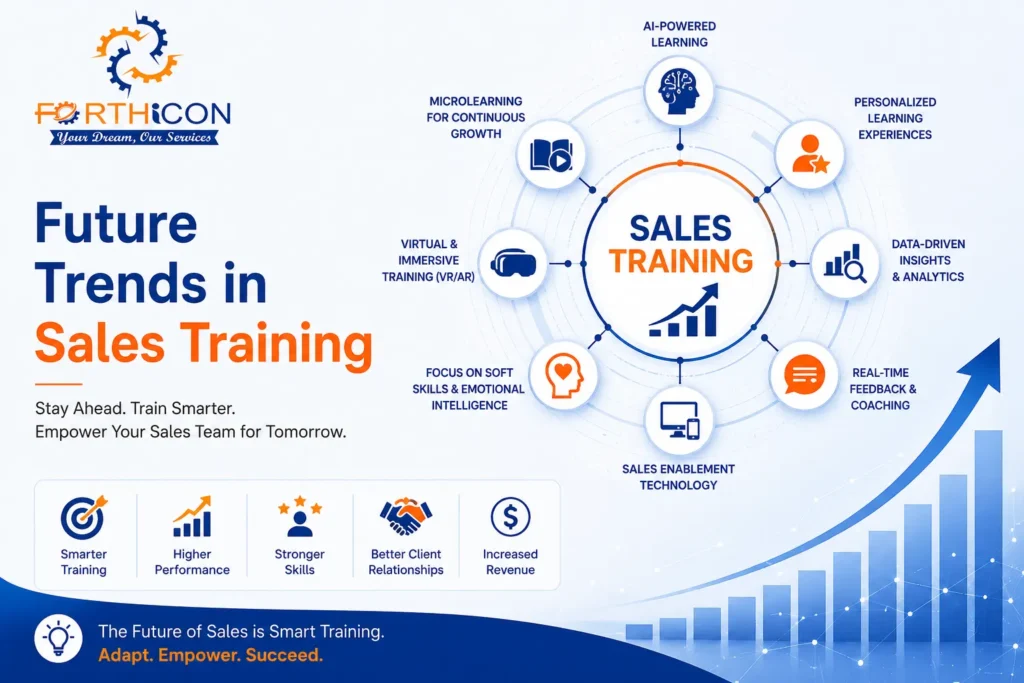
The future of Sales Training will continue evolving with digital transformation and customer behavior changes.
AI-Based Coaching
Artificial intelligence will provide real-time sales recommendations and analytics.
Virtual Reality Training
VR simulations will improve practical learning experiences.
Personalized Learning Paths
Training platforms will customize lessons based on employee performance.
Data-Driven Sales Strategies
Analytics will help businesses improve customer targeting and sales forecasting.
Remote Learning Platforms
Online training systems will continue growing for global workforce development.
Businesses adopting modern Sales Training technologies will gain competitive advantages in revenue generation and customer engagement.
How to Build an Effective Sales Skill Development Program
Businesses should follow structured strategies when developing Sales Training programs.
Identify Training Goals
Define specific performance objectives and skill gaps.
Analyze Team Performance
Evaluate current sales challenges and opportunities.
Create Practical Learning Modules
Use role-playing, simulations, and real-world scenarios.
Provide Continuous Coaching
Regular coaching improves long-term employee performance.
Monitor Training Results
Track KPIs, conversions, and employee improvement metrics.
Effective Sales Training programs focus on both technical skills and relationship-building capabilities.
Conclusion
Sales Training is one of the most valuable investments businesses can make for long-term revenue growth, customer engagement, and competitive success. Modern sales environments require professionals who understand communication, customer psychology, digital tools, negotiation strategies, and relationship management.
Organizations that prioritize continuous Sales Training improve productivity, customer satisfaction, employee confidence, and operational performance. From consultative selling and lead generation to social selling and CRM automation, advanced training techniques help businesses adapt to changing market conditions and customer expectations.
Technology-driven learning platforms, AI-powered coaching systems, and data analytics are transforming how companies train their sales teams. Businesses that embrace these innovations gain stronger competitive advantages and improved revenue opportunities.
As industries continue evolving, Sales Training will remain essential for organizations seeking sustainable growth, stronger customer relationships, and higher sales performance in modern business environments.
Frequently Asked Questions About Sales Training
1. Why Businesses Need Sales Training in Pune?
Sales Training is the process of teaching sales professionals how to improve communication, customer interaction, negotiation, lead conversion, and overall selling performance. Modern businesses operate in highly competitive markets where customers have access to more information and choices than ever before. Because of this, companies need skilled sales teams that can build trust, understand customer needs, and provide effective solutions.
Professional Sales Training helps businesses improve revenue generation by increasing conversion rates and customer satisfaction. Employees learn how to communicate more confidently, present products effectively, and handle objections professionally.
Sales Training also improves product knowledge. When sales representatives fully understand products or services, they can explain benefits clearly and answer customer questions accurately. This creates better buying experiences and improves brand credibility.
Another major benefit is improved employee confidence and motivation. Trained sales professionals feel more prepared during customer interactions, negotiations, and presentations.
Businesses investing in Sales Training often experience:
- Higher revenue growth
- Better customer retention
- Improved employee productivity
- Stronger customer relationships
- Increased market competitiveness
In today’s digital business environment, Sales Training has evolved beyond traditional classroom learning. Companies now use online training platforms, CRM systems, AI-powered coaching tools, and performance analytics to improve learning outcomes.
Continuous Sales Training ensures teams remain updated with changing market trends, customer expectations, and modern selling techniques.
2. How does Sales Training in Pune improve revenue growth?
Sales Training directly impacts business revenue by improving the performance and efficiency of sales teams. Trained sales professionals communicate more effectively, build stronger customer relationships, and close deals more successfully.
One major way Sales Training improves revenue is through better conversion rates. Employees learn how to identify customer pain points, present solutions strategically, and guide customers through the buying process.
Sales Training also improves lead qualification. Instead of wasting time on low-quality prospects, teams learn how to focus on customers with higher purchasing potential.
Objection handling is another important factor. Customers often hesitate because of concerns related to price, timing, competition, or trust. Professional Sales Training teaches representatives how to respond confidently and provide value-based solutions.
Upselling and cross-selling techniques also contribute to higher revenue. Sales professionals learn how to recommend additional products or services that meet customer needs.
Businesses also benefit from improved customer retention. Existing customers are more likely to return when they receive professional service and personalized support.
Modern Sales Training includes CRM systems and sales analytics, helping organizations monitor performance and optimize strategies based on real-time data.
Companies that invest in continuous sales development often achieve faster business growth and stronger long-term profitability.
3. What skills are taught during Sales Skill Development programs?
Modern Sales Training programs focus on developing both technical selling skills and interpersonal communication abilities.
One of the most important skills is communication. Sales professionals learn how to speak clearly, listen actively, ask strategic questions, and build customer trust.
Negotiation skills are also essential. Training programs teach employees how to discuss pricing, manage objections, and create win-win solutions.
Customer psychology is another important topic. Understanding buying behavior helps sales teams personalize conversations and improve customer engagement.
Sales Training programs also include:
- Lead generation techniques
- Prospecting strategies
- Presentation skills
- Product knowledge
- Time management
- Relationship building
- Closing techniques
- CRM software usage
Digital selling skills have become increasingly important as businesses move online. Sales representatives learn how to use social media platforms, email outreach, virtual meetings, and automation tools.
Role-playing exercises are commonly used to improve practical experience. Employees practice real sales scenarios and receive feedback from trainers.
Modern Sales Training also focuses on emotional intelligence because customer relationships play a major role in purchasing decisions.
The combination of communication, technical knowledge, and customer engagement skills helps businesses build high-performing sales teams.
4. How can small businesses benefit from Sales Skill Development?
Small businesses often operate with limited budgets and smaller teams, making every customer interaction extremely important. Professional Sales Training helps small businesses improve efficiency, customer service, and revenue generation.
One major advantage is improved conversion rates. Trained employees understand how to communicate value effectively and close more deals.
Sales Training also helps small businesses compete with larger companies. Even if a business has fewer resources, skilled sales representatives can build strong customer relationships and deliver personalized experiences.
Customer retention improves significantly because trained staff provide better communication and support.
Small businesses also benefit from:
- Improved lead generation
- Better time management
- Increased productivity
- Higher employee confidence
- Reduced customer complaints
Digital Sales Training platforms are especially beneficial for small businesses because they provide affordable learning solutions.
Employees learn modern sales strategies such as:
- Social selling
- CRM usage
- Email marketing
- Online customer engagement
- Virtual sales presentations
Sales Training also improves teamwork and internal communication within small organizations.
As businesses grow, strong sales foundations help maintain consistent customer experiences and operational performance.
Investing in Sales Training allows small businesses to increase profitability while building long-term customer trust and brand reputation.
5. What is consultative selling in Sales Skill Development?
Consultative selling is a customer-focused sales approach that emphasizes understanding customer needs and providing personalized solutions instead of simply promoting products aggressively.
Modern Sales Training programs often prioritize consultative selling because customers today expect businesses to solve problems rather than push products.
In consultative selling, sales professionals:
- Ask strategic questions
- Listen actively
- Understand customer challenges
- Recommend tailored solutions
- Build long-term relationships
This approach improves trust because customers feel understood and valued.
Sales representatives act more like advisors or consultants rather than traditional salespeople. This creates stronger emotional connections and improves customer satisfaction.
Consultative selling also improves long-term business growth because customers are more likely to remain loyal when businesses focus on their needs.
Training programs teach employees how to:
- Conduct discovery conversations
- Analyze customer requirements
- Personalize recommendations
- Provide educational guidance
- Build credibility
Businesses using consultative selling often experience:
- Higher conversion rates
- Better customer retention
- Increased referrals
- Improved brand reputation
In modern competitive markets, consultative selling has become one of the most effective Sales Training techniques for improving customer engagement and revenue growth.
6. How does technology improve modern Sales Skill Development?
Technology has transformed Sales Training by making learning more interactive, accessible, scalable, and data-driven.
Online learning platforms allow businesses to train employees remotely through video courses, live webinars, virtual classrooms, and mobile applications.
CRM-integrated training systems help sales professionals learn how to manage customer relationships more efficiently.
Artificial intelligence is also becoming important in modern Sales Training. AI-powered platforms analyze sales conversations and provide personalized coaching recommendations.
Technology-driven Sales Training includes:
- Interactive simulations
- Virtual role-playing
- Performance analytics
- Gamification systems
- Automated learning paths
These tools improve engagement and knowledge retention.
Sales analytics help businesses monitor:
- Conversion rates
- Customer interactions
- Employee performance
- Training effectiveness
Virtual reality and augmented reality technologies are also being introduced to simulate real sales environments for practical learning experiences.
Technology improves flexibility because employees can access training materials anytime and from any location.
Businesses using digital Sales Training platforms often reduce training costs while improving scalability and performance measurement.
As remote work continues growing globally, technology-driven sales education will remain essential for workforce development.
7. What are the biggest challenges solved by Sales Skill Development?
Businesses face several sales-related challenges that can negatively impact revenue and customer relationships. Professional Sales Training helps organizations overcome these obstacles effectively.
One major challenge is poor communication. Many sales professionals struggle with presentations, customer conversations, and relationship building. Training improves confidence and communication skills.
Another common problem is inconsistent sales performance. Without structured training, teams may use different approaches that create unpredictable results.
Sales Training also solves:
- Weak negotiation abilities
- Poor objection handling
- Low conversion rates
- Limited product knowledge
- Inefficient lead management
- Lack of customer engagement
Modern customers expect personalized experiences and quick responses. Training helps sales representatives adapt to evolving customer expectations.
Employee motivation is another challenge. Ongoing Sales Training improves confidence, career growth opportunities, and workplace satisfaction.
Technology adoption can also be difficult for sales teams. CRM systems, automation tools, and digital communication platforms require proper training for effective use.
Businesses that address these challenges through structured Sales Training often achieve stronger operational performance and customer satisfaction.
Continuous improvement programs help organizations remain competitive in rapidly changing business environments.
8. How do CRM systems support Sales Skill Development?
CRM systems play an important role in modern Sales Training because they help businesses organize customer information, monitor sales activities, and improve communication strategies.
CRM stands for Customer Relationship Management, and these platforms centralize customer data such as:
- Contact information
- Purchase history
- Communication records
- Sales opportunities
- Customer preferences
Sales Training programs teach employees how to use CRM systems efficiently for lead tracking, pipeline management, and customer engagement.
CRM-integrated Sales Training improves:
- Productivity
- Time management
- Customer service
- Reporting accuracy
- Sales forecasting
Sales representatives can track customer interactions and follow up more effectively.
CRM systems also support automation by reducing repetitive administrative tasks such as scheduling emails and updating customer records.
Managers use CRM analytics to monitor team performance and identify training needs.
Businesses using CRM-supported Sales Training often improve conversion rates and operational efficiency.
Modern CRM platforms integrate with marketing tools, communication systems, and AI-powered analytics, helping businesses create more personalized customer experiences.
CRM knowledge has become an essential skill for modern sales professionals in digital business environments.
9. Why is continuous Sales Training important?
Sales environments change constantly due to market competition, customer behavior shifts, technological advancements, and economic conditions. Continuous Sales Training helps businesses remain competitive and adaptable.
Without ongoing training, sales professionals may rely on outdated techniques that no longer match customer expectations.
Continuous Sales Training helps employees:
- Improve communication
- Learn new technologies
- Adapt to market trends
- Understand customer psychology
- Improve negotiation strategies
Businesses also introduce new products and services regularly. Training ensures employees understand updated offerings and can communicate benefits effectively.
Ongoing coaching improves long-term performance because employees receive regular feedback and skill development opportunities.
Continuous Sales Training also supports employee motivation and career growth. Workers often feel more engaged when organizations invest in professional development.
Businesses that prioritize continuous learning usually experience:
- Higher productivity
- Better customer retention
- Increased innovation
- Stronger employee loyalty
- Improved revenue performance
Digital learning platforms make ongoing Sales Training more accessible through mobile applications, webinars, and self-paced courses.
Organizations that continuously develop their sales teams are better prepared for future business challenges and market opportunities.
10. How can businesses create effective Sale Training programs?
Creating successful Sales Training programs requires strategic planning, practical learning methods, and continuous performance monitoring.
The first step is identifying business goals and skill gaps. Companies must understand what challenges their sales teams face and what improvements are needed.
Businesses should then develop customized training modules that focus on:
- Communication skills
- Product knowledge
- Customer engagement
- Negotiation techniques
- CRM usage
- Lead generation
- Closing strategies
Interactive learning methods improve engagement and retention. Effective Sales Training programs often include:
- Role-playing exercises
- Real-world scenarios
- Coaching sessions
- Group workshops
- Online learning modules
Managers should also provide regular feedback and mentorship.
Performance measurement is essential for evaluating training effectiveness. Businesses should track:
- Conversion rates
- Revenue growth
- Customer satisfaction
- Employee productivity
- Lead quality
Technology integration improves scalability and flexibility. Online learning systems allow employees to access training materials anytime.
Continuous improvement is important because markets and customer expectations evolve rapidly.
Businesses that build structured and practical Sales Training programs create stronger sales cultures, improve customer experiences, and achieve long-term business growth.