
Table of Contents
Introduction
DevOps Services have become one of the most important technology solutions for modern businesses aiming to accelerate software delivery, improve operational efficiency, and enhance collaboration between development and IT teams. In today’s competitive digital environment, companies must deliver high-quality software quickly while maintaining performance, security, and scalability. Traditional software development methods often create delays, communication gaps, and operational inefficiencies that slow business growth.
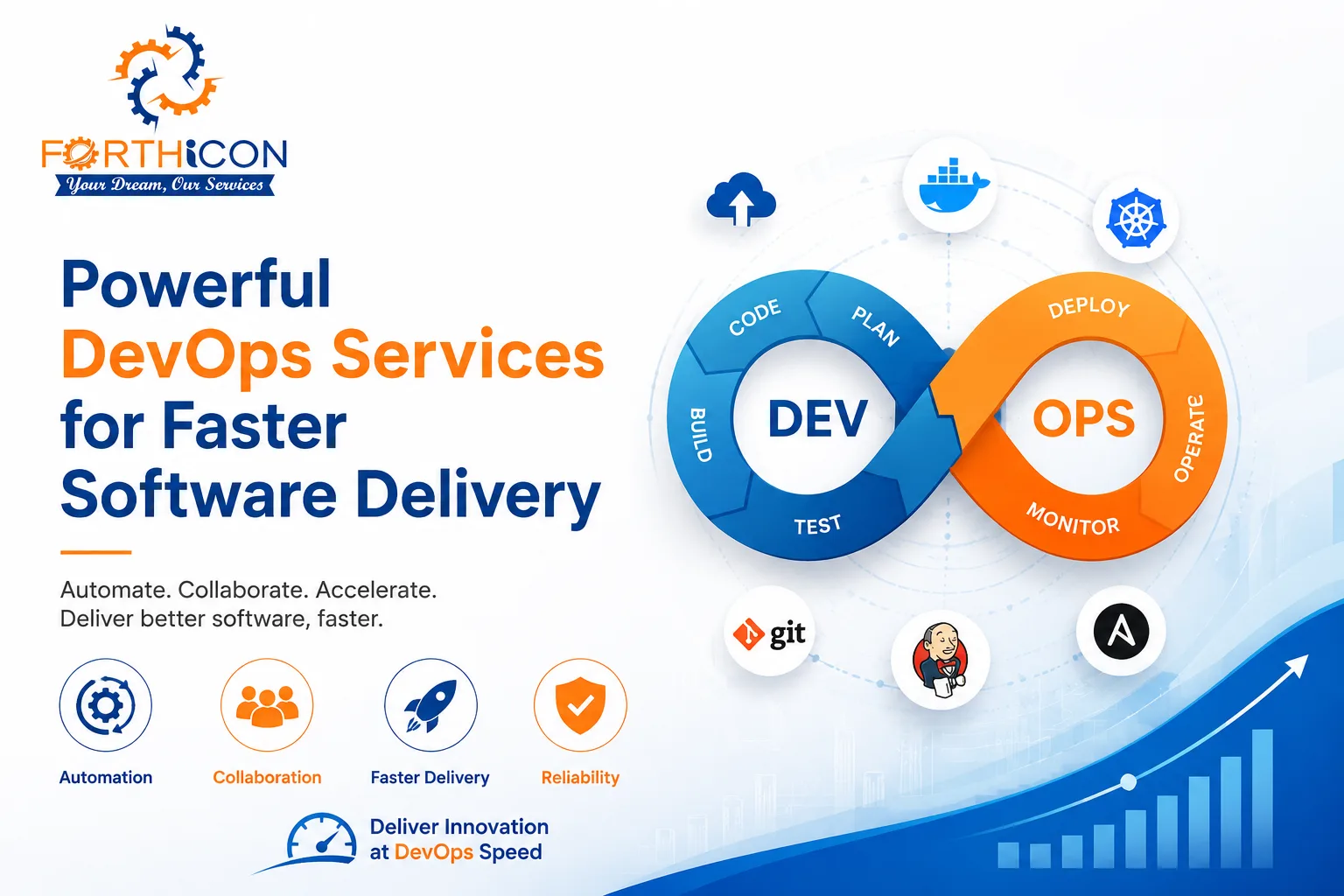
DevOps combines software development and IT operations into a unified process that focuses on automation, continuous integration, continuous delivery, monitoring, and collaboration. Professional DevOps Services help businesses streamline workflows, reduce deployment errors, improve software quality, and accelerate time-to-market for applications and digital products.
Organizations across industries such as healthcare, banking, e-commerce, manufacturing, education, and technology are adopting DevOps practices to remain competitive and agile. Modern businesses require faster release cycles, reliable infrastructure, cloud scalability, and automated deployment systems. DevOps Service provide the tools, processes, and expertise needed to achieve these goals effectively.
With the rise of cloud computing, artificial intelligence, containerization, and microservices architecture, DevOps has become a core part of digital transformation strategies. Businesses using DevOps methodologies often experience better collaboration, improved software reliability, reduced operational costs, and faster innovation.
In this comprehensive guide, we will explore the importance of DevOps Services, their benefits, core principles, tools, processes, industry applications, future trends, and how businesses can implement DevOps successfully.
What are DevOps Service?
DevOps Services refer to professional solutions and practices that integrate software development and IT operations to improve collaboration, automation, and software delivery processes. The main goal of DevOps is to shorten the software development lifecycle while ensuring high-quality releases and stable system performance.
DevOps Services include:
- Continuous Integration (CI)
- Continuous Delivery (CD)
- Infrastructure Automation
- Cloud Deployment
- Monitoring and Logging
- Security Integration
- Container Management
- Configuration Management
These services help businesses automate repetitive tasks, improve team communication, reduce deployment failures, and optimize software infrastructure.
Modern DevOps strategies focus on collaboration between developers, operations teams, quality assurance teams, and security professionals. This integrated approach allows businesses to release software updates faster and more efficiently.
Why DevOps Services are Important for Businesses
Modern businesses rely heavily on software applications, cloud platforms, and digital services. Traditional development methods often struggle to keep up with growing customer expectations and rapid market changes. DevOps Services solve these challenges by improving development speed, operational efficiency, and software reliability.
Faster Software Delivery
DevOps automates development and deployment processes, allowing businesses to release updates and applications more quickly.
Improved Collaboration
DevOps creates better communication and collaboration between development and operations teams.
Reduced Operational Costs
Automation reduces manual tasks, minimizes errors, and lowers infrastructure management costs.
Better Software Quality
Continuous testing and monitoring improve software stability and reduce bugs.
Enhanced Scalability
Cloud-based DevOps infrastructure helps businesses scale applications according to demand.
Businesses adopting DevOps Services often achieve better agility and competitive advantages in the digital marketplace.
Core Principles of DevOps Service
Continuous Integration
Continuous Integration allows developers to merge code changes frequently into a shared repository.
Benefits:
- Faster bug detection
- Improved code quality
- Reduced integration issues
Developers can identify problems early and maintain stable software environments.
Continuous Delivery
Continuous Delivery automates the deployment process to ensure software can be released quickly and reliably.
Advantages:
- Faster deployments
- Reduced downtime
- Improved release management
Continuous Delivery improves customer satisfaction by delivering updates more efficiently.
Infrastructure as Code
Infrastructure as Code automates server and infrastructure management using scripts and configuration files.
Key Benefits:
- Faster infrastructure setup
- Improved consistency
- Reduced manual errors
Automation improves operational efficiency and scalability.
Monitoring and Logging
Monitoring systems track application performance, server health, and operational issues in real-time.
Monitoring Helps:
- Detect issues quickly
- Improve system uptime
- Enhance application performance
Businesses can resolve technical problems before they impact customers.
Key Components of DevOps Services
Automation Tools
Automation is one of the most important aspects of DevOps Service.
Automated Tasks Include:
- Software testing
- Deployment
- Configuration management
- Infrastructure provisioning
Automation reduces human errors and improves productivity.
Cloud Integration
Cloud computing plays a major role in DevOps implementation.
Cloud Benefits:
- Scalability
- Flexibility
- Cost optimization
- Remote accessibility
Popular cloud platforms include AWS, Microsoft Azure, and Google Cloud.
Containerization
Container technologies like Docker help businesses package applications consistently across environments.
Benefits of Containers:
- Faster deployment
- Better portability
- Improved scalability
Containerization simplifies application management and deployment.
Security Integration
Modern DevOps Services integrate security practices into development workflows.
DevSecOps Features:
- Automated security testing
- Vulnerability scanning
- Compliance monitoring
Security integration improves data protection and software reliability.
Benefits of DevOps Services
Faster Time-to-Market
Businesses can release products and updates more quickly using automated workflows.
Improved Collaboration
Teams work together more efficiently through shared processes and communication tools.
Better Application Performance
Continuous monitoring and testing improve software quality and system reliability.
Reduced Deployment Failures
Automation reduces configuration issues and manual deployment errors.
Increased Business Agility
DevOps helps businesses respond quickly to market changes and customer demands.
DevOps Tools Used in Modern Businesses
Professional DevOps Services use various tools for automation, deployment, and monitoring.
CI/CD Tools
- Jenkins
- GitLab CI/CD
- CircleCI
Container Tools
- Docker
- kubernets
Configuration Management
- Ansible
- Puppet
- Chef
Monitoring Tools
- Prometheus
- Grafana
- Nagios
Cloud Platforms
- AWS
- Azure
- Google Cloud Platform
These tools improve workflow automation and operational efficiency.
Industries Using DevOps Services
Banking and Financial Services
Banks use DevOps for secure software deployment, transaction monitoring, and cloud infrastructure management.
Healthcare Industry
Healthcare providers use DevOps to improve system reliability and patient data management.
E-Commerce Businesses
Online stores rely on DevOps for website performance, scalability, and faster feature releases.
IT and Software Companies
Technology companies use DevOps to accelerate software development cycles and improve collaboration.
Manufacturing Industry
Manufacturers use DevOps for automation, operational monitoring, and IoT infrastructure management.
DevOps Services benefit organizations across multiple industries.
DevOps Services and Cloud Computing
Cloud computing and DevOps work closely together to improve scalability and operational efficiency.
Advantages of Cloud-Based DevOps
Faster Infrastructure Deployment
Cloud platforms allow businesses to deploy servers and applications quickly.
Cost Efficiency
Businesses pay only for the resources they use.
Better Flexibility
Cloud systems allow remote access and scalable infrastructure.
Improved Disaster Recovery
Cloud backup systems improve business continuity and data protection.
Cloud integration has become a major part of modern DevOps Services.
Challenges in DevOps Implementation
Cultural Resistance
Teams may resist process changes or automation strategies.
Skill Gaps
Businesses may require training for DevOps tools and methodologies.
Security Concerns
Rapid deployments may introduce security vulnerabilities if not managed properly.
Complex Infrastructure
Large-scale systems may require advanced DevOps expertise and planning.
Professional DevOps Services help businesses overcome these implementation challenges successfully.
Future Trends in DevOps Services
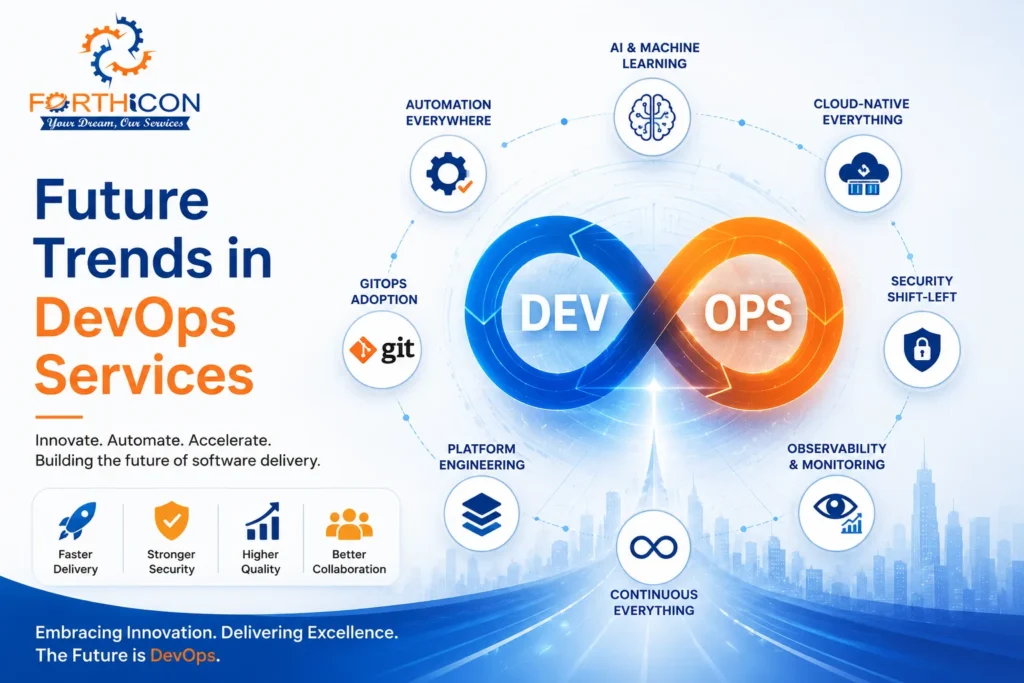
Artificial Intelligence in DevOps
AI-powered automation improves monitoring, testing, and predictive analytics.
DevSecOps Growth
Security integration will become more important in development workflows.
Serverless Computing
Businesses will adopt serverless architectures for cost efficiency and scalability.
Kubernetes Expansion
Container orchestration platforms will continue growing in popularity.
Automated Monitoring
Advanced monitoring systems will improve issue detection and operational insights.
The future of DevOps Services will focus heavily on automation, AI, and cloud-native technologies.
How to Choose the Right DevOps Services Provider
Selecting the right DevOps partner is important for successful implementation.
Evaluate Technical Expertise
Choose companies with experience in cloud platforms, CI/CD pipelines, and automation tools.
Check Industry Experience
Look for providers familiar with your business sector and infrastructure requirements.
Focus on Security Practices
Ensure the provider follows strong security and compliance standards.
Review Client Testimonials
Analyze customer reviews and project portfolios before making decisions.
Consider Scalability
Choose DevOps Services providers capable of supporting future business growth.
Professional DevOps partners help businesses implement efficient and scalable workflows.
Importance of DevOps Services in Digital Transformation
Digital transformation requires businesses to adopt faster, smarter, and more automated operational models. DevOps Services play a major role in helping organizations modernize software development and IT infrastructure.
Businesses using DevOps practices achieve:
- Faster innovation
- Better customer experiences
- Improved operational efficiency
- Stronger scalability
- Reduced infrastructure costs
Modern enterprises cannot compete effectively without agile software delivery and automation systems. DevOps enables businesses to remain flexible and responsive in changing markets.
Best Practices for Successful DevOps Implementation
Start with Small Projects
Begin DevOps implementation gradually before scaling across the organization.
Focus on Automation
Automate testing, deployment, and infrastructure management whenever possible.
Encourage Team Collaboration
Strong communication between teams improves project success.
Monitor Performance Continuously
Use monitoring tools to track application health and infrastructure performance.
Invest in Training
Provide employees with DevOps education and technical skill development.
Following these best practices helps businesses maximize the benefits of DevOps Services.
Conclusion
DevOps Services have transformed modern software development and IT operations by improving automation, collaboration, scalability, and deployment speed. Businesses adopting DevOps methodologies can deliver high-quality applications faster while reducing operational complexity and infrastructure costs.
From continuous integration and cloud deployment to monitoring and security automation, DevOps provides businesses with powerful tools and processes for digital success. Industries such as banking, healthcare, e-commerce, manufacturing, and IT services are rapidly adopting DevOps strategies to improve performance and customer experiences.
As technology continues evolving, DevOps Services will remain essential for businesses pursuing digital transformation, cloud scalability, and faster innovation. Companies investing in DevOps today will achieve stronger operational efficiency, improved software quality, and sustainable long-term growth in the competitive digital marketplace.
Frequently Asked Questions About DevOps Services
1. What are DevOps Services and how do they help businesses?
DevOps Services are professional solutions that combine software development and IT operations to improve collaboration, automation, deployment speed, and application performance. Traditional software development often creates communication gaps between development and operations teams, leading to slower releases, deployment failures, and operational inefficiencies. DevOps solves these problems by creating a unified workflow focused on continuous integration, continuous delivery, monitoring, and automation.
Businesses use DevOps Services to accelerate software delivery, reduce infrastructure costs, and improve operational reliability. These services help automate repetitive tasks such as testing, deployment, server management, and configuration updates. Automation reduces human errors and increases efficiency.
Modern DevOps practices also improve collaboration among developers, testers, operations engineers, and security teams. This integrated environment allows businesses to release software updates more frequently while maintaining high-quality performance and security standards.
DevOps Services are widely used in industries such as banking, healthcare, e-commerce, manufacturing, and technology because businesses need scalable and agile systems to compete in today’s digital environment.
2. Why are DevOps Services important for modern software development?
DevOps Services are important because modern businesses require faster software releases, improved scalability, and reliable digital systems. Traditional software development processes are often slow and disconnected, making it difficult to respond quickly to customer demands and market changes.
DevOps improves software development by introducing automation, continuous testing, cloud integration, and collaborative workflows. Businesses can deliver applications and updates more quickly without sacrificing quality or security.
Modern customers expect seamless digital experiences and frequent product improvements. DevOps allows organizations to release updates continuously, fix issues rapidly, and improve customer satisfaction.
DevOps also reduces downtime and operational risks by using monitoring systems, automated testing, and infrastructure management tools. Businesses benefit from improved productivity, better collaboration, reduced deployment failures, and stronger system reliability.
As companies continue adopting digital transformation strategies, DevOps Services have become essential for maintaining competitiveness and operational agility.
3. What are the main benefits of using DevOps Services?
DevOps Services provide multiple benefits that improve software development, operational efficiency, and business growth. One of the biggest advantages is faster software delivery. Automated deployment and continuous integration help businesses release applications more quickly and efficiently.
Another major benefit is improved collaboration between development and operations teams. Shared workflows and communication tools reduce misunderstandings and improve project coordination.
DevOps also improves software quality through automated testing and continuous monitoring. Businesses can identify bugs earlier and resolve issues before they affect customers.
Scalability is another important benefit. Cloud-based DevOps infrastructure allows businesses to scale resources according to demand without major operational disruptions.
Additional benefits include:
- Reduced infrastructure costs
- Faster recovery from failures
- Improved security integration
- Better customer experiences
- Higher operational efficiency
- Enhanced business agility
Organizations using DevOps Services often achieve better performance, reduced downtime, and stronger competitive advantages.
4. How does automation improve DevOps Services?
Automation is one of the most important components of DevOps Services because it improves speed, consistency, and operational efficiency. Manual processes are often slow, error-prone, and difficult to scale. Automation reduces repetitive tasks and allows teams to focus on innovation and problem-solving.
In DevOps, automation is used for:
- Software testing
- Application deployment
- Infrastructure provisioning
- Configuration management
- Monitoring and reporting
Automated testing helps developers identify bugs quickly before software reaches production environments. Automated deployment pipelines ensure consistent and reliable application releases.
Infrastructure automation allows businesses to configure servers, cloud environments, and databases using scripts instead of manual setup. This improves consistency and reduces configuration errors.
Automation also improves scalability because businesses can deploy new resources rapidly based on customer demand. Modern DevOps Services rely heavily on automation to achieve continuous integration and continuous delivery objectives.
5. What tools are commonly used in DevOps Service?
Professional DevOps Services use a variety of tools for automation, monitoring, collaboration, and deployment management. These tools help businesses improve software development workflows and operational performance.
Popular DevOps tools include Jenkins for continuous integration and automated testing. GitLab CI/CD is widely used for version control and deployment automation. Docker helps businesses package applications into portable containers for consistent deployment across environments.
Kubernetes is commonly used for container orchestration and scalable infrastructure management. Ansible, Puppet, and Chef are used for configuration management and infrastructure automation.
Monitoring tools like Prometheus and Grafana help businesses track application performance and infrastructure health in real-time.
Cloud platforms such as AWS, Microsoft Azure, and Google Cloud Platform also play important roles in DevOps implementation because they provide scalable and flexible infrastructure solutions.
The right combination of DevOps tools depends on business requirements, infrastructure complexity, and software development goals.
6. How do DevOps Services improve software security?
Modern DevOps Service integrate security directly into development and deployment workflows through a process called DevSecOps. Traditional security methods often treat security as a separate stage after development, which can create delays and vulnerabilities.
DevSecOps introduces automated security testing, vulnerability scanning, and compliance monitoring throughout the development lifecycle. This allows businesses to identify security issues earlier and reduce risks before deployment.
Security automation tools continuously scan applications, infrastructure, and code repositories for vulnerabilities. Businesses can respond quickly to threats and maintain stronger protection against cyberattacks.
DevOps also improves security by using:
- Access control systems
- Infrastructure monitoring
- Automated patch management
- Secure cloud configurations
- Data encryption practices
Continuous monitoring helps businesses detect unusual activities and system vulnerabilities in real-time. DevOps Services help organizations maintain compliance with industry regulations while improving software reliability and customer trust.
7. Which industries benefit the most from DevOps Service?
Almost every industry benefits from DevOps Service because digital transformation and software automation have become essential for modern business operations. However, some industries depend more heavily on DevOps due to their operational complexity and customer expectations.
Banking and financial institutions use DevOps for secure transaction systems, cloud infrastructure management, and faster software deployment. Healthcare organizations rely on DevOps for patient management systems, application reliability, and secure data processing.
E-commerce businesses benefit from DevOps by improving website scalability, reducing downtime during high traffic, and accelerating feature releases. Technology companies use DevOps extensively for agile software development and operational automation.
Manufacturing industries use DevOps for IoT infrastructure management, automation systems, and operational monitoring. Educational institutions also use DevOps for online learning platforms and cloud-based systems.
DevOps Services provide scalability, automation, and operational flexibility across multiple sectors.
8. What challenges do businesses face during DevOps implementation?
Implementing DevOps Service can provide major benefits, but businesses may also face several challenges during adoption. One common challenge is cultural resistance. Teams accustomed to traditional workflows may hesitate to adopt collaborative and automated processes.
Skill gaps are another challenge because DevOps requires knowledge of cloud platforms, automation tools, containerization, and continuous deployment systems. Businesses may need employee training or external expertise.
Infrastructure complexity can also create implementation difficulties, especially for organizations with legacy systems and large-scale applications.
Security concerns may arise if businesses prioritize speed without integrating proper security controls. This is why DevSecOps practices are important for balancing automation and protection.
Other challenges include:
- Tool integration complexity
- Process standardization
- Continuous monitoring requirements
- Initial implementation costs
Professional DevOps Services providers help businesses overcome these challenges through strategic planning, automation frameworks, employee training, and scalable infrastructure solutions.
9. How does cloud computing support DevOps Service?
Cloud computing and DevOps Service work together to improve scalability, flexibility, and operational efficiency. Cloud platforms provide on-demand infrastructure resources that support automated deployment and continuous integration workflows.
Businesses using cloud-based DevOps can deploy applications faster because cloud environments eliminate the need for manual server provisioning. Cloud infrastructure also improves scalability because businesses can increase or reduce resources based on demand.
Cloud computing supports:
- Remote accessibility
- Infrastructure automation
- Faster disaster recovery
- Cost optimization
- Global application deployment
Major cloud platforms like AWS, Azure, and Google Cloud offer tools specifically designed for DevOps workflows. These platforms support container management, serverless computing, monitoring systems, and CI/CD pipelines.
Cloud integration has become a core component of modern DevOps Services because it improves agility and reduces infrastructure management complexity.
10. How can businesses choose the best DevOps Services provider?
Choosing the right DevOps Service provider is important for successful implementation and long-term operational efficiency. Businesses should first evaluate the provider’s technical expertise in automation, cloud computing, CI/CD pipelines, containerization, and infrastructure management.
Industry experience is also important because different industries have unique compliance, security, and operational requirements. Businesses should review case studies, client testimonials, and project portfolios before making decisions.
The best DevOps Service providers offer scalable solutions, transparent communication, and customized implementation strategies based on business goals.
Businesses should also evaluate:
- Security standards
- Cloud platform expertise
- Monitoring capabilities
- Support and maintenance services
- Pricing structure
- Automation frameworks
Reliable DevOps partners help organizations improve software delivery, operational performance, scalability, and digital transformation outcomes.