
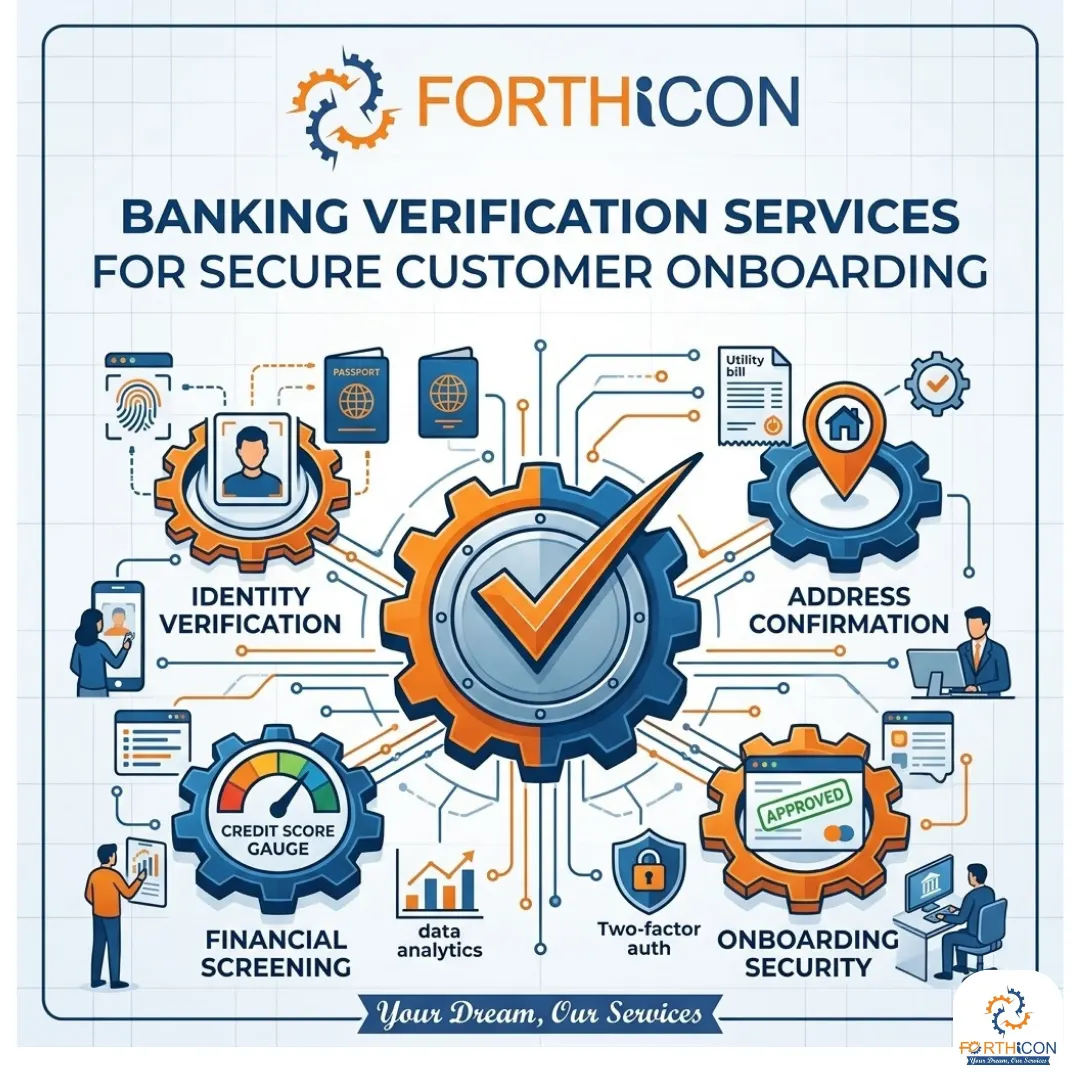
Table of Contents
Introduction
In today’s rapidly evolving financial ecosystem, banks, non-banking financial companies (NBFCs), and fintech organizations must ensure that every customer onboarding process is secure, compliant, and efficient. Financial institutions handle sensitive customer information, making identity verification and compliance with regulatory standards essential.
This is where Banking Verification Services play a critical role. These services help financial institutions verify customer identities, confirm contact information, validate documents, and ensure compliance with regulatory requirements before providing banking services.
With increasing digital banking adoption, organizations must implement modern verification technologies to prevent fraud and streamline onboarding processes. Professional service providers such as Forthicon Pvt Ltd offer comprehensive banking verification solutions designed to support financial institutions across India.
In this article, we will explore the importance of Banking Verification Services, how they work, and why they are essential for secure customer onboarding in modern banking systems.
What Are Banking Verification Services?
Banking Verification Services refer to processes used by financial institutions to confirm the identity, contact details, and financial credibility of customers before granting access to banking services.
These services ensure that customers are legitimate and comply with regulatory requirements set by financial authorities.
Verification typically includes:
- Identity verification
- Address verification
- Contact point verification
- Document authentication
- Compliance checks
Banks and financial institutions use these verification processes to prevent fraud, money laundering, and identity theft.
Importance of Banking Verification in Customer Onboarding
Customer onboarding is the first interaction between a financial institution and a new client. A secure onboarding process builds trust and ensures compliance with financial regulations.
Here are some key reasons why Banking Verification Services are essential.
1.Prevent Financial Fraud
Fraudulent activities such as identity theft and account manipulation can cause significant financial losses. Verification services ensure that only legitimate customers gain access to banking systems.
2.Ensure Regulatory Compliance
Financial institutions must comply with regulations established by authorities such as Reserve Bank of India. Proper verification helps banks meet these compliance requirements.
3.Improve Customer Trust
Customers feel more secure when banks implement strict verification procedures to protect their financial information.
4.Streamline Onboarding Processes
Automated verification solutions reduce manual work and accelerate the onboarding process.
5.Reduce Operational Risks
Verification systems help detect suspicious activities early and prevent potential financial crimes.
Types of Banking Verification Services
Financial institutions use various verification methods depending on regulatory requirements and operational needs.
1.Contact Point Verification (CPV)
Contact Point Verification ensures that the customer’s contact details are accurate and legitimate.
This process verifies:
- Phone numbers
- Email addresses
- Residential addresses
- Business addresses
Field verification teams may conduct physical visits to confirm the authenticity of provided information.
Contact Point Verification is widely used by banks and NBFCs to reduce the risk of fraudulent accounts.
2.Video KYC Verification
Video KYC is a modern digital solution that allows banks to verify customer identities remotely through video calls.
This process typically includes:
- Live video verification
- Identity document validation
- Facial recognition technology
- Real-time interaction with verification officers
Video KYC has become increasingly popular because it provides a convenient and secure way to complete verification without requiring customers to visit bank branches.
Many digital banks and fintech companies now rely on video KYC to streamline customer onboarding.
3.Physical KYC Verification
Despite digital advancements, physical KYC verification remains important in certain cases.
Physical verification involves:
- In-person identity verification
- Document inspection
- Address confirmation visits
- Biometric data collection
This method is often required for high-value accounts or regulatory compliance in specific financial services.
4.Document Verification Services
Document verification ensures that customer documents are authentic and valid.
Banks verify documents such as:
- Government-issued identity proofs
- Address proof documents
- Income verification documents
- Business registration certificates
Advanced technologies like artificial intelligence and machine learning help detect forged documents and prevent fraudulent activities.
5.EMI Reminder and Customer Support Verification
Financial institutions often provide support services to ensure customers meet their loan obligations.
Verification services also include:
- First EMI reminder calls
- Payment assistance support
- Customer guidance for payment procedures
These services improve customer engagement and reduce loan default rates.
Technologies Used in Banking Verification
Modern Banking Verification Services rely on advanced technologies to enhance security and efficiency.
Artificial Intelligence and Machine Learning
AI-powered systems analyze customer data to detect suspicious patterns and potential fraud.
Biometric Authentication
Biometric technologies such as facial recognition and fingerprint scanning help verify customer identities accurately.
Blockchain Technology
Blockchain ensures secure and tamper-proof storage of verification records.
Cloud-Based Verification Systems
Cloud infrastructure enables financial institutions to manage verification processes securely and efficiently.
Benefits of Banking Verification Services
Implementing professional Banking Verification Services provides numerous advantages for financial institutions.
Improved Security
Verification systems protect banking platforms from unauthorized access and financial fraud.
Faster Customer Onboarding
Automated verification processes reduce onboarding time and improve customer satisfaction.
Regulatory Compliance
Banks must comply with regulations established by financial authorities to avoid penalties.
Operational Efficiency
Verification services reduce manual work and improve operational efficiency
Fraud Detection
Advanced verification technologies identify suspicious activities and prevent financial crimes.
Banking Verification for NBFCs and FinTech Companies
Non-banking financial companies and fintech startups also require reliable verification systems.
These organizations rely heavily on digital platforms to deliver financial services.
Verification services help them:
- Confirm customer identities
- Prevent fraudulent loan applications
- Ensure regulatory compliance
- Build trust with customers
Many fintech companies integrate digital verification solutions into their mobile applications and online platforms.
Choosing the Right Banking Verification Service Provider
Selecting a reliable service provider is essential for successful verification implementation.
Businesses should consider the following factors when choosing Banking Verification Services.
Regulatory Compliance Expertise
Ensure the provider understands regulatory frameworks established by authorities like the Reserve Bank of India.
Technology Capabilities
Modern verification providers should use AI, automation, and secure digital systems.
Nationwide Coverage
Providers with pan-India verification networks can support businesses across multiple locations.
Data Security Standards
Financial institutions must ensure that customer data is handled securely.
Customer Support
Reliable support services help resolve verification issues quickly.
Future Trends in Banking Verification
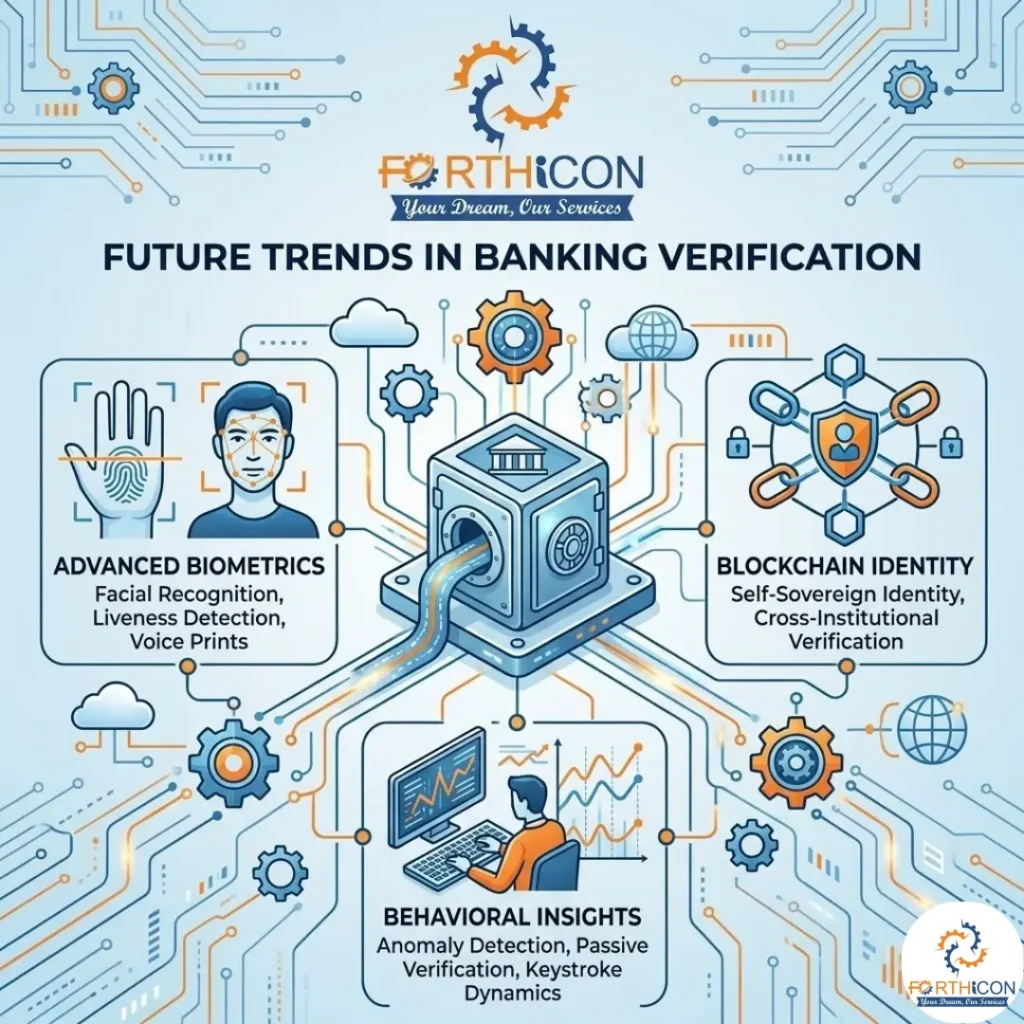
The future of Banking Verification Services will be shaped by technological innovations and evolving regulatory frameworks.
Digital Identity Verification
Governments and financial institutions are adopting digital identity systems to streamline verification processes.
AI-Based Fraud Detection
AI algorithms will continue improving fraud detection capabilities.
Biometric Authentication Expansion
Biometric technologies will become more common in banking applications.
Paperless Banking
Financial institutions are moving toward fully digital onboarding systems to enhance efficiency and reduce paperwork.
To ensure regulatory compliance and secure banking operations, financial institutions must follow strict guidelines issued by the Reserve Bank of India. These regulations require banks to implement proper identity verification processes before onboarding customers. Modern digital verification systems also follow cybersecurity frameworks recommended by organizations like National Institute of Standards and Technology to protect customer data and financial transactions.
Conclusion
Secure customer onboarding is essential for the success of modern financial institutions. Banking Verification Services help banks, NBFCs, and fintech companies verify customer identities, comply with regulatory requirements, and prevent financial fraud.
From contact point verification and video KYC to document authentication and digital verification systems, these services play a vital role in maintaining trust and security in the banking sector.
Organizations that invest in advanced verification solutions will be better equipped to manage regulatory compliance, improve operational efficiency, and provide secure banking experiences for customers.
As digital banking continues to grow, reliable Banking Verification Services will remain a fundamental component of the financial ecosystem.
Frequently Asked Questions (FAQ) – Banking Verification Services
1.What are Banking Verification Services?
Banking Verification Services refer to processes used by banks, financial institutions, NBFCs, and fintech companies to verify the identity and information of customers before providing financial services. These services ensure that customers are genuine and comply with financial regulations.
Verification typically includes checking identity documents, validating addresses, confirming contact information, and ensuring regulatory compliance. By implementing professional Banking Verification Services, financial institutions can prevent fraud, reduce risk, and improve customer onboarding efficiency.
Many organizations rely on specialized service providers like Forthicon Pvt Ltd to manage verification processes efficiently across multiple locations.
2.Why are Banking Verification Services important for financial institutions?
Banking verification is essential for maintaining trust, security, and regulatory compliance in the financial sector. Financial institutions deal with sensitive information and must ensure that customers are legitimate before granting access to financial products.
Banking Verification Services help institutions:
- Prevent identity fraud and financial crimes
- Ensure compliance with regulatory authorities
- Verify customer information accurately
- Improve the security of financial transactions
- Build customer trust
Without proper verification processes, banks risk financial losses and regulatory penalties.
3.What is KYC in banking verification?
KYC stands for Know Your Customer, a mandatory process used by financial institutions to verify the identity of their customers. KYC ensures that customers are genuine and prevents illegal activities such as money laundering and financial fraud.
KYC verification includes collecting documents such as identity proof, address proof, and photographs. Financial institutions must comply with regulations issued by authorities like Reserve Bank of India.
KYC is a fundamental component of Banking Verification Services and is required before opening bank accounts, issuing loans, or providing financial services.
4.What are the different types of banking verification methods?
There are several types of verification methods used in modern Banking Verification Services.
Contact Point Verification (CPV)
This method verifies customer contact details such as phone numbers, email addresses, and physical addresses.
Video KYC Verification
Customers complete verification through live video interaction with banking representatives.
Physical KYC Verification
This traditional method involves in-person verification of documents and identity.
Document Verification
Banks verify identity and financial documents to ensure authenticity.
These methods help financial institutions maintain accurate customer records and comply with regulations.
5.What is Contact Point Verification (CPV)?
Contact Point Verification (CPV) is a process used to confirm the accuracy of customer contact details. It involves verifying the customer’s phone number, email address, and residential or business address.
Field verification teams may visit the provided address to confirm the authenticity of the information.
CPV is widely used by banks, NBFCs, and financial companies to ensure that customers provide correct contact information. It is an important part of Banking Verification Services and helps prevent fraud and identity misrepresentation.
6.What is Video KYC and how does it work?
Video KYC is a digital verification process that allows banks to verify customer identities through live video calls. This process eliminates the need for physical visits to bank branches.
During video KYC:
- Customers connect with a verification officer via video call
- Identity documents are displayed and validated
- Facial recognition confirms identity
- Verification is completed in real time
Video KYC is becoming popular because it provides faster and more convenient Banking Verification Services for customers.
7. How do Banking Verification Services prevent fraud?
Fraud prevention is one of the main purposes of Banking Verification Services. Financial fraud can occur when individuals use fake identities, forged documents, or stolen information to access banking services.
Verification systems prevent fraud by:
- Confirming customer identities
- Detecting fake or forged documents
- Validating addresses and contact information
- Monitoring suspicious activities
Advanced technologies such as artificial intelligence and biometric authentication further improve fraud detection capabilities.
8.Which organizations require Banking Verification Services?
Many types of financial institutions rely on Banking Verification Services.
These include:
- Retail banks
- Corporate banks
- Non-banking financial companies (NBFCs)
- FinTech companies
- Loan providers
- Insurance companies
These organizations must verify customer identities before providing financial services to ensure compliance with regulatory guidelines.
9.How long does the banking verification process take?
The duration of banking verification depends on the type of verification used.
For example:
- Video KYC verification may take only a few minutes
- Contact point verification may take 24–48 hours
- Physical KYC verification may require a few days depending on location
Modern Banking Verification Services use digital technologies to speed up the process while maintaining accuracy and compliance.
10.What technologies are used in modern Banking Verification Services?
Modern verification systems rely on advanced technologies to improve accuracy and security.
Common technologies include:
Artificial Intelligence (AI)
AI helps analyze customer data and detect suspicious behavior.
Biometric Authentication
Biometric systems such as facial recognition and fingerprint scanning confirm customer identity.
Cloud-Based Verification Systems
Cloud infrastructure enables secure storage and processing of verification data.
Data Analytics Tools
Analytics tools help institutions track verification performance and identify risks.
These technologies help financial institutions deliver faster and more reliable Banking Verification Services.
11.How do Banking Verification Services help improve customer onboarding?
Customer onboarding is the process of registering new customers in banking systems. Efficient onboarding improves customer experience and reduces delays.
Banking Verification Services streamline onboarding by:
- Automating document verification
- Reducing paperwork
- Speeding up verification processes
- Ensuring regulatory compliance
Digital verification solutions allow customers to complete onboarding quickly without visiting bank branches.
12.What are the benefits of outsourcing Banking Verification Services?
Many financial institutions outsource verification processes to professional service providers.
Outsourcing Banking Verification Services offers several advantages:
- Access to trained verification professionals
- Faster processing times
- Reduced operational costs
- Pan-India verification networks
- Improved regulatory compliance
Outsourcing also allows banks to focus on core financial operations while experts manage verification tasks.