
Table of Contents
The physical verification process in banking is an essential step to ensure authentic customer onboarding and prevent financial fraud. FORTHICON, a Pune-based company, provides professional banking verification services across India, helping banks maintain compliance and reduce risks.
Introduction to Physical Verification Process in Banking
The Physical Verification Process in banking is an essential mechanism designed to ensure the authenticity of customer information, the existence of collateral, and the accuracy of records maintained by financial institutions. While banks rely heavily on documents submitted by customers, documents alone cannot always guarantee the truthfulness of the information provided, which is why physical verification acts as an additional layer of security and risk management. This process involves on-site visits to the customer’s residential or business address, inspection of collateral such as property, vehicles, or inventory, and direct interaction with the customer to confirm details. Its primary purpose is to verify the identity of the customer, ensure that pledged assets truly exist and belong to them, prevent fraudulent activities, and maintain operational accuracy across banking records. Physical verification also plays a critical role in regulatory compliance, helping banks adhere to guidelines issued by authorities such as the Reserve Bank of India (RBI) and other financial regulators. Typically, the process includes planning the verification, reviewing submitted documents, conducting the physical inspection, preparing a detailed report of findings, and taking follow-up actions based on observations.
Importance of Physical Verification Process in Banks
Physical verification provides several benefits for banks:
- Fraud Prevention: Detects false identities and addresses.
- Regulatory Compliance: Ensures adherence to RBI guidelines and AML regulations.
- Risk Reduction: Minimizes potential financial losses.
- Customer Trust: Builds confidence in banking services.
- Accurate Records: Maintains precise KYC information.
Banks offering home loans or business financing rely on companies like FORTHICON to verify properties and businesses accurately, reducing the risk of fraud.
Types of Physical Verification
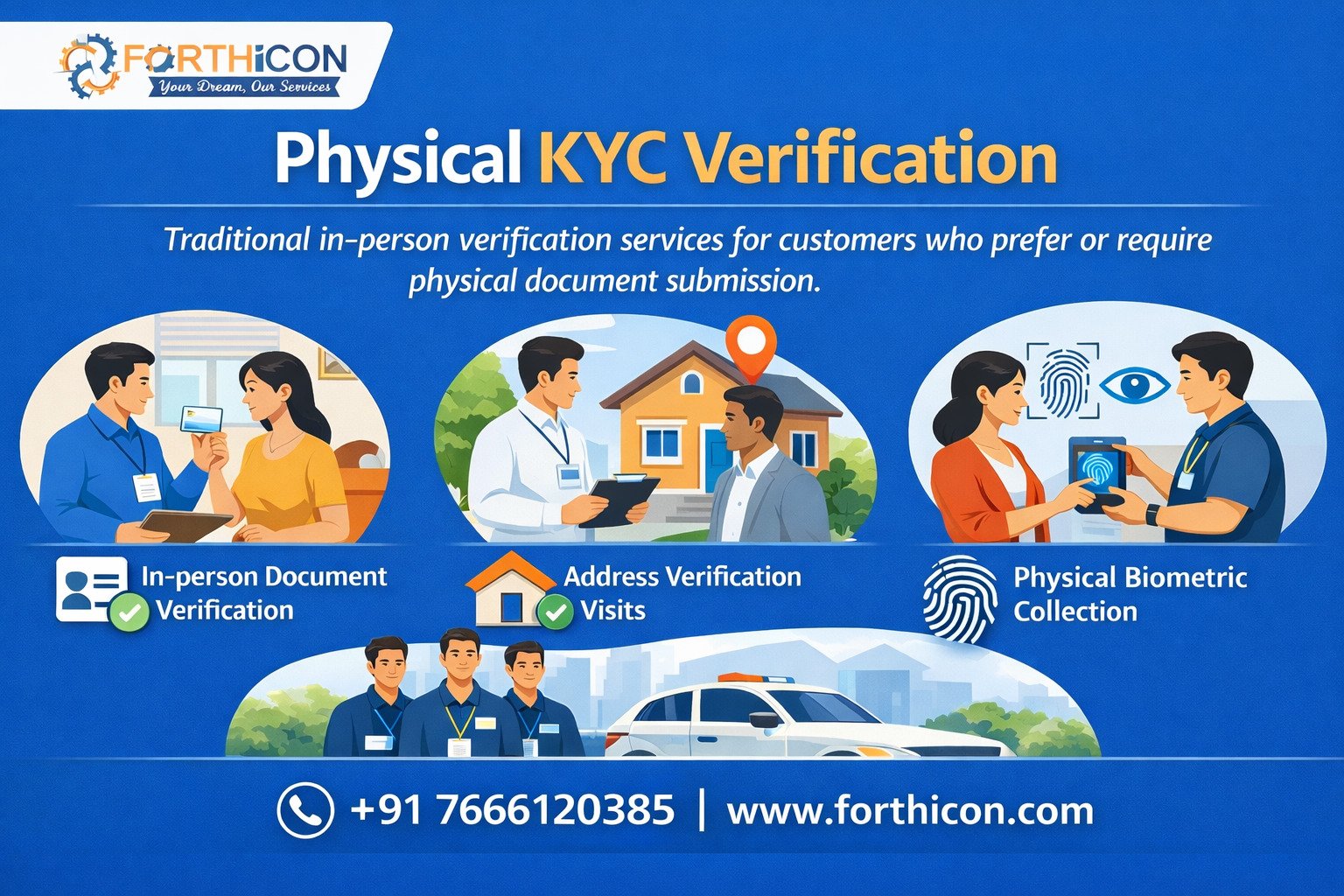
- Residential Verification: Confirms the customer’s residential address.
- Business Verification: Validates the legitimacy of business operations.
- Loan Verification: Checks property documents, collateral, or income statements.
- Account Opening Verification: Confirms identity and address.
- High-Value Transaction Verification: Ensures compliance for large transactions.
FORTHICON provides all these verification services efficiently throughout India.
Step-by-Step Physical Verification Process
- Initiation: Verification is triggered after application submission.
- Document Review: Preliminary review of submitted IDs, address proofs, and income documents.
- Assigning Field Officer: FORTHICON assigns trained officers to perform in-person verification.
- On-Site Verification: Officers visit residences, businesses, or properties to validate information.
- Photographic Evidence: Photos of the address, business, or property are captured.
- Report Submission: Detailed reports are submitted to the bank.
- Final Approval: Banks review reports before account activation or loan disbursal.
Role of Field Officers in Verification
Field officers are responsible for:
- Visiting addresses or business premises.
- Interacting with neighbors or local authorities.
- Verifying submitted documents.
- Reporting discrepancies.
- Capturing photographs and digital evidence.
FORTHICON ensures officers are well-trained and equipped for accurate verification anywhere in India.
Required Documents for Verification
- Government IDs: Aadhaar, Passport, PAN Card.
- Proof of Address: Utility bills, rental agreements, bank statements.
- Income Proof: Salary slips, tax returns, bank statements.
- Property or Collateral Documents: Legal ownership or lease agreements.
These documents are cross-checked thoroughly during verification.
Technology Integration in Physical Verification
FORTHICON uses technology to improve verification efficiency:
- Mobile apps for real-time data collection.
- GPS tracking to confirm officer visits.
- Digital photography for documentation.
- Database verification for cross-checking information.
- AI-assisted document verification for fraud detection.
Common Challenges and Solutions
Address Discrepancies: Use alternate proofs or neighbor statements.
Fraudulent Documents: AI scanning and officer vigilance.
Uncooperative Customers: Schedule visits with notice or use video verification.
Remote Locations: Local agents or hybrid verification methods.
Enhances Credit Assessment Accuracy
The physical verification process in banking significantly enhances the accuracy of credit assessment by providing a real-world confirmation of the information submitted by customers during loan applications or account opening. While financial statements, documents, and declarations give an overview of a customer’s financial standing, they cannot always capture the actual operational or business conditions. Through on-site visits to residential addresses, business premises, or collateral locations, bank officials can observe the true scale and nature of the customer’s assets, inventory, or business operations. This hands-on verification enables the bank to evaluate the customer’s repayment capacity more realistically, detect any inconsistencies or exaggerations in submitted documents, and make informed lending decisions. By directly assessing the condition of collateral, the operational status of businesses, and the overall environment of the customer’s financial activity, banks reduce the risk of granting loans to unqualified borrowers or accepting insufficient security. Ultimately, this process strengthens the credit evaluation mechanism, ensures more reliable risk assessment, and contributes to minimizing defaults, thereby supporting the overall stability and soundness of the banking system.
Best Practices for Banks
Train field officers thoroughly.
Use mobile apps and GPS for reporting.
Maintain SOPs for documentation.
Ensure professionalism and confidentiality.
Conduct audits for compliance.
Encourage customer cooperation.
Case Studies: Successful Physical Verification Implementation
Case Study 1: FORTHICON used GPS-enabled apps for home loan verification, reducing errors by 40% & speeding approvals.
Case Study 2: Hybrid verification for SME loans reduced turnaround times by 30%.
Case Study 3: AI-assisted verification for premium accounts shortened processing times while maintaining compliance.
Regulatory Compliance and Legal Considerations
Banks must comply with RBI KYC guidelines, AML regulations, and internal audits. Physical verification by companies like FORTHICON helps maintain adherence to these legal requirements, avoiding fines or penalties.
Future Trends in Physical Verification
- AI-driven document verification
- Video-based KYC combined with on-site visits
- Blockchain for secure records
- Automation of routine verification tasks
- Biometric verification
FORTHICON stays updated with these trends to provide modern, reliable verification services nationwide.
Case Study: FORTHICON Success Stories
FORTHICON has helped multiple businesses in Pune achieve their recruitment goals efficiently. One IT startup needed 50 skilled developers in three months. By leveraging RPO services, FORTHICON sourced and onboarded all candidates within the timeline, ensuring quality and cultural fit. Another manufacturing firm benefited from reduced hiring costs and faster recruitment cycles by partnering with FORTHICON.
These success stories demonstrate how RPO can transform talent acquisition and deliver measurable business impact.
Conclusion
Recruitment Process Outsourcing in India is revolutionizing the way companies attract and hire talent. Partnering with a trusted RPO provider like FORTHICON in Pune enables businesses to enjoy faster hiring, access a broader talent pool, cost efficiency, and improved candidate experience.
Investing in RPO services is not just about filling positions; it’s about gaining a strategic advantage in today’s competitive market. With FORTHICON, companies can focus on growth while we
manage their recruitment needs seamlessly.
What is the Physical Verification Process in Banking?
The Physical Verification Process in Banking is a procedure where banks or financial institutions verify a customer’s residential or business address in person. FORTHICON, Pune, provides expert assistance to ensure this process is completed efficiently and accurately.
Why is Physical Verification Process in Banking important?
The Physical Verification Process in Banking helps prevent fraud, confirms the authenticity of customer details, and ensures compliance with regulatory standards. FORTHICON’s team in Pune makes this process smooth for clients.
How does FORTHICON assist with the Physical Verification Process in Banking?
FORTHICON, Pune, handles all steps of the Physical Verification Process in Banking, including documentation checks, in-person visits, and reporting back to the bank, saving time and ensuring accuracy.
What documents are required for the Physical Verification Process in Banking?
Typically, documents like government-issued ID proofs, address proofs, and property papers are needed. FORTHICON, Pune, guides clients on the exact documents required for a seamless Physical Verification Process in Banking.
How long does the Physical Verification Process in Banking take?
The duration can vary depending on the bank and location. FORTHICON, Pune, ensures timely completion of the Physical Verification Process in Banking, providing detailed reports to banks promptly.
Can FORTHICON handle multiple verifications at the same time?
Yes, FORTHICON, Pune, is equipped to manage multiple Physical Verification Processes in Banking simultaneously while maintaining accuracy and reliability.
How does FORTHICON ensure a smooth Physical Verification Process in Banking for clients in Pune?
FORTHICON, Pune, follows a structured approach for the Physical Verification Process in Banking. From pre-verification document checks to in-person visits, the team ensures every step is accurate and efficient.
What are the key steps involved in the Physical Verification Process in Banking handled by FORTHICON?
The process includes collecting necessary documents, verifying addresses on-site, cross-checking details, and preparing detailed reports. FORTHICON manages all these steps for hassle-free completion.
Which types of accounts or loans require a Physical Verification Process in Banking?
New bank accounts, loan applications, and KYC updates often require the Physical Verification Process in Banking. FORTHICON ensures compliance with these requirements in Pune efficiently.