Table of Contents
Introduction
In today’s digital-first business environment, organizations are increasingly adopting multiple cloud platforms to improve flexibility, scalability, performance, and resilience. As businesses expand their digital infrastructure, managing multiple cloud environments becomes more complex. This is where a Multicloud Management Solution becomes essential.
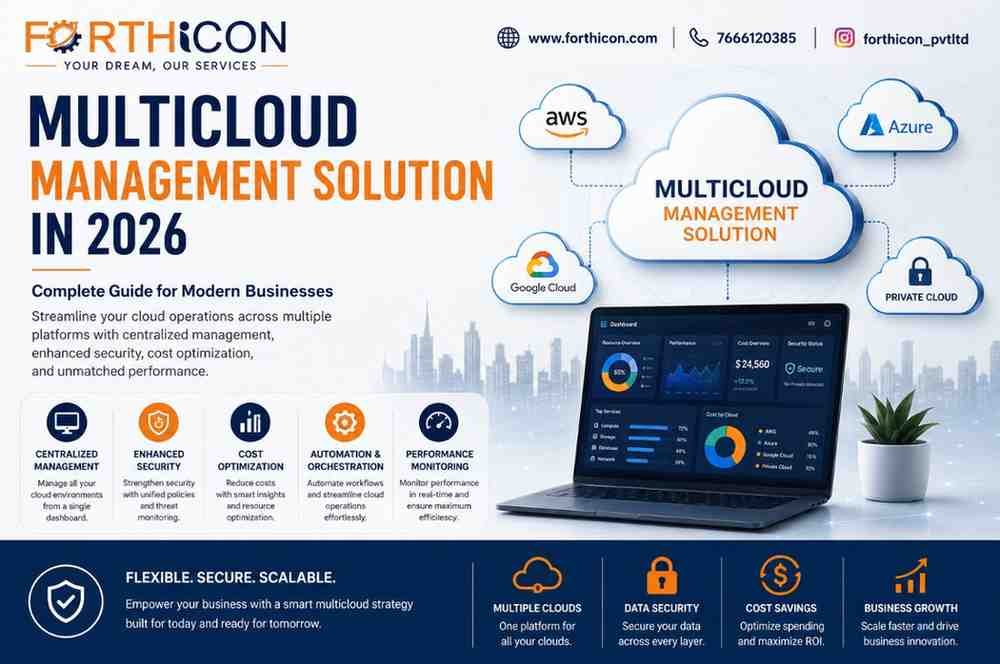
A Multicloud Management Solution enables organizations to manage, monitor, secure, and optimize workloads across different cloud service providers from a centralized platform. Whether a company uses Amazon Web Services (AWS), Microsoft Azure, Google Cloud Platform (GCP), or private cloud infrastructure, a multicloud approach helps maintain control and visibility over the entire cloud ecosystem.
In 2026, multicloud strategies have become a standard practice for enterprises seeking to avoid vendor lock-in, enhance business continuity, and improve operational efficiency. This comprehensive guide explores everything you need to know about Multicloud Management Solutions, including benefits, features, challenges, implementation strategies, and future trends.
What is a Multicloud Management Solution?
A Multicloud Management Solution is a software platform or framework that allows organizations to manage multiple cloud environments through a unified interface.
Instead of managing each cloud provider separately, businesses can use a centralized system to:
- Monitor cloud resources
- Automate workflows
- Manage security policies
- Control costs
- Optimize performance
- Ensure compliance
- Govern cloud operations
The primary goal is to simplify cloud management while maximizing the benefits of using multiple cloud providers.
Why Businesses Need a Multicloud Management Solution in 2026
Cloud adoption continues to accelerate globally. Organizations now rely on different cloud providers for various business needs.
For example:
- AWS for infrastructure services
- Microsoft Azure for enterprise applications
- Google Cloud for analytics and AI
- Private clouds for sensitive workloads
Managing these environments independently can create operational challenges.
Common Challenges
- Increased complexity
- Security inconsistencies
- Resource visibility issues
- Higher operational costs
- Compliance management difficulties
- Vendor management challenges
A Multicloud Management Solution addresses these issues by providing centralized control and automation.
Understanding the Multicloud Strategy
A multicloud strategy involves using services from more than one cloud provider.
Unlike relying on a single cloud vendor, organizations distribute workloads across multiple platforms.
Reasons for Adopting a Multicloud Strategy
- Avoid vendor dependency
- Improve reliability
- Enhance performance
- Meet compliance requirements
- Optimize costs
- Increase flexibility
Businesses gain greater control over their cloud resources while reducing operational risks.
Key Features of a Multicloud Management Solution
Centralized Cloud Management
One of the most important features is centralized visibility.
Organizations can monitor:
- Cloud resources
- Applications
- Virtual machines
- Storage systems
- Network performance
Through a single dashboard.
This simplifies cloud administration and improves operational efficiency.
Cloud Monitoring and Analytics
Real-time monitoring provides insights into cloud performance.
Capabilities include:
- Resource utilization tracking
- Application monitoring
- Performance analysis
- Service health monitoring
These insights help organizations identify issues before they affect operations.
Cloud Cost Optimization
Managing cloud costs is a major challenge for enterprises.
A Multicloud Management Solution helps businesses:
- Track cloud spending
- Identify unused resources
- Optimize workloads
- Allocate budgets effectively
This reduces unnecessary expenses and improves return on investment.
Security Management
Security remains a top priority in cloud environments.
Modern solutions provide:
- Access control management
- Identity and authentication services
- Threat detection
- Security policy enforcement
- Data encryption
Centralized security controls reduce vulnerabilities and improve protection.
Automation and Orchestration
Automation reduces manual tasks and improves efficiency.
Organizations can automate:
- Resource provisioning
- Backup processes
- Workload deployment
- Scaling operations
- Incident response
This enhances productivity and reduces operational overhead.
Compliance and Governance
Businesses must comply with various industry regulations.
A Multicloud Management Solution supports:
- Regulatory compliance
- Policy enforcement
- Audit reporting
- Risk management
This helps organizations maintain governance across cloud environments.
Benefits of Using a Multicloud Management Solution
Enhanced Flexibility
Organizations can choose the best cloud provider for each workload.
Benefits include:
- Better resource allocation
- Increased agility
- Improved service delivery
Reduced Vendor Lock-In
Vendor lock-in occurs when businesses become dependent on a single cloud provider.
A multicloud strategy reduces this risk by distributing workloads across multiple platforms.
This provides greater negotiating power and flexibility.
Improved Business Continuity
Cloud outages can disrupt operations.
Using multiple cloud providers helps organizations:
- Maintain redundancy
- Improve disaster recovery
- Ensure service availability
This reduces downtime and protects business operations.
Better Performance Optimization
Different cloud providers offer unique strengths.
Businesses can deploy workloads where they perform best.
Examples include:
- AI workloads on Google Cloud
- Enterprise applications on Azure
- Infrastructure services on AWS
This maximizes efficiency and performance
Stronger Security Posture
A Multicloud Management Solution improves security by providing consistent policies across environments.
Benefits include:
- Centralized security monitoring
- Faster threat detection
- Improved compliance management
Multicloud vs Hybrid Cloud
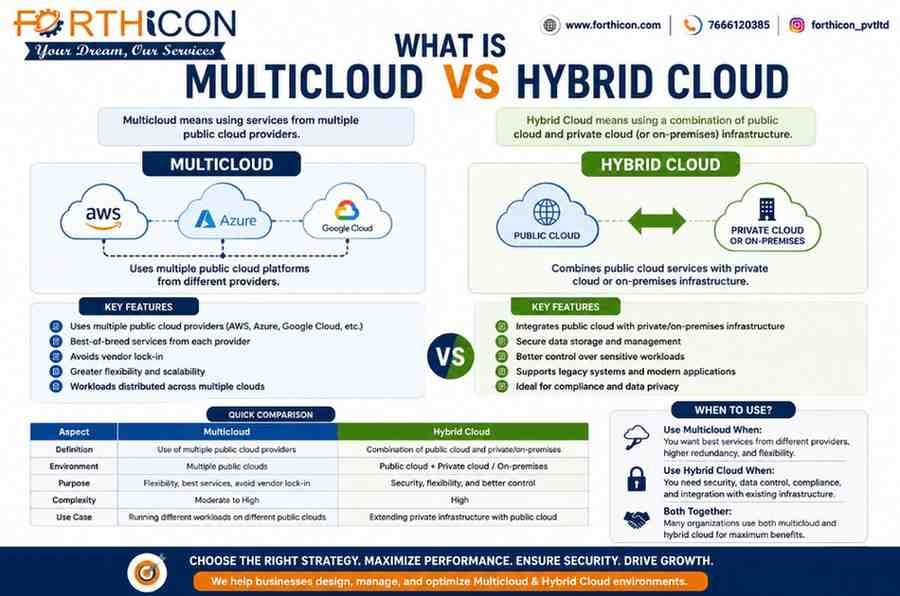
Many people confuse multicloud and hybrid cloud environments.
Although similar, they serve different purposes.
Multicloud
Uses multiple public cloud providers.
Examples:
- AWS + Azure
- Azure + Google Cloud
- AWS + Google Cloud + Oracle Cloud
Advantages
- Flexibility
- Reduced vendor dependency
- Improved resilience
Hybrid Cloud
Combines public cloud and private infrastructure.
Examples:
- Private data center + AWS
- Private cloud + Azure
Advantages
- Greater control
- Enhanced security
- Regulatory compliance
Many organizations use both multicloud and hybrid cloud strategies together.
Core Components of a Multicloud Management Solution
Cloud Resource Management
Tracks and manages cloud assets across providers.
Examples include:
- Compute resources
- Storage
- Databases
- Containers
Identity and Access Management
Controls user permissions and authentication.
Benefits include:
- Improved security
- Reduced unauthorized access
- Better compliance
Networking Management
Provides visibility into cloud networking infrastructure.
Capabilities include:
- Traffic monitoring
- Network optimization
- Connectivity management
Application Management
Organizations can deploy and manage applications across cloud platforms.
Benefits include:
- Improved scalability
- Faster deployment
- Better workload distribution
Data Management
Effective data management ensures:
- Data availability
- Data protection
- Backup and recovery
This is critical for business continuity.
Challenges of Multicloud Environments
Despite the advantages, organizations face several challenges.
Increased Complexity
Managing multiple cloud platforms requires specialized skills.
Organizations must understand:
- Different architectures
- Service models
- Pricing structures
Security Risks
Each cloud provider has unique security controls.
Without centralized management, inconsistencies can create vulnerabilities.
Cost Visibility
Cloud spending can become difficult to track across multiple providers.
Organizations need advanced monitoring and reporting capabilities.
Compliance Challenges
Different regions and industries have varying compliance requirements.
Maintaining consistent governance becomes essential.
Best Practices for Implementing a Multicloud Management Solution
Define Clear Objectives
Organizations should identify business goals before implementation.
Examples include:
- Cost reduction
- Improved performance
- Enhanced security
Establish Governance Policies
Strong governance ensures consistency across cloud environments.
Policies should address:
- Security standards
- Compliance requirements
- Resource usage
Automate Wherever Possible
Automation reduces operational complexity.
Businesses should automate:
- Provisioning
- Monitoring
- Scaling
- Reporting
Monitor Performance Continuously
Real-time monitoring helps identify issues quickly.
Key metrics include:
- Resource utilization
- Application performance
- Security events
Train IT Teams
Employees should understand:
- Cloud platforms
- Security practices
- Management tools
Training improves adoption and operational success.
Industries Benefiting from Multicloud Management Solutions
Healthcare
Healthcare organizations use multicloud environments for:
- Electronic health records
- Data analytics
- Telemedicine platforms
Financial Services
Banks and financial institutions benefit from:
- Enhanced security
- Regulatory compliance
- High availability
Manufacturing
Manufacturers use cloud platforms for:
- Supply chain management
- ERP systems
- Industrial IoT
Retail and E-commerce
Retail businesses rely on cloud solutions for:
- Online stores
- Customer analytics
- Inventory management
Government Organizations
Government agencies use multicloud environments to improve:
- Security
- Scalability
- Service delivery
Future Trends in Multicloud Management Solutions
Artificial Intelligence Integration
AI-powered tools help automate cloud management tasks.
Applications include:
- Predictive analytics
- Cost optimization
- Security monitoring
Cloud-Native Technologies
Organizations increasingly adopt:
- Containers
- Kubernetes
- Microservices
These technologies simplify multicloud deployment.
Advanced Security Solutions
Future platforms will provide:
- Zero-trust architecture
- Automated threat detection
- AI-driven security analytics
FinOps Adoption
FinOps focuses on cloud financial management.
Organizations will increasingly use FinOps practices to optimize cloud spending.
Unified Cloud Operations
Future solutions will offer greater integration across cloud providers.
This will simplify administration and improve efficiency.
Why Invest in a Multicloud Management Solution in 2026?
Businesses today depend heavily on cloud infrastructure.
A Multicloud Management Solution helps organizations:
- Improve operational efficiency
- Reduce cloud costs
- Strengthen security
- Increase scalability
- Simplify governance
- Enhance business continuity
Companies that adopt effective cloud management strategies gain a significant competitive advantage in an increasingly digital marketplace.
Conclusion
A Multicloud Management Solution has become an essential technology for modern businesses operating across multiple cloud environments. By providing centralized visibility, automation, security management, compliance support, and cost optimization, these solutions help organizations maximize the value of their cloud investments.
As cloud adoption continues to grow in 2026, businesses must adopt intelligent management strategies to handle increasing complexity. Whether you are a startup, mid-sized organization, or global enterprise, implementing a reliable Multicloud Management Solution can improve efficiency, enhance security, reduce costs, and support long-term digital transformation goals.
Organizations that embrace multicloud management today will be better positioned to innovate, scale, and succeed in the rapidly evolving cloud computing landscape.
Frequently Asked Questions (FAQs) About Multicloud Management Solutions
1. What is a Multicloud Management Solution?
A Multicloud Management Solution is a platform or software framework that enables organizations to manage, monitor, secure, and optimize multiple cloud environments from a single interface. Instead of handling each cloud provider separately, businesses can use one centralized dashboard to oversee cloud operations across providers such as Amazon Web Services (AWS), Microsoft Azure, Google Cloud Platform (GCP), Oracle Cloud, and private cloud infrastructures.
As businesses increasingly adopt cloud technologies, managing different platforms can become complex. Each cloud provider offers unique services, pricing models, security controls, and management tools. Without a centralized solution, IT teams often struggle with visibility, governance, and operational consistency.
A multicloud management platform helps organizations:
- Monitor cloud resources
- Manage workloads
- Control costs
- Automate operations
- Improve security
- Maintain compliance
- Optimize performance
These solutions simplify cloud administration while allowing businesses to leverage the strengths of multiple cloud providers.
In 2026, multicloud environments have become common because organizations seek greater flexibility, scalability, and resilience. A well-implemented management solution ensures smooth cloud operations and supports long-term digital transformation initiatives.
2. Why do businesses use multiple cloud providers?
Organizations use multiple cloud providers to gain flexibility, reduce dependency on a single vendor, and improve operational resilience.
Different cloud providers offer specialized services. For example:
- AWS excels in infrastructure services.
- Microsoft Azure integrates well with enterprise applications.
- Google Cloud provides advanced analytics and AI capabilities.
Using multiple providers allows organizations to choose the best platform for each workload.
Key reasons businesses adopt a multicloud strategy include:
Avoiding Vendor Lock-In
Depending on a single cloud provider can limit flexibility and increase risks. Multicloud environments allow organizations to switch workloads if necessary.
Improved Reliability
If one cloud provider experiences downtime, workloads can continue running on another platform.
Better Performance
Organizations can deploy applications where they perform most efficiently.
Cost Optimization
Businesses can compare pricing across providers and allocate workloads accordingly.
Regulatory Compliance
Some industries require data to be stored in specific regions or infrastructures, making multiple providers necessary.
By using multiple cloud platforms, organizations can build a more flexible, resilient, and efficient IT environment.
3. What are the key features of a Multicloud Management Solution?
A comprehensive multicloud platform includes numerous features designed to simplify cloud administration.
Centralized Dashboard
Provides a unified view of all cloud resources.
Cloud Monitoring
Tracks performance, availability, and utilization across providers.
Cost Management
Monitors spending and identifies opportunities for savings.
Security Management
Applies consistent security policies across environments.
Automation
Automates provisioning, scaling, deployment, and maintenance tasks.
Compliance Monitoring
Helps organizations meet regulatory requirements.
Resource Optimization
Identifies underutilized resources and improves efficiency.
Reporting and Analytics
Generates detailed insights into cloud performance and spending.
Identity and Access Management
Controls user permissions and authentication.
Disaster Recovery Support
Enhances business continuity through backup and recovery planning.
These features help organizations maintain visibility, control, and operational efficiency across complex cloud ecosystems.
4. How does a Multicloud Management Solution improve cloud security?
Cloud security is one of the biggest concerns for organizations operating in multiple cloud environments.
Each cloud provider uses different security tools and configurations. Without centralized management, maintaining consistent protection becomes difficult.
A multicloud platform enhances security through:
Unified Security Policies
Organizations can apply the same security standards across all cloud providers.
Identity Management
Centralized access controls reduce unauthorized access risks.
Threat Detection
Advanced monitoring identifies suspicious activities in real time.
Data Encryption
Protects sensitive information during storage and transmission.
Compliance Enforcement
Ensures adherence to industry regulations and internal policies.
Security Auditing
Provides detailed logs and reporting for security reviews.
By centralizing security management, organizations reduce vulnerabilities and improve their overall security posture.
5. What is the difference between Multicloud and Hybrid Cloud?
Many people use these terms interchangeably, but they have distinct meanings.
Multicloud Environment
A multicloud strategy involves using services from multiple public cloud providers.
Examples include:
- AWS and Azure
- Azure and Google Cloud
- AWS, Google Cloud, and Oracle Cloud
The primary goal is to leverage the strengths of different providers.
Hybrid Cloud Environment
A hybrid cloud combines public cloud infrastructure with private cloud systems or on-premises data centers.
Examples include:
- Private data center plus AWS
- On-premises infrastructure plus Azure
The goal is to balance flexibility with greater control over sensitive workloads.
Key Difference
- Multicloud focuses on multiple cloud providers.
- Hybrid cloud focuses on combining public and private infrastructure.
Many organizations use both strategies simultaneously to maximize flexibility and security.
6. How does a Multicloud Management Solution reduce cloud costs?
Cloud spending can quickly become difficult to manage when multiple providers are involved.
A multicloud platform helps organizations control expenses through:
Resource Visibility
Identifies where cloud resources are being used.
Cost Tracking
Provides detailed spending reports.
Rightsizing Recommendations
Suggests optimal resource allocation.
Idle Resource Detection
Identifies unused virtual machines, storage, and services.
Budget Monitoring
Tracks expenses against predefined budgets.
Automated Scaling
Adjusts resources based on actual demand.
Chargeback and Showback Reporting
Allocates cloud costs to departments and projects.
By improving visibility and control, businesses can eliminate waste and maximize return on cloud investments.
7. Which industries benefit most from Multicloud Management Solutions?
Almost every industry can benefit from cloud management platforms, but some sectors rely heavily on multicloud strategies.
Healthcare
Healthcare organizations use cloud services for:
- Electronic health records
- Telemedicine
- Data analytics
Financial Services
Banks and financial institutions require:
- High security
- Regulatory compliance
- Business continuity
Manufacturing
Manufacturers use cloud technologies for:
- ERP systems
- Supply chain management
- Industrial IoT
Retail and E-Commerce
Retailers depend on cloud platforms for:
- Online stores
- Inventory management
- Customer analytics
Government Agencies
Government organizations use cloud infrastructure to improve scalability and security.
Education
Educational institutions utilize cloud platforms for:
- Learning management systems
- Collaboration tools
- Digital classrooms
These industries benefit from improved flexibility, security, and operational efficiency.
8. What challenges do organizations face when managing multiple clouds?
While multicloud environments offer numerous advantages, they also introduce complexity.
Operational Complexity
Different providers use different tools and management processes.
Security Risks
Maintaining consistent security policies can be challenging.
Cost Management Difficulties
Tracking expenses across multiple providers requires specialized tools.
Compliance Challenges
Organizations must ensure compliance across different infrastructures.
Skills Gaps
IT teams need expertise in multiple cloud platforms.
Data Integration Issues
Moving and synchronizing data between clouds can be complex.
Performance Monitoring
Monitoring workloads across environments requires centralized visibility.
A robust multicloud platform addresses these challenges by providing unified management and automation capabilities.
9. What are the future trends in Multicloud Management Solutions?
Cloud technologies continue to evolve rapidly.
Several trends are shaping the future of multicloud management.
Artificial Intelligence
AI will automate cloud operations and improve decision-making.
Machine Learning Analytics
Advanced analytics will provide deeper operational insights.
Cloud-Native Technologies
Containers and Kubernetes will become increasingly important.
Zero-Trust Security
Organizations will adopt stricter security frameworks.
FinOps Adoption
Cloud financial management practices will become standard.
Intelligent Automation
Routine management tasks will become highly automated.
Unified Operations Platforms
Future solutions will offer seamless integration across providers.
Sustainable Cloud Computing
Businesses will focus on reducing energy consumption and environmental impact.
Organizations that embrace these trends will gain competitive advantages in cloud management.
10. How should businesses choose the right Multicloud Management Solution?
Selecting the right solution requires careful evaluation of business requirements and long-term objectives.
Consider Cloud Compatibility
Ensure support for all current and future cloud providers.
Evaluate Security Features
Look for robust identity management, encryption, and compliance capabilities.
Assess Automation Capabilities
Automation reduces operational workloads and improves efficiency.
Review Reporting Tools
Comprehensive analytics provide valuable business insights.
Check Scalability
The solution should support future growth.
Analyze Cost Management Features
Budgeting and optimization tools are essential.
Evaluate User Experience
A user-friendly interface improves adoption and productivity.
Consider Vendor Support
Reliable technical support is crucial for successful implementation.
Review Integration Options
The platform should integrate with existing business applications and infrastructure.
Choosing the right solution helps organizations maximize cloud investments and achieve long-term success.