Table of Contents
Introduction
IoT Development Services are transforming the way businesses operate in the modern digital world. The Internet of Things (IoT) enables smart devices, machines, sensors, and software applications to communicate with each other through the internet. This technology helps businesses automate processes, collect real-time data, improve operational efficiency, and deliver better customer experiences.
As industries continue to embrace digital transformation, IoT Development Services have become essential for organizations seeking innovation, automation, and intelligent business operations. From smart homes and healthcare systems to industrial automation and logistics management, IoT solutions are creating smarter and more connected ecosystems across industries.
Modern businesses generate massive amounts of operational data every day. Traditional systems often struggle to process and utilize this information efficiently. IoT technologies solve this challenge by connecting devices and enabling real-time communication, monitoring, and analytics. Businesses can make faster decisions, reduce operational costs, improve productivity, and enhance security using advanced IoT solutions.
Companies across industries are now investing heavily in IoT Development Services to gain competitive advantages, optimize workflows, and improve customer engagement. Smart devices and connected systems are rapidly becoming the foundation of future-ready businesses.
In this comprehensive guide, we will explore the importance of IoT Development Services, their benefits, technologies, applications, trends, challenges, and how businesses can leverage IoT for sustainable growth and innovation.
What Are IoT Development Services?
IoT Development Services involve designing, developing, implementing, and managing Internet of Things solutions for businesses. These services help organizations connect devices, sensors, applications, and cloud platforms to create intelligent ecosystems that collect and exchange data automatically.
IoT solutions generally include:
- Smart sensors
- Connected devices
- Mobile applications
- Cloud infrastructure
- Data analytics systems
- AI integration
- Security protocols
- Automation platforms
IoT Development Services enable businesses to monitor systems remotely, automate operations, improve resource management, and make data-driven decisions.
These services include:
- IoT software development
- IoT mobile app development
- Embedded systems development
- Cloud integration
- Device connectivity
- IoT platform development
- IoT security implementation
- Real-time analytics solutions
IoT technologies are now being used across healthcare, manufacturing, agriculture, transportation, retail, logistics, banking, and smart city projects.
Why IoT Development Services Are Important for Businesses
Businesses today need faster, smarter, and more efficient systems to remain competitive. IoT Development Services help companies modernize their operations and improve productivity through automation and connectivity.
Key reasons businesses adopt IoT solutions include:
- Real-time monitoring
- Improved operational efficiency
- Automated workflows
- Reduced downtime
- Better customer experiences
- Predictive maintenance
- Enhanced security
- Data-driven decision-making
- Energy optimization
- Faster communication
IoT-powered systems help businesses identify problems early, optimize resource usage, and improve overall performance.
For example, manufacturers use IoT sensors to monitor machinery performance and prevent equipment failures. Retail businesses use smart inventory systems to track products automatically. Healthcare providers use wearable IoT devices to monitor patient health remotely.
IoT Development Services provide businesses with scalable solutions that support long-term growth and digital transformation.
Key Components of IoT Development Services
1. Smart Devices and Sensors
Smart devices and sensors are the foundation of IoT systems. These devices collect real-time data from physical environments and transmit information through connected networks.
Examples include:
- Temperature sensors
- GPS trackers
- Wearable devices
- Smart cameras
- Industrial machines
- Smart meters
These devices help businesses gather operational insights continuously.
2. Connectivity Solutions
Connectivity enables communication between devices, applications, and cloud systems.
Common connectivity technologies include:
- Wi-Fi
- Bluetooth
- 5G networks
- Zigbee
- RFID
- LPWAN
- Cellular networks
Reliable connectivity is essential for efficient IoT performance.
3. Cloud Computing Integration
Cloud platforms store and process the massive amount of data generated by IoT devices.
Cloud integration helps businesses:
- Access data remotely
- Scale operations easily
- Improve data storage
- Enable real-time monitoring
- Support advanced analytics
Cloud-based IoT Development Services provide flexibility and cost-effective infrastructure management.
4. Data Analytics and AI Integration
IoT systems generate valuable business data. Analytics and AI technologies help organizations extract actionable insights from this information.
Businesses use analytics for:
- Predictive maintenance
- Customer behavior analysis
- Operational optimization
- Performance monitoring
- Demand forecasting
AI-powered IoT systems improve automation and intelligent decision-making.
Benefits of IoT Development Services
Improved Operational Efficiency
IoT Development Services automate routine tasks and streamline operations. Businesses can monitor systems in real time and reduce manual intervention.
Automation improves productivity while minimizing human errors.
Real-Time Monitoring
IoT solutions provide instant access to operational data from connected devices.
Businesses can monitor:
- Equipment performance
- Supply chain operations
- Energy consumption
- Employee productivity
- Customer interactions
Real-time monitoring helps companies respond quickly to issues.
Cost Reduction
IoT technologies reduce operational costs through automation, predictive maintenance, and energy optimization.
Businesses save money by:
- Preventing equipment failures
- Reducing downtime
- Optimizing resource usage
- Improving inventory management
IoT Development Services improve long-term cost efficiency.
Better Customer Experience
Connected technologies improve customer interactions and personalization.
Examples include:
- Smart retail experiences
- Personalized recommendations
- Faster customer support
- Real-time service updates
Businesses can improve satisfaction and loyalty using IoT-powered systems.
Industries Using IoT Development Services
Manufacturing Industry
Manufacturers use IoT solutions for:
- Predictive maintenance
- Smart factories
- Equipment monitoring
- Production automation
IoT Development Services improve efficiency and reduce production delays.
Healthcare Industry
Healthcare providers use IoT for:
- Remote patient monitoring
- Wearable health devices
- Smart medical equipment
- Emergency response systems
IoT technologies improve patient care and operational efficiency.
Retail Industry
Retail businesses use IoT solutions for:
- Smart shelves
- Inventory tracking
- Customer analytics
- Personalized shopping experiences
IoT improves inventory management and customer engagement.
Transportation and Logistics
Logistics companies use IoT for:
- Fleet tracking
- Route optimization
- Cargo monitoring
- Fuel management
Real-time tracking improves delivery efficiency and supply chain visibility.
Smart Cities
Governments use IoT Development Services for:
- Smart traffic systems
- Waste management
- Energy monitoring
- Public safety systems
IoT technologies improve urban infrastructure management.
IoT Development Process
Requirement Analysis
The first step is understanding business goals, operational challenges, and project requirements.
Developers identify:
- Device requirements
- Connectivity needs
- Security standards
- Integration objectives
System Design
Developers create IoT architecture that includes devices, software, cloud platforms, and analytics systems.
System design focuses on:
- Scalability
- Reliability
- Security
- User experience
Device Integration
Devices and sensors are connected to networks and applications.
Developers ensure seamless communication between all system components.
Application Development
IoT mobile and web applications are developed for monitoring, analytics, and device management.
Applications provide dashboards, alerts, and real-time reports.
Testing and Deployment
IoT systems undergo testing for:
- Performance
- Security
- Connectivity
- Compatibility
After successful testing, solutions are deployed for business operations.
Latest Trends in IoT Development Services
AI-Powered IoT
Artificial intelligence enhances IoT systems by improving automation and predictive analytics.
AI-powered IoT helps businesses make intelligent decisions using real-time data.
Edge Computing
Edge computing processes data closer to IoT devices instead of relying entirely on cloud servers.
Benefits include:
- Faster processing
- Reduced latency
- Better performance
5G Connectivity
5G networks improve IoT performance with:
- Faster data transmission
- Lower latency
- Improved device connectivity
5G will accelerate smart business innovations.
Smart Automation
Businesses are increasingly using IoT Development Services for automated workflows and intelligent process management.
Automation reduces manual tasks and increases operational efficiency.
Challenges in IoT Development Services
Security Risks
Connected devices may become targets for cyberattacks if proper security measures are not implemented.
Businesses need:
- Data encryption
- Secure authentication
- Network security
- Regular updates
Data Privacy Concerns
IoT systems collect large amounts of user and operational data.
Businesses must comply with data privacy regulations and protect sensitive information.
Integration Complexity
Integrating IoT devices with existing systems can be technically challenging.
Professional IoT Development Services ensure smooth integration and compatibility.
Scalability Issues
As businesses grow, IoT systems must handle increasing numbers of devices and data volumes.
Scalable infrastructure is essential for long-term performance.
Future of IoT Development Services
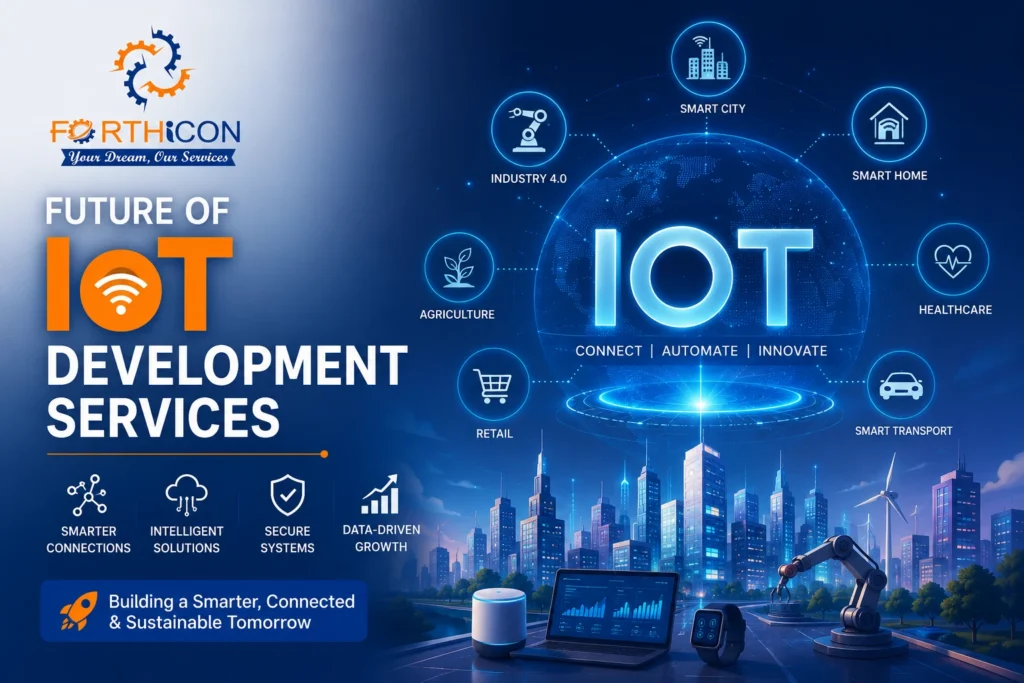
The future of IoT Development Services is highly promising. Connected technologies will continue transforming industries worldwide.
Future trends may include:
- Smarter AI integration
- Autonomous systems
- Advanced robotics
- Intelligent healthcare devices
- Fully automated factories
- Smart transportation systems
- Sustainable energy management
Businesses adopting IoT technologies today will gain long-term competitive advantages in the digital economy.
Why Businesses Should Invest in IoT Development Services
Businesses investing in IoT Development Services benefit from:
- Improved efficiency
- Faster operations
- Better customer experiences
- Reduced operational costs
- Intelligent automation
- Real-time insights
- Competitive advantages
IoT technologies support digital transformation and future business scalability.
Organizations using connected systems can improve decision-making, automate workflows, and create innovative business models.
Best Practices for Successful IoT Implementation
Define Clear Business Goals
Businesses should identify operational challenges and desired outcomes before implementing IoT solutions.
Focus on Security
Strong cybersecurity measures are essential for protecting connected systems and sensitive data.
Choose Scalable Infrastructure
Scalable IoT platforms support future business growth and expanding device networks.
Monitor Performance Regularly
Continuous monitoring helps businesses optimize IoT performance and identify operational issues early.
Partner with Experienced Developers
Professional IoT Development Services providers ensure successful implementation, integration, and long-term support.
Conclusion
IoT Development Services are revolutionizing modern businesses by enabling intelligent automation, real-time monitoring, and connected digital ecosystems. From healthcare and manufacturing to retail and logistics, IoT technologies are improving operational efficiency, reducing costs, and enhancing customer experiences.
Businesses adopting IoT solutions gain valuable insights through real-time data collection and analytics. Smart devices, cloud computing, AI integration, and automation technologies help organizations improve productivity and make faster decisions.
As digital transformation accelerates, IoT Development Services will become even more important for future business growth and innovation. Companies investing in IoT technologies today will be better prepared for the evolving digital economy and competitive business environment.
For organizations seeking smarter operations, improved efficiency, and scalable digital infrastructure, IoT Development Services offer powerful solutions for long-term success.
Frequently Asked Questions About IoT Development Services
1. What are IoT Development Services?
IoT Development Services refer to the process of designing, building, managing, and maintaining Internet of Things solutions for businesses and organizations. These services help connect devices, software applications, sensors, cloud platforms, and networks to create smart systems capable of exchanging and analyzing real-time data. IoT technology enables machines and devices to communicate automatically without human intervention, improving operational efficiency and automation.
Businesses across industries use IoT Development Services to create intelligent ecosystems that streamline workflows, monitor performance, and improve customer experiences. For example, manufacturers use IoT sensors to track machine performance, while healthcare providers use wearable devices to monitor patient health remotely.
IoT Development Services include hardware integration, embedded software development, mobile app creation, cloud connectivity, cybersecurity implementation, and real-time analytics. Professional IoT developers ensure devices communicate securely and efficiently across networks.
Modern businesses rely heavily on data-driven operations, and IoT solutions help organizations collect accurate information continuously. These insights help improve decision-making, reduce operational costs, and enhance productivity. IoT technology also supports automation, predictive maintenance, inventory management, and smart monitoring systems.
As digital transformation continues across industries, IoT Development Services are becoming essential for businesses seeking innovation, automation, and long-term growth. Companies investing in IoT technologies gain competitive advantages through smarter operations and enhanced efficiency.
2. Why are IoT Development Services important for businesses?
IoT Development Services are important because they help businesses automate operations, improve efficiency, reduce costs, and enhance customer experiences. In today’s competitive digital environment, businesses need intelligent systems capable of processing real-time information and supporting faster decision-making.
IoT technology allows devices and systems to communicate automatically through connected networks. Businesses can monitor operations continuously, identify issues early, and optimize workflows using real-time data insights. This level of automation improves productivity and reduces manual errors.
One of the biggest advantages of IoT Development Services is operational visibility. Companies can track equipment performance, inventory levels, supply chain movement, and customer interactions in real time. This improves resource management and business planning.
IoT solutions also help businesses reduce operational expenses through predictive maintenance and automation. Smart systems identify equipment problems before failures occur, minimizing downtime and repair costs.
Customer experience is another major factor. IoT-powered applications provide personalized services, smart notifications, automated support, and improved convenience for users. Businesses can better understand customer behavior and deliver customized experiences.
Industries such as manufacturing, healthcare, logistics, retail, agriculture, and smart cities are rapidly adopting IoT technologies to remain competitive and future-ready. IoT Development Services support innovation, scalability, and long-term business growth in the modern digital economy.
3. What industries benefit the most from IoT Development Services?
Many industries benefit significantly from IoT Development Services because connected technologies improve automation, monitoring, and operational efficiency. One of the largest adopters is the manufacturing industry. Smart factories use IoT sensors for predictive maintenance, equipment tracking, production monitoring, and automated operations.
Healthcare organizations also rely heavily on IoT solutions. Wearable devices, smart monitoring systems, and connected medical equipment improve patient care and remote health management. Hospitals use IoT technologies to monitor patients in real time and optimize healthcare operations.
The retail industry benefits through smart shelves, automated inventory systems, personalized customer experiences, and intelligent payment solutions. Retailers use IoT data to improve customer engagement and inventory accuracy.
Transportation and logistics companies use IoT Development Services for fleet management, route optimization, cargo tracking, and fuel monitoring. Real-time visibility improves delivery performance and supply chain management.
Agriculture is another major sector using IoT technologies. Smart farming solutions monitor soil conditions, irrigation systems, weather patterns, and crop health to improve agricultural productivity.
Smart city projects use IoT systems for traffic management, energy monitoring, waste management, and public safety. Connected infrastructure improves urban efficiency and sustainability.
Financial institutions, hospitality businesses, educational organizations, and energy companies also use IoT Development Services to modernize operations and improve service delivery.
4. What technologies are used in IoT Development Services?
IoT Development Services use various advanced technologies to build intelligent connected systems. One of the core technologies is embedded systems development, which allows devices and sensors to collect and transmit data.
Cloud computing is another important technology used in IoT systems. Cloud platforms store, process, and analyze large amounts of data generated by connected devices. Businesses use cloud infrastructure for scalability, remote access, and centralized management.
Artificial intelligence and machine learning are increasingly integrated into IoT solutions. AI helps businesses analyze data patterns, automate processes, and make predictive decisions based on real-time information.
Connectivity technologies are essential for IoT communication. Common technologies include Wi-Fi, Bluetooth, Zigbee, RFID, LPWAN, and 5G networks. These communication protocols enable devices to exchange data securely and efficiently.
IoT Development Services also involve mobile and web application development. Businesses use dashboards and apps to monitor devices, receive alerts, and manage operations remotely.
Cybersecurity technologies play a major role in protecting IoT ecosystems. Encryption, authentication systems, firewalls, and secure APIs help safeguard connected devices and business data from cyber threats.
Data analytics platforms are used to convert raw IoT data into actionable business insights. Analytics tools help organizations improve performance, customer experiences, and operational efficiency.
5. How do IoT Development Services improve operational efficiency?
IoT Development Services improve operational efficiency by automating processes, enabling real-time monitoring, and providing data-driven insights. Businesses can streamline operations and reduce manual intervention using connected systems and smart devices.
One major advantage is automation. IoT-powered systems automate repetitive tasks such as inventory tracking, machine monitoring, energy management, and equipment maintenance. This reduces human errors and increases productivity.
Real-time monitoring also improves efficiency. Businesses can monitor operations continuously and identify problems before they become critical issues. For example, manufacturers use IoT sensors to detect equipment abnormalities and schedule preventive maintenance.
IoT technologies also improve communication between systems, devices, and departments. Faster information sharing enhances collaboration and operational coordination.
Resource optimization is another key benefit. Businesses can monitor energy consumption, equipment usage, and employee productivity to improve overall performance and reduce waste.
IoT Development Services also support predictive analytics. Businesses can analyze historical and real-time data to forecast maintenance needs, customer demand, and operational risks. Predictive insights help organizations make proactive decisions and improve long-term efficiency.
By automating workflows and providing intelligent insights, IoT solutions help businesses save time, reduce costs, and improve operational performance across industries.
6. What are the security challenges in IoT Development Services?
Security is one of the biggest challenges in IoT Development Services because connected devices constantly exchange sensitive data across networks. If proper security measures are not implemented, IoT systems can become vulnerable to cyberattacks, data breaches, and unauthorized access.
One common challenge is device vulnerability. Many IoT devices have limited processing power, making advanced security implementation difficult. Weak passwords and outdated firmware can increase security risks.
Data privacy is another concern. IoT systems collect large amounts of operational and customer data. Businesses must protect sensitive information and comply with data protection regulations.
Network security is critical in IoT ecosystems. Hackers may attempt to intercept data transmissions or gain access to connected systems. Businesses must use secure communication protocols and encryption technologies.
Authentication and access control are also important. Only authorized users and devices should access IoT networks and data systems.
Professional IoT Development Services include cybersecurity implementation, regular software updates, data encryption, secure APIs, and network monitoring to reduce security risks.
As IoT adoption continues growing, businesses must prioritize cybersecurity to protect connected devices, customer information, and operational infrastructure from evolving cyber threats.
7. What is the role of cloud computing in IoT Development Services?
Cloud computing plays a critical role in IoT Development Services because it provides scalable infrastructure for storing, processing, and analyzing data generated by connected devices. IoT systems produce massive amounts of real-time data, and cloud platforms help businesses manage this information efficiently.
Cloud integration allows businesses to access IoT data remotely from any location. This improves operational visibility and enables real-time monitoring of devices and systems.
Scalability is another major advantage. Cloud platforms can easily support increasing numbers of devices, users, and data volumes without requiring expensive hardware upgrades.
IoT cloud solutions also improve collaboration and system integration. Businesses can connect applications, devices, and analytics platforms through centralized cloud infrastructure.
Data analytics and artificial intelligence services are commonly integrated into cloud-based IoT systems. Businesses can analyze operational data, predict trends, and automate decision-making using advanced cloud technologies.
Cloud computing also improves disaster recovery and data backup capabilities. Businesses can securely store information and recover critical data quickly during system failures.
Modern IoT Development Services rely heavily on cloud infrastructure because it provides flexibility, cost efficiency, and high-performance computing capabilities for connected business operations.
8. How does AI improve IoT Development Services?
Artificial intelligence significantly improves IoT Development Services by enhancing automation, analytics, and intelligent decision-making. AI-powered IoT systems can analyze large amounts of real-time data and identify patterns that humans may miss.
One major benefit is predictive maintenance. AI algorithms analyze equipment performance data and predict failures before they occur. Businesses can reduce downtime and maintenance costs through proactive repairs.
AI also improves automation in IoT ecosystems. Smart systems can make decisions automatically based on data insights. For example, AI-powered smart buildings can optimize lighting, temperature, and energy consumption automatically.
Customer experience is another area where AI enhances IoT Development Services. Businesses use AI-powered analytics to understand customer behavior and deliver personalized recommendations and services.
Machine learning algorithms continuously improve IoT system performance by learning from historical and real-time data. This enables smarter operations and more accurate predictions.
AI-powered IoT solutions are widely used in healthcare, manufacturing, logistics, retail, agriculture, and smart city projects to improve operational efficiency and innovation.
The combination of AI and IoT technologies creates intelligent ecosystems capable of supporting advanced automation and future-ready business operations.
9. What are the future trends in IoT Development Services?
The future of IoT Development Services is rapidly evolving with new technologies and innovations transforming connected systems. One major trend is the growth of AI-powered IoT solutions that improve automation and predictive analytics.
5G connectivity is another important trend. Faster network speeds and lower latency will improve device communication and support large-scale IoT ecosystems.
Edge computing is becoming increasingly popular because it processes data closer to devices instead of relying entirely on cloud servers. This reduces latency and improves performance.
Smart automation and robotics are also expanding rapidly. Businesses are adopting autonomous systems for manufacturing, logistics, customer support, and industrial operations.
Wearable technologies and smart healthcare devices will continue growing in the healthcare industry. IoT-powered medical systems will improve patient monitoring and remote healthcare services.
Sustainable IoT solutions are another emerging trend. Businesses are using smart energy systems, environmental monitoring, and resource optimization technologies to improve sustainability.
As IoT Development Services continue evolving, businesses will benefit from smarter operations, enhanced automation, and improved digital transformation capabilities.
10. How can businesses choose the right IoT Development Services provider?
Choosing the right IoT Development Services provider is essential for successful project implementation and long-term business growth. Businesses should first evaluate the provider’s experience and expertise in IoT technologies, cloud integration, cybersecurity, and software development.
Industry knowledge is also important. Providers familiar with specific industries can deliver more effective and customized IoT solutions.
Businesses should review the company’s portfolio, case studies, and previous projects to understand their technical capabilities and success history.
Security expertise is critical when selecting an IoT development partner. The provider should implement strong cybersecurity measures, data protection standards, and compliance practices.
Scalability is another important factor. Businesses should choose providers capable of supporting future growth and expanding IoT infrastructure.
Reliable technical support and maintenance services are also essential for long-term performance and troubleshooting.
A professional IoT Development Services provider should offer end-to-end solutions including strategy planning, device integration, cloud deployment, analytics, application development, and ongoing support.
By selecting an experienced and reliable partner, businesses can successfully implement IoT technologies and achieve operational efficiency, automation, and digital transformation goals.